
At the end of this fascinating book there is an announcement for an Essay Competition with a prize money of Rs 100, Rs 50, and Rs 25 each for the students of classes 8, 9, and 10. There is also a coupon in the book which is to be filled by the student and signed by the school Principal confirming that the 150 words essay is written by the student himself and no one else. The last date for submission of essays is 15 November 1933 and the announcement of winners of the competition is scheduled for 1st January 1934 in Madras.
Don’t you think way back then the schools, students, teachers, and the publishers were so much better! To keep the interest of students in poetry, or for that matter reading itself, was so important to them that a princely sum of Rs. 100 was given as the First Prize simply to understand and interpret poetry. Mind you this is in the 1930s when the salary of an English teacher in a school was all of Rs. 22 per month. This is the period when schools or education was managed and funded at community level only. As per Census figures of 1931 we had 22,86,411 Secondary Schools in India with an overall literacy rate of 9.5% only.
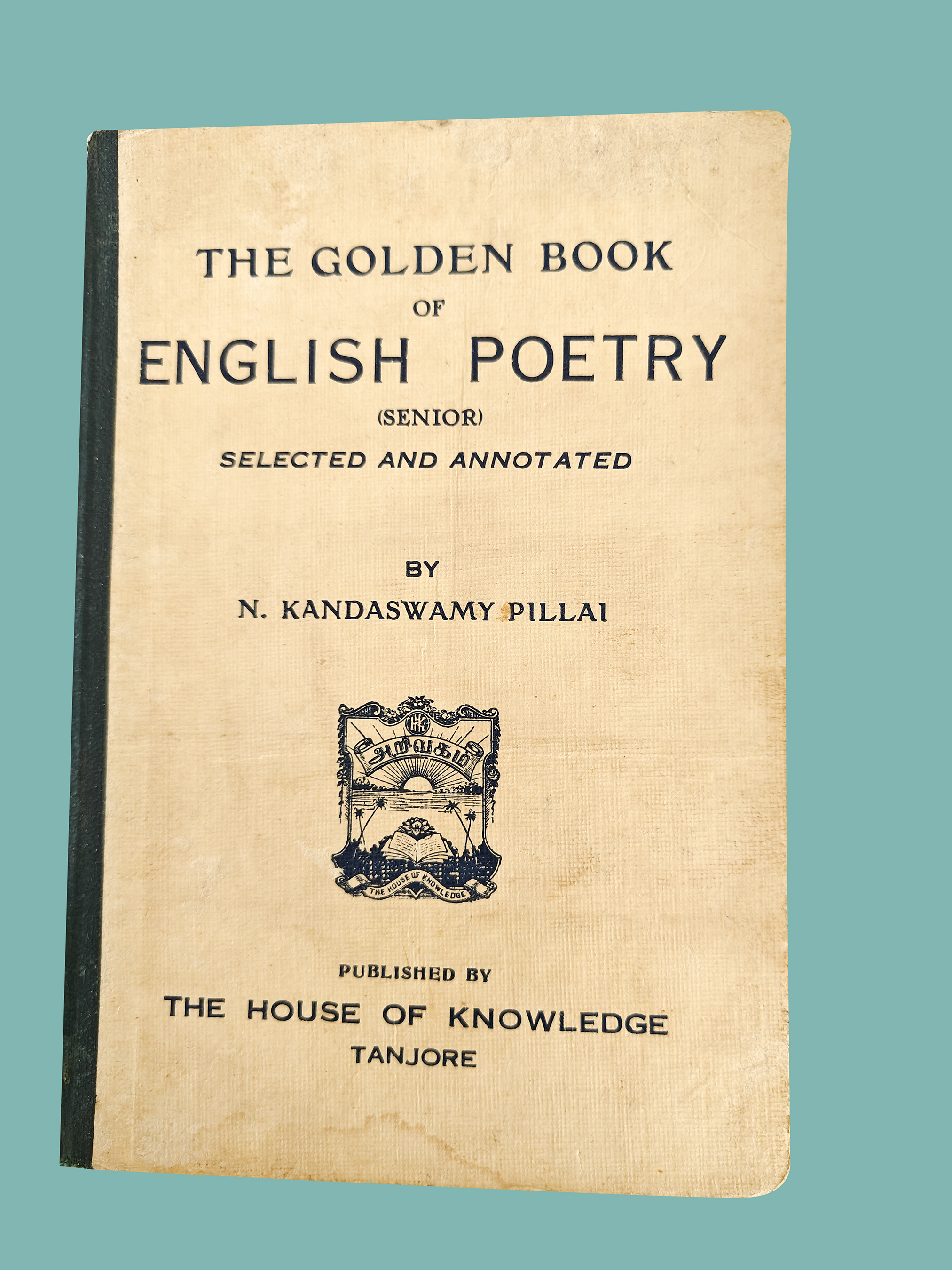
Published in 1933, The Golden Book of English Poetry, Selected and Annotated by N. Kandaswamy Pillai, the anthology was a part of curriculum for students of schools in Madras Presidency. The anthology has poems from 58 poets as diverse as Lord Macaulay to John Keats. At the head of each poem is a brief note on the author and a line or two of comments. At the end of the poems there are Notes, ‘to words, phrases and terms unfamiliar to students’. The book also has 11 ballads. The Editor in his preface says, “Tennyson and Victorians have been excluded…” in a hope to bring out a companion volume to this. Published by The House of Knowledge, Tanjore the book doesn’t mention its price or, maybe a page is missing from this antiquarian volume (I love their colophon). This well preserved copy, that I recently bought from a dealer, was originally owned by one J. S. Sowmianarayanan possibly a student or even a teacher.
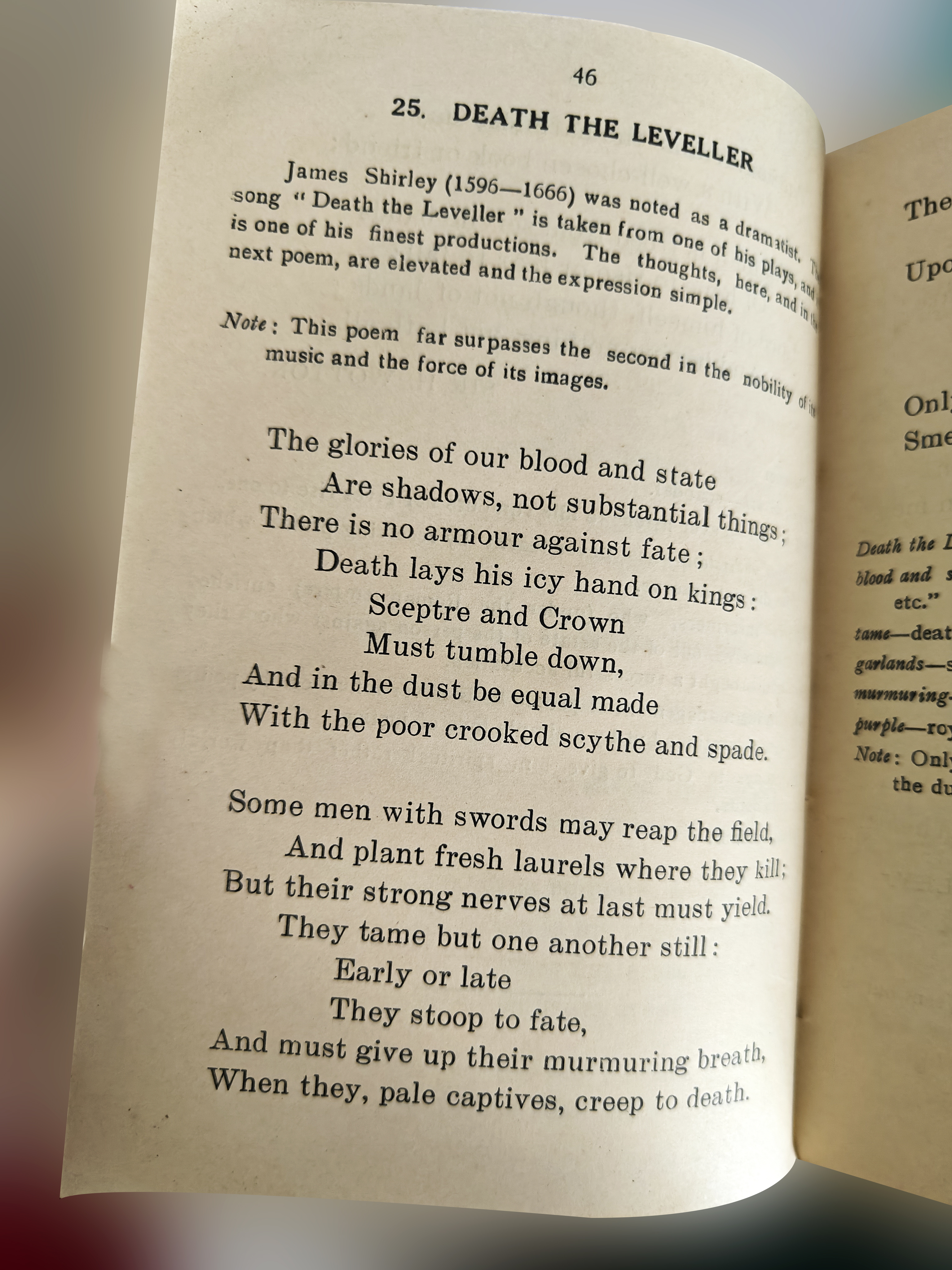
For the times that we are living in, I find the lines of this song by James Shirley most appropriate:
Some men with swords may reap the field,
James Shirley
And plant fresh laurels where they kill;
But their strong nerves at last must yield.
They tame but one another still :
Early or late
They stoop to fate,
And must give up their murmuring breath,
When they, pale captives, creep to death.

 Ankahi. Unsaid.