
Hanuman ji and Dronagiri Parbat
There are a few mountains that one has heard of and known from early childhood itself but never had the opportunity to see, travel to, or to tread and climb. Some of these mountains are also connected to or are a part of a myth – thus they do not find credence with you unless you are ru-baru (face-to-face) with the mountain and admire not just its beauty but also start relating to it in more ways than one. These myths, especially if they are served wrapped in stories from a religious epic, become part of one’s life.
Now imagine a myth that has been repeatedly enacted in front of your eyes every year, year-after-year. Such a myth or the story doesn’t remain pure myth any more – somewhere in your head and heart you start relating to them as if they are/were historical and did exist. Unfortunately, a story, a myth, a belief that is played on the idiot box inside your own house for years doesn’t take long to settle in your mind as a credible one.
The story or myth of pavanputra mahabali Hanuman, uprooting part of a mountain from Himalayas and carrying it all the way to Lanka on his right palm is that part of Ramayan that one can’t forget. But no one tells you where exactly this act played up in geography. Would you believe me if I told you that this episode is supposed to have happened at a place just about 520 km away from Delhi by road. However, currently the road to it is in a bad shape and the area is risky to approach.
The catastrophic and devastating floods in Rishiganga and Dhauliganga river valleys on 7 February 2021 which left hundreds dead and destroyed every single settlement in its way have also left some indelible and ugly marks on the Himalayan topography in this part of Uttarakhand. I, together with two friends, witnessed and passed through a very large section of this area in October 2022, a year after rampaging floods brought about terror to this land. I can say with some amount of certainty that this disaster was man-made and caused by our hunger for so called ‘development’, making roads, blowing up unstable hills with dynamite, reckless cutting of trees and bushes, making dams, blocking river passage with construction waste etc. in a fragile ecosystem called the Himalayas. This area is near the China border.
The narrow road from Tapovan (Joshimath) to Malari has barely been made motorable, it is still broken in patches, the hill sides are still rolling down and rockfall is common in many sections risking the lives of people passing through this area and those working to repair it. Dhauliganga river is still choked at many places by large rocks and boulders impeding its flow. Clearing these may take years. The large rocks partly blocking the river pose further threat that these spots may end up becoming large lakes that could devastate villages downhill when they break. If you don’t look at these and only look up, the mountains appear to be sitting in graceful silence.
‘Beauty in barrenness’ is exemplified in the rocky pinnacles of this difficult to access area. I am certain in the times of Lord Ram the area must have been a paradise and environmental issues would not have been so serious. Hanuman Ji, while flying over this area, must have peeped inside the Nanda Devi Sanctuary and would have felt happy flying over the sparkling white peaks of Himalayas. I wonder if he had also flown over Badrinath and the town of Joshimath blessed by Adi Shankaracharya as supreme seat Math. If Hanuman ji turned his head right or looked further north he would surely have bowed to Shiva’s abode Mount Kailash and the splendid lower arctic region beyond that from where the Aryans entered India. Originating from near Lake Manasarovar, the silvery streak of Sindhu river (Indus) must have been a guide to Hanuman in flying to Ravan’s Lanka.
In Kamba Ramayan Sushen Vaidya asks Hanuman to bring the Sanjeevni booti (herb) to save the life of Lakshman who was seriously wounded by a weapon hurled at him by Ravan’s son Indrajit. Having forgotten the name, unable to identify the herb and running short of time, Hanuman, it is said, carried a part of the mountain itself. While his effort was able to save the life of Lakshman, the villagers living in and around the mountain were upset with Hanuman’s act. For this they are angry with Lord Hanuman till date.
It was raining when we left Tapovan on a cold October morning. Looking at the dark and grey skies our driver was not happy with the prospects of having to drive on a dangerous route on a slippery road. For nearly 20 kilometres there was no vegetation on the hills. The river, deep below in the valley, was in torrents and noisy because of many large boulders blocking its flow. It had been raining for the past 15 days in this area so a lot of water had been flowing down the hills. There were no roadside chai shacks as very few locals were going up. The vehicular movement was restricted to army vehicles only.
It was cold and windy. My first glimpse of the beautiful peak came from between two ridges which were dropping down on the other side of the Dhauliganga river. It was for a flash of a second as the clouds parted revealing the peak. I shouted for the car to be stopped. A little ahead we spotted a roadside sign board put up by ITBP with an arrow indicating Dronagiri Village. The car windows were rolled down and we trudged back some 100 metres to view the peak from between two ridges. There was nothing but clouds. We were disappointed.
It is said that the villagers of Dronagiri do not hold Hanuman as sacred and don’t pray to him. There are no Hanuman temples in the small village. The area surrounding Mount Dronagiri or Dunagiri is blessed with dozens of such life-saving herbs. Closer to the Badrinath area, around the Valley of Flowers Mount Dronagiri and Dronagiri village can be reached on route to Malari (closer to China border) from Tapovan area in Joshimath.
This is one of the high peaks of the Himalayas in the Chamoli District and can be easily identified. Dunagiri (7,066 m) lies at the northwest corner of the Nanda Devi Sanctuary Wall, which is a ring of peaks surrounding Nanda Devi in Uttarakhand. Even on our way back we could not see the mountain. But luck was with us as we decided to trek up to Kartik Swami temple from Kanak Chauri in Rudraprayag.
We left our camp Kanak Chauri at five in the morning. It was still dark, the sky was spotless, clear and glittering with millions of stars. We reached the uppermost chamber of the temple located atop of a ridge by 7.30. Sunlight had started peering from thin clouds and in a matter of minutes a humongous crescent of peaks showed up in front of us. It was mesmerising to see some of the most beautiful 7,000m+ high peaks dressed up in all their finery in front of us.
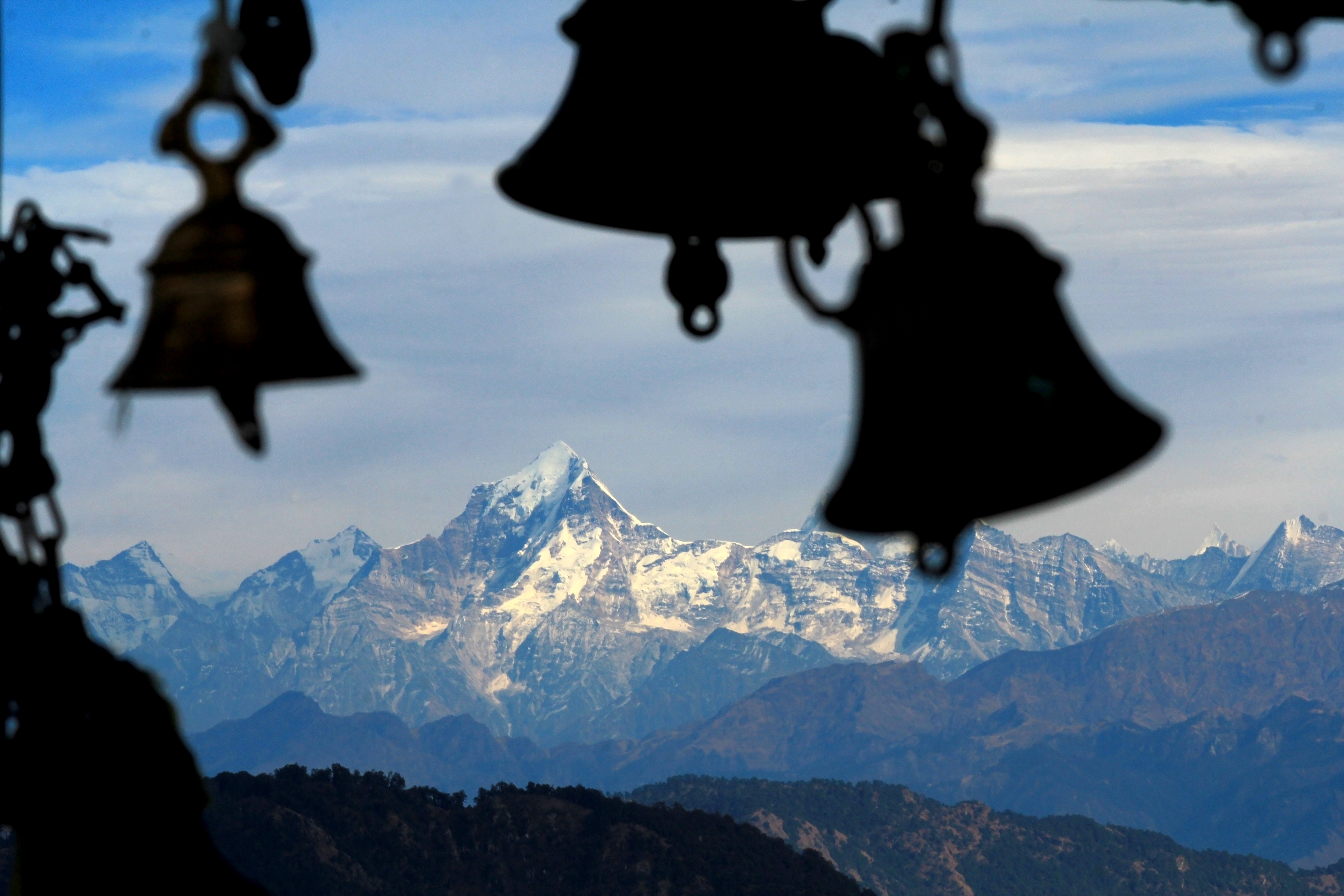
Through the copper bells, sacred threads and red chunnis tied to the railings of the temple courtyard, I could immediately spot the twin peaks of Nanda Devi and Dunagiri. With its conical peak and difficult routes over sharp ridges Dunagiri was first climbed on 5 July 1939 by the Swiss team and has since been climbed by many. (in picture Mount Dunagiri from Kanak Chauri)
As the sun shone a little more and we came out of the initial shock we could identify other important and enchanting peaks like Nanda Ghunti, Trisuli, Meru-Sumeru, Chaukhamba, Panchachuli, Kamet, Neelkanth, Bandarpoonch, Kedarnath Dome and Balakun. There were many others at a distance and some closer which we could not identify.
Barefoot on that freezing cold stone platform we were shivering but the shutters of our cameras went berserk. The fear that the cloud cover could envelope the view anytime made us stand there in awe and offer our thanks and gratitude to the Himalayas for giving us this opportunity to see this magical spectacle which few are lucky to watch.
 Ankahi. Unsaid.