I was a bit early for the laidback traders of Shahjahanabad. Shops and businesses open here well past 11 am. In any case it was a cold, grey day with intermittent drizzle which meant that the shops would not open before noon and only then I would get what I was there for. Small and mid-size commercial delivery vans were parked along the side of narrow passages which had started crowding. In the absence of any sunlight drivers and unloaders of goods, together with daily wager collies and jhalli wallas were crowding around tea stalls under the canopies of shuttered shops. Then there were a few food carts (rehdi wallas) busy selling hot-n-fresh breakfast – Omelet, parantha, pakoras, kachoris and bun-makhan – there was quite a variety but no kebabs.
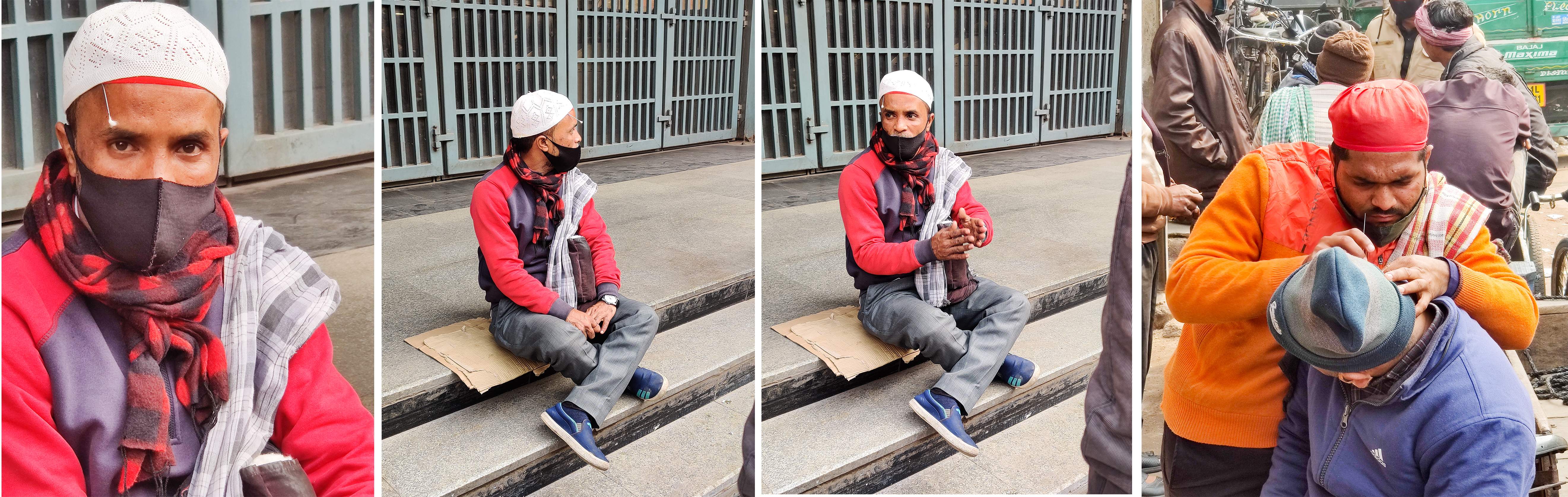
Whiling away time I was taking pictures of random old buildings and generally looking around when I spotted him sitting on the steps outside Chawri Bazaar Metro station – the Kaan Melia (कान मैलिया) – possibly waiting for someone with an ear-ache or an itch or simply wanting to the get the ear cleaned. Trust me, with some people it is addictive. I hadn’t seen one for a long time and thus, was looking at him as though I had spotted an extinct species. Suddenly he turned his head and caught me staring at him. That was rude of me but my eyes were fixed on his face. He had such an expressive face. There was so much he was saying.
Tucked in his taqiyah (skull cap) was a thin flexible cable-like contraption (called Silai) with balled cotton at one end which works like an ear cleaning bud. He was clutching on to a small leather bag under his left arm. Covered under his white crochet-knitted cap was the trademark red cap of ear cleaners of old Delhi and the Central Park in Connaught Place. I was so very tempted to go and sit right next to him, turn my head – right or left whichever way he said – and let him do the rest. A tingling sensation was already running down my neck and spine.
But I didn’t do any such thing. Instead, I looked at him and smiled. He didn’t smile back, knowing well that I was not his customer kind. I stood firm on my ground and kept flashing the smile. He turned his face to the other side rejecting all my attempts at striking a conversation. He got up, folded the brown corrugated box he was sitting on, and started walking. I followed him and requested him to stop. Kamran stopped. This time he turned to me with a smile. आपको कान साफ़ करना है नहीं, तस्वीर आपने ले ही है अब और क्या चाहिए ? (You won’t get your ears cleaned, you have already taken my pictures, now what else do you want?) He started walking again, but this time alongside me.
I was embarrassed by his question. He was accusing me of taking his pictures without his permission. आप से बात करना है, कुछ पूछना है आपके काम के बारे में आपके बारे में (I want to talk to you, want to ask you about your work, about you). He stopped and gave an approving smile and then holding me by my right elbow pulled me back, saving me from the tempo-rickshaw that was coming from behind me. Kamran indicated that we should cross over and move to the other side of the road. We did. A few steps ahead was a tea shop at the corner of Kucha Pati Ram. He stopped and with his ‘eyes’ ordered tea which was being served in मिटटी के कुल्हड़ (clay cups). With tea in our hands we moved to a corner next to the giant wooden gate, safe and away from the milling crowd.
At 4 feet 7 inches Kamran was short but well built and stout. His hand clutching the kulhad seemed that of a boxer or a wrestler unlike the profession he was practicing. He looked at me and without any hesitation started talking about himself, his profession, and his family. Not expecting it to happen without a prompt or a question, I was taken aback but it made my task easier. I didn’t have to think of questions.
हम कान मैलिया लोग राज घरानों में काम करते थे। राजा, महाराजा और अमीर लोगों के यहाँ हर हफ्ते कान मैलिया जाते थे। तब हमारे पुरखे बाल काटते थे, मालिश करते थे और नाखून भी बनाते थे। बहुत इज़्ज़त का काम था हमारा, हमारे काम को शाही काम बोला जाता था , खूब इनाम मिलता था। हमारी पहुँच क़िले के अंदर तक थी। दिल्ली की सार हवेलियां और रईस हमें बुलाते थे। (We Kaan Melias (ear cleaners) worked for the royalty. Kings and emperors and very rich people of the society had kaan melias on their weekly visit. Those days our ancestors also did hair cutting and nail trimming, some also specialized in head massage. It was a respectable profession, we moved around the royalty, ours was called ‘shahi kaam‘. We were paid handsomely. We had access to the Fort (Red?), Havelis and houses of the rich gentry.)
लोग हमें कान मैलिया बुलाते हैं पर असल में हम नाइ हैं। हमारे पेशे वालों को तो बहुत इज़्ज़त दी जाती थी। हमारे बुज़ुर्ग लोग 400 साल पहले मुग़ल फोजों के साथ हिंदुस्तान आये थे। और मुग़लों के साथ ही यहाँ बस गए। राजा महराजा लोग हमारी इज़्ज़त और एहतराम करते थे पुराने ज़माने से ये मुसलमानों का पेशा रहा है अब और लोग भी करने लगे हैं पर इतना काम तो है ही नहीं (We are known as ear cleaners but actually we are barbers. People from our professional were really respected a lot. Our forefathers came with Mughal army 400 years back and settled here in Hindustan. Kings and emperors would respect us and gave us a good position. In earlier times this profession was practiced only by Muslims but now other people also do it but there is not so much work). That reminded me of something that I had read in one of the accounts that Kaan Melia were also the ‘official gossip spreaders’ and worked for the establishment of the time. They would also bring in ‘hot news’ for masses from inside the fort or the haveli.
How is the work now? How much is he able to earn especially considering the pandemic and the lockdown? How do his family and children react to his job?
वक़्त बदल रहा है, हमारी औलाद ये काम नहीं करना चाहती। दोनों बेटों ने दूकान खोल ली है। सारे दिन में मुश्किल से 150 से 200 भी नहीं बनते। अब बहुत काम लोग सड़क पे बैठ के कान साफ़ कराना चाहते हैं। बहुत से तो इस से डरते हैं। हम तो पूरा ख़याल रखते हैं। मैंने कभी किसी की दर्द भी नहीं होने दिया। किसी के कान का नुक्सान भी नहीं किया। (The times are changing. My children dont want to do this work. Both my sons have started a shop. I cant even make 150-200 rupees in a day. Now a very people want to get their ear cleaned sitting on the road. A lot of people fear this. I take full care and protection. No one feels pain and I have never hurt any one’s ear) I ask him what are his other tools besides the twirler he calls silai. He opens the leather bag and proudly pulls out a sleek pen-like device (possibly Chinese make). Pressing a tiny button he shows me that this is a torch with which he peers down the ear. He also carries a small bottle of Dettol in another pocket. From another, he pulls out a set of pincers required to pull out the wax. A roll of cotton tumbles out of the bag while Kamran secures small cloth squares he uses to clean the ears of his clients.
A burqa clad woman passes us as we drop the empty kulhads in the bin. Out of curiosity I promptly asked him, ‘Do women also ask to get their ears cleaned? ‘Yes,’ he says excitedly, ‘many get it done in the privacy of their homes, in mohallas, and kuchas not here in the bazaar’, he adds.
Do you make enough money? He turns his head, left and then right, as if looking for someone but actually avoiding my question. I see he is worried. ‘No’, he shakes his head and looks down at the garbage filled corner of the lane. ‘The day I don’t get a customer till noon I go and join my friends at Hauz Qazi intersection and do other work. There is always some work for a collie. I can also do household painting work or push a cart. He doesn’t look me in the eye while saying all that. ‘I am getting late, I have to go’, he turns to leave as I touch his shoulder in warmth and love. Kamran turns, smiles and asks to shake my hand.
How is the work now? How much is he able to earn especially considering the pandemic and the lockdown? How do his family and children react to his job?
वक़्त बदल रहा है, हमारी औलाद ये काम नहीं करना चाहती। दोनों बेटों ने दूकान खोल ली है। सारे दिन में मुश्किल से 150 से 200 भी नहीं बनते। अब बहुत काम लोग सड़क पे बैठ के कान साफ़ कराना चाहते हैं। बहुत से तो इस से डरते हैं। हम तो पूरा ख़याल रखते हैं। मैंने कभी किसी की दर्द भी नहीं होने दिया। किसी के कान का नुक्सान भी नहीं किया। (The times are changing. My children don’t want to do this work. Both my sons have started a shop. I cant even make 150-200 rupees in a day. Now a very people want to get their ear cleaned sitting on the road. A lot of people fear this. I take full care and protection. No one feels pain and I have never hurt any one’s ear) I ask him what are his other tools besides the twirler he calls silai. He opens the leather bag and proudly pulls out a sleek pen-like device (possibly Chinese make). Pressing a tiny button he shows me that this is a torch with which he peers down the ear. He also carries a small bottle of Dettol in another pocket. From another, he pulls out a set of pincers required to pull out the wax. A roll of cotton tumbles out of the bag while Kamran secures small cloth squares he uses to clean the ears of his clients.
A burqa clad woman passes us as we drop the empty kulhads in the bin. I promptly ask him, ‘Has a woman ever sought to get her ears cleaned? ‘Yes,’ he says excitedly, ‘many get it done in the privacy of their homes in mohallas and kuchas not her in the bazaar’, he adds.
Do you make enough money? He turns his head, left and then right, as if looking for someone but actually avoiding my question. I see he is worried. ‘No’, he shakes his head and looks down at the garbage filled corner of the lane. ‘The day I don’t get a customer till noon I go and join my friends at Hauz Qazi intersection and do other work. There is always some work for a collie. I can also do household painting work or push a cart. He doesn’t look me in the eye while saying all that. ‘I am getting late, I have to go’, he turns to leave as I hold touch his shoulder in warmth and love. Kamran turns, smiles and we shake hands. The face mask had to be pulled up!!!
Kamran – the ear cleaner of old Delhi. Chawri Bazaar, Delhi. 20 January 2022
Iftaar congregation at Jama Masjid, Delhi during Ramzan / Eid, 2016
Wonder if God listens to its faithfuls or not, but somewhere I feel it is very unfair on those who fast for an entire month, every single day for the month of Ramzan. But to us, kafirs, this month gives a limitless opportunity to gorge on delicacies from sehri (at dawn) to iftar (at dusk) day after day without having to fast. With no iftar invitation coming my way this year I called my friend Azhar and decided to enjoy an iftar evening at Jama Masjid. On Azhar’s asking I reached outside Delite theatre at Asaf Ali Road at 5.30pm from where he accompanied me through the busy lanes and bylanes of puraani Delhi. Although the day had been cloudy and sultry, by the time we reached Matia Mahal and crossed Urdu Bazaar there was a gentle breeze flowing above us giving much needed relief. On the crowded street though it was the vehicular smoke, dust and smell of kebabs, tikkas, gosht being cooked in deghs and biryani which was all encompassing. For the devout heading to end their day’s fast after the evening namaaz the smell of good food is the most difficult ordeal to go through. One is hungry & thirsty, counting every minute for that moment when one will be able to fulfil his roza and take a few swigs of sherbat or munch a khajoor (date) – at that time to pass through street where every inch of space is decked up with food, food and more food is a torture to even the strongest of beings. The road to gate number 3 of the Masjid was completely blocked from all sides. It was even difficult to walk and find your way past thousands of people, rickshaws, scooters and cars.
The magnificent Jama Masjid, with its imposing red stone wall ran to my right. It was past 6.15pm when we reached that point where there was long queue at the security check. From outside I could see the last of sun rays shimmering through the southern minaret and lazily resting on the ramparts. Adjusting my bag in one hand and clutching my shoes in the other I ran past the crowd to land on the crowded square courtyard. Hundreds of families in their colourful attires had taken up each inch of available space. Somehow struggling my way through them I reached the central water pond where too there was a queue of people waiting for their turn to do vaju (ablution). Past them I managed to reach the main entry facing Red Fort. Having positioned myself strategically facing the Masjid. I managed to catch the setting sun behind the western minar and the smaller dome on its side. The announcement for iftar (to end the fast) came as a loud bang of a fire cracker post which there was a call by the muezzin. I had found my friends Azhar, his brother and Shoaib comfortably positioned in a corner next to the main prayer area. Food had already laid, there were dates, fruit salad, banana fritters, pakoras, kebabs, sherbat and chilled water. By the time we finished eating the call to prayers, next namaaz, had already been announced. Wow!!! what a scene it is. As the lights are lit over the largest mosque in the country, Shahjehanabad the city of the Mughals came alive. Thousands of faithful quickly took position in neatly formed rows to offer prayers as the Imam reads the scriptures. It takes all of 20 minutes for the prayers to be over and then it is time to gorge on more food as people scramble their way out of Jama Masjid to hit the colourful bazaars and food streets all around it offering lip-smacking delicacies. As I came out of the Masjid having thanked my friends and having made peace with the God I was amazed to see the jam-packed bazaar below the main gate, past the steps where a canal used to run till a few years back. With dozens of people crowding at every shop, it was difficult to negotiate way past the crowd of men women and children busy buying artificial jewellery, clothes, household goods, gifts, sevaiyaan and kebabs. Colourfully decorated streets on all sides of Jama Masjid were lit with strings of tiny LED lights had the spirit of festivity. Shimmering streamers and flags tied from one end of the bustling street to the other were like a low-hanging canopy of stars coupled with paper lanterns, a reminder of the times gone by.
Fasting and feasting, thats what Ramzan is all about to me.




 Ankahi. Unsaid.
You must be logged in to post a comment.