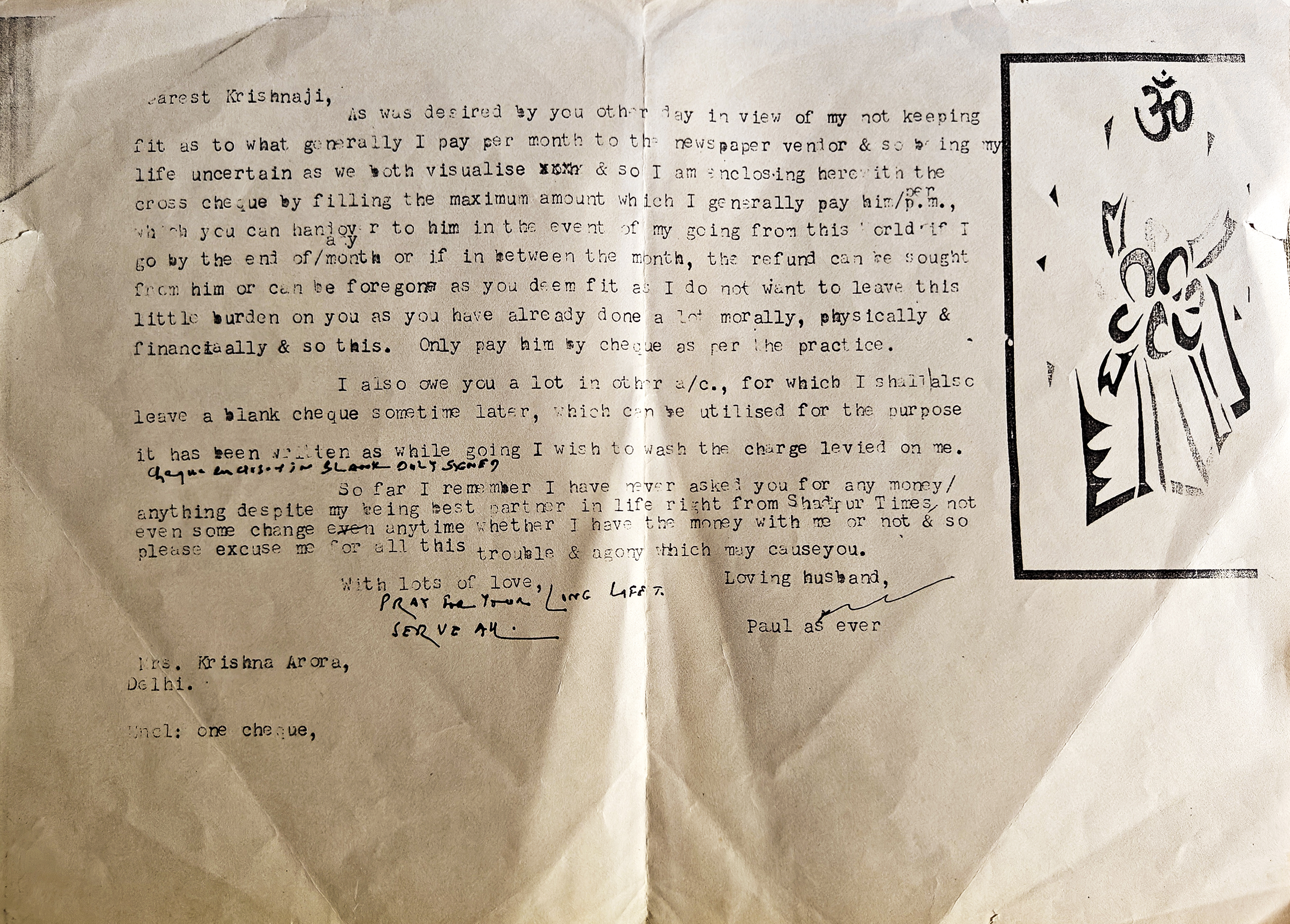
Daddy’s last love letter to Ma. I don’t think he typed or wrote another piece to her. This must have been less than a month before he passed away. We found the letter and the blank signed cheque in one his diaries. The cheque was duly handed over to the newspaper vendor; who initially refused to accept the money and later, reluctantly accepted it. It was not a small amount. Daddy subscribed to nearly 16 newspapers hand-delivered to him at home each morning, besides 8 to 10 magazines. I quote the letter as is and also add the scanned image of the same.
Dearest Krishna ji
As was desired by you (the) other day in view of my not keeping fit as to what generally I pay per month to the newspaper vendor & so being my life uncertain as we both visualise & so I am enclosing herewith the cross cheque by filling the maximum amount which I generally pay him per month’ which you can handover to him in the event of my going from this world. If I go by the end of any month or if in between the month, the refund can be sought from him or can be foregone as you deem fit as I do not want to leave this little burden on you as you have already done a lot morally, physically & financially, and so this. Only pay him my cheque as per the practice.
I also owe you a lot in other a/c. (account) for which I shall also leave a blank cheque sometime later, which can be utilised for the purpose it has been written as while going I wish to wash the charge levied on me. Cheque enclosed is blank duly signed. (hand-written sentence added to typed letter).
So far I remember I have never asked you for any money / anything despite my being best partner in life right from Shadipur times, not even some change even anytime whether I have the money with me or not & so please excuse me for all this trouble & agony which may cause you.
With lots of love, [Pray for your long life to serve all] (hand written)
Armed with a bamboo ink pen and a steady hand, Ethiopian Orthodox priest Zelalem Mola carefully copied text in the ancient Ge’ez language from a religious book onto a goatskin parchment.
This painstaking task is preserving an ancient tradition, all the while bringing him closer to God, the 42-year-old said.
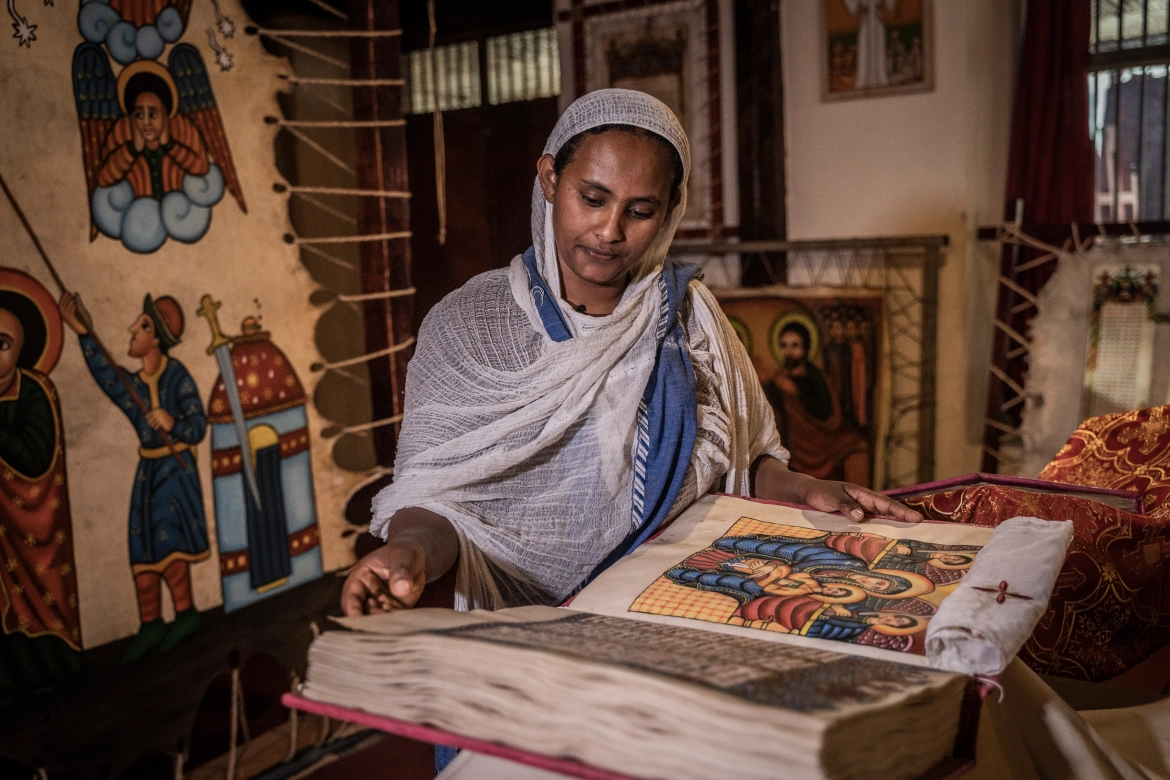
At the Hamere Berhan Institute in Addis Ababa, priests and lay worshippers work by hand to replicate sometimes centuries-old religious manuscripts and sacred artwork.
The parchments, pens and inks are all prepared at the institute, which lies in the Piasa district in the historic heart of the Ethiopian capital.
Yeshiemebet Sisay, 29, who is in charge of communications at Hamere Berhan, said the work began four years ago.
“Ancient parchment manuscripts are disappearing from our culture, which motivated us to start this project,” she said.
The precious works are kept mainly in monasteries, where prayers or religious chants are conducted using only parchment rather than paper manuscripts.
“This custom is rapidly fading. … We thought if we could learn skills from our priests, we could work on it ourselves, so that is how we began,” Yeshiemebet said.
‘It’s hard work’
In the institute’s courtyard, workers stretch goatskins tightly over metal frames to dry under a weak sun.
“After the goatskin is immersed in the water for three to four days, we make holes on the edge of the skin and tie it to the metal, so that it can stretch,” Tinsaye Chere Ayele said.
With two other colleagues, the 20-year-old carried out his task using a makeshift scraper, seemingly oblivious to the stench emanating from the animal hide.
Once clean and dry, the skins will be stripped of their goat hair and then cut to the desired size for use as pages of a book or for painting.
Yeshiemebet said most of the manuscripts are commissioned by individuals who then donate them to churches or monasteries.
Some customers order small collections of prayers or paintings for themselves to have “reproductions of ancient Ethiopian works”, she said.
“Small books can take one or two months. If it is a collective work, large books can take one to two years.
“If it’s an individual task, it can take even longer,” she said, leafing through books clad in red leather, their texts adorned with brightly coloured illuminations and religious images.
Sitting in one of the institute’s rooms with parchment pages placed on his knees, Zelalem patiently copied a book titled Zena Selassie (History of the Trinity).
“It is going to take a lot of time,” the priest said. “It’s hard work, starting with the preparation of the parchment and the inks. This one could take up to six months to complete.”
“We make a stylus from bamboo, sharpening the tip with a razor blade.”
The scribes use different pens for each colour used in the text – black or red – and either a fine or broad tip. The inks are made from local plants.
‘Talking to saints and God’
Like most other religious works, Zena Selassie is written in Ge’ez.
This dead language remains the liturgical language of the Ethiopian Orthodox Church, and its alpha syllabic system – in which the characters represent syllables – is still used to write Ethiopia’s national language Amharic as well as Tigrinya, which is spoken in Tigray and neighbouring Eritrea.
“We copy from paper to parchment to preserve [the writings] as the paper book can be easily damaged while this one will last a long time if we protect it from water and fire,” Zelalem said.
Replicating the manuscripts “needs patience and focus. It begins with a prayer in the morning, at lunchtime and ends with prayer.”
“It is difficult for an individual to write and finish a book, just to sit the whole day, but thanks to our devotion, a light shines brightly within us,” Zelalem added.
“It takes so much effort that it makes us worthy in the eyes of God.”
This spiritual dimension also guides Lidetu Tasew, who is in charge of education and training at the institute, where he teaches painting and illumination.
“Spending time here painting saints is like talking to saints and to God,” the 26-year-old said.
“We have been taught that wherever we paint saints, there is the spirit of God.”
On his 15th death anniversary I recall and relive his passing away the following piece I wrote for the memorial meeting my brother Jawahar held at his place in Toronto, Canada. Dad passed away on 29th July 2008.
All these turtles who lie upside down flapping their chests, washed ashore, stranded on a beach or stuck between the rocks, are attention seeking narsacists – looking for love or a beloved’s hand to calm their nerves, pat them and carry them back to their fun-n-games in the sea. Try kissing its sexy neck and it withdraws like a sulk; try riding a giant one after the ‘rescue’ and he dumps you deep with the first tide. Ah, try me next time…







You must be logged in to post a comment.