12 September 1987 to 23 September 1987 (parts of a diary)
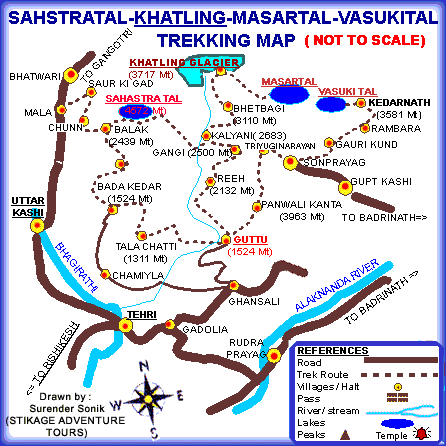
14th – Reached Ghuttu by bus from Tihri, the beautiful oval shaped valley of which nothing would be left in years to come. Asia’s biggest dam and a hydel project have already been started. Two rivers flow into the valley. Bhilangana enters the Tihri valley from east and Bhagirathi from north-east. The dam iss being built on Bhagirathi while the Bhilangana water will be diverted through tunnerls from under the mountains. Bhagirathi water will be collected in Tihri valley bowl submerging the entire township. It is a pity… a new township is being built across on a flatter plain. People have been paid damages and different places alloted to them for residence but no one is ready to leave. Spent the night a Sarvodya school, a place where children are given free accomodation and education. Sleeping shack is mosquito infested, so couldn’t sleep till late at night.
Ghuttu: Sky is clearing up fast and heavy clouds have settled in the valley and are slowly floating around to find a way through the valley and upwards. People here are well aware of laws etc. they have had cases regarding land which have reached up to Allahabad High Court. The place that we are staying in ( a school building) was built in 1947 and has remained a primary school building ever since. Goats and sheep have just come into the verandah opposite us and are being pushed inside the lower cabins of the house. It is about 5 pm now and getting cold outside. Talking to these people is an alarming thing, so many problems – infertility, no postal service, no hospital or dispensery, broken bridges and children moving away from the village to towns. Village has 2 tailors but those are expensive, larger population is female, Rs 25 per kg rice. People destroying jungle in certain parts.
Pant is talking to them about various development projects of government sepecially about education and its benefits in terms of jobs and facilities and he is convincing the Pradhan about importance of reading and writing. Bachhan Singh Rana is the Pradhan of Gangi village.
Umrao Singh was jailed for illegal land occupation, took the case to Tihri and then to Lucknow and then to Allahabad High Court. Won the case and retained ancestral land, knows good english words and various Acts and their numbers etc. Studied up to class 5 in 1951 in Gangi Primary school operating since 1947. Has remained Primary since inception.
Morning tea at 5 and we started packing. Spent the night at Ghuttu PWD Rest House, comfortable cot but one blanket was too little for the night chill. Porters and Guide Tripan Singh came only at 7. Had breakfast and started trek with heavy back-pack. Tricky trek along the side of Bhilangana was of moderate exhaustion. 9Km trek up to Reeh valley was done by 11.30 and we planned to proceed to Gangi.. This stretch was through moist and slippery jungle. Friends saw snakes and deer.. lot of problems and issues with the porters who reached Reeh at 3 pm leaving no chance to proceed further to Gangi. Overcast sky and very chilly. Hot words with porters. Finally we went up towards the hutment area. Not a soul here, most of the huts are shut and locked, but the verandahs are open. Hot cup of tea and…. wonderful view of rain and clouds from our open “gallery”. Food is being prepared outside under a small rock shelter. Gangi 8500 ft.
Had nothing since morning so food was a welcome sign. Got rice and dal with baked potatoes, my nose is running and it is getting cold – drizzling – sometime a cloud moves away to let the sunlight fall on meadows and jungle opposite us. Shall be sleeping early. Rastogi, Singhal and myself are stacked in one of the verandahs.
15th – Reeh – Gangi 9km. Night at Reeh was not comfortable, choked nose and bad throat. Sloping floor made it all the more difficult to sleep. Got up at 5. Planned to reach Kalyani today but the porters are slow and adamant not to pace up. First 5 kms were a difficult steep ascent through dense wet forest of Rhododendrons and Walnut. Sun spares us for the first 3 kms as we were in the shadow of the hill but then it got very hot. On the way we stopped at a waterfall. Singhal started the bathing idea and then everyone lept into the bone chilling water. Cold is no word.. fresh from the bath gave us new zest to move faster. On the way came across two deserted villages of Nallana and Lalla, mere 20-25 huts in both but all locked and surrounded with full grown blooming Ramdana beans. Bright Red flowers with its seeds falling all around. But we are not supposed to touch them as it is not good “omen”. Last 4 kms were a mix of rolling up and down through the forest reaching this beautiful village of about 100 people who move down during winters and harvesting times in plains. Nice and happy people. Village has one shop for grocery etc. Went around talking to a few.
16th Gangi: Our guide Tripan (53) Singh is an experienced person on the route and promises not much problem crossing the Mayali Pass after Khatling. Very few trekkers do this route to Kedarnath. Only a couple of Bengali parties have visited Kedar from here. The upper reaches will probably have the maximum number of lakes, frozen or dry, anywhere else in the mountains. This village too, like others, has a good crop of Potato and Rajmah (red kidney beans). People are peeling fresh rajmah for drying. Entire village survives on farming and making wool thread from sheep hair. Rain has stopped and we can see many a rainbow scattered in skies over the valley. The green jungle background gives a heavenly look to the colours. Light is falling abruptly on woods across Bhilangana from the heavy clouds up almost on east-north-east while west and south are clear with beautiful sapphire blue sky. The villagers have had a session of Panchayat today with heated arguments and long discussion over a personal matter. All the elderly men have gathered on this massive stone verandah opposite the temple. Devi’s Bagghi is lying outside well decorated in bright red cloth and silver jewellery. Strangely few houses here have slate stone as roof, mostly it is wooden planks. The houses are two-tiered and the lower portion is for animals, fodder and other stuff needed during winter and rains. Otherwise the village has all the milk and food needed. Village Pradhan Shri Bachhan Singh Rana is now sitting with me and Pant discussing various problems like road building and deforestation. Government has sanctioned funds to build a motorable road up to Gangi but forest department is resisting it owing to both the mafia and in the name of deforestation. They are well aware of the current affairs and know about the current PM and President. They have transistors too but mainly for entertainment (songs and music) none is interested in other affairs.
16th – Village photography and meeting people. Our stay once again will be in a school hutment, so no pitching of tents. When we reached here about 15 children were being taught by a teacher. The place was broomed and cleaned for us. A cup of tea at one of the houses was really refreshing. Bhilangana is ferocious this side, cutting deep through north-east. It is raining now and the valley is covered with clouds all around. A child, Bahadur Singh is sitting with me and asking for a pen… he knows to write Hindi. The shed is leaking from all four sides, so all have huddled up in the centre. Plan to move early tomorrow.
17th Gangi- Tari Udiyar – 14km.. this morning we started for the toughest part of our trek taking us to Sahastratal. Starting at 7am the tricky path went along Bhilangana for about 5km, with a halt at Kalyani. Just before Kalyani there is a steep descent of about 500mt landing in front of a green meadow with just three huts (photo) A good view of the valley and snow covered peaks in front was a pleasure. Khichri and curd for lunch was a delight. Curd was bought from the villagers of Gangi. We were not expecting the terrible trek ahead. Almost a 70 degree ascent through dense jungle with no trail or indication of a beaten path was limb cracking. The villagers had warned us ‘rarely anyone goes up to Sahastra tal’. Two hours into the climb we came across what looked like a wall of massive boulders scattered all around from where no way seemed to go up. Looking at them it seemed impossible to negotiate them. The porters made it up first climbing through cracks and niches and pulled our luggage up and we followed. Three hours of climb on steep mountain face took us to its ridge, which started another long and winding ascent over connected steep ridges which had nearly a thousand meter drop on both sides. A lesson in mountaineering and honing our climbing skills. From 12 noon to 7pm we kept crossing ridge after ridge, gaining height all the time and finally reached a tooth-like bent rock face jetting out of one of the rolling meadow. On the western face of it there were tin-sheets which created a shelter. As we entered it we realised it was a natural cave formation which had been extended with the help of tin sheets to create enough sleeping room for some 10/12 people. The place is known as Tari Udiyar (udiyar meaning cave or night shelter).
18th Tari – Shastratal (4.5km – 16740 ft) Tari to Kalyani (17km)
Given another choice I will never do it again, although it was the most fascinating of everything that I have done or seen yet. It was almost suicidal to have attempted Shastratal Lakes and the way back, steep descent over 11 ridges and rock faces in total darkness with not even a torch to see what were we walking or tumbling on. For once it was given up that night. Had some breathing issue in the middle of the night.
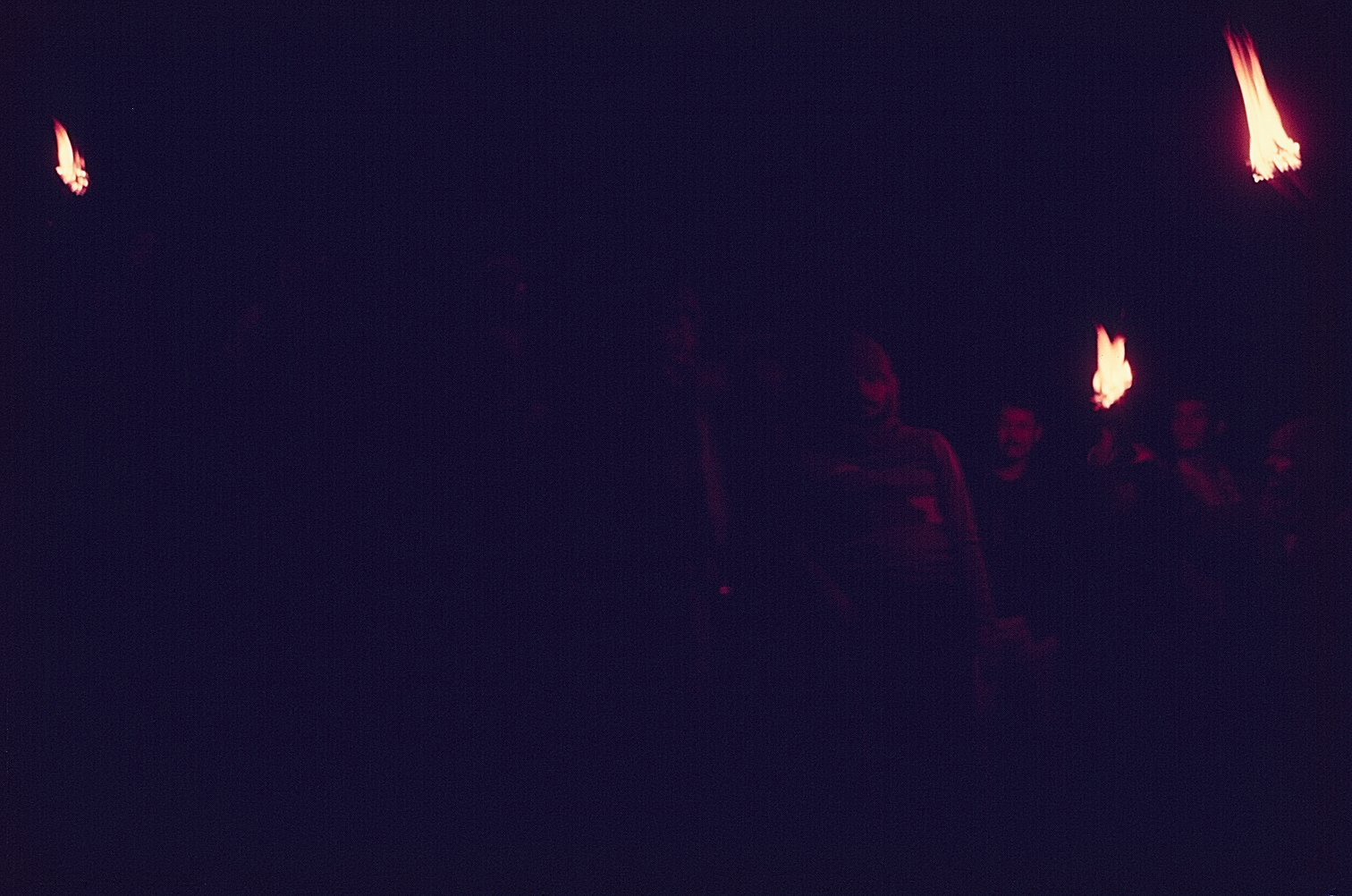
The shelter was cold but comfortable, dripping at a few places. Sat in the candle light and wrote a short poem. The morning ascent to started at 7am after light breakfast. In about an hour and a half we were amid the most stunning views of dozens of green water lakes dotting this area close to 17000 ft. Almost misty, clouds hanging so low, it seemed we were floating amid them. The mist was coming in waves, striking the snow covered slopes and settling over the lakes No sunlight, hundred of glacial melts coming from all sides feeding green water lakes. It is believed that this and the surrounding areas have over a thousand lakes, thus the name Sahastra. Depressions amid the cliffs around creating ideal lake forming situations. Weird shapes and sizes of numerous lakes that at time merge into each other. Virtually frozen region. Villagers from surrounding valleys come here to offer prayers. Visitors have left cow face like shapes at edges of the lakes which form small streams going down. The major lake is called Matra Tal and is a beauty. After a brief puja there, done by one of the porters we stared our journey back. The descent was not just slippery but terrible pain for the whole body… knees getting the worst of it. Morning dew, coupled with steep descent and boulder ridden path. After a light lunch at Tari, we started the descent. Looking down at the precipice of dangerous ridges and rock faces sent terror down everyone’s spine. Somehow made it to Bondi Udiyar after which one could see the real danger of slippery descent through wet jungle floor. Slowly the Sun was setting in the west and we were heading due north. Thick and tall pine trees let very little light in. Even at 3pm it was getting dark all around. The needle-pine on jungle floor, covered with last nights’ dew, acted like a cushioned-skate-board under our feet. With nothing to hold we were skidding and falling like kids in the process of learning to skate. A few of us picked up Ringals (a thin variety of bamboo) to tap our way. No one could walk five steps without skidding and falling. In the process one would hit a tree trunk or a rock protruding out. It was very frustrating and slowly it got dark.. so dark that we couldn’t see each other. This is one evening of descent that no one will forget ever. In all there were three torches with the group but, lo and behold… none worked. We were hitting everything, boulders, tree trunks and each other. The lower outcrop in jungle tearing apart exposed skin. It was getting cold by the minute. We were cursing Trepan Singh and the porters. At times on all-fours.. the wet jungle soil must have created patterns of war-paint on our bodies. Just when we were in the last 2 km stretch Trepan Singh thought about the Kerosene oil being carried by us… he collected wet ringals, tied the gamchhas over them and created four “mashaals”… my my it was such a relief but too late.. at least the fear of the jungle subsided. Another 20 minutes and we reached back our camp at Kalyani. The journey back was so exhausting that no one even had the strength to get up and wash. Few rounds of chai around fire and then we went to wash our bodies and souls of that terrible descent. Rotti, allu and dal around campfire and most of us dozed off out in the open.
19th Kalyani [8700ft]– Kharsoli [9600ft] (11km) – After the terrible yesterday – it was kind of an easy day. Woke up late at 7.30, had breakfast and left for Kharsoli in warm and soothing sun-light. A little tussle about “bhaar” (the back-pack weight) with new porters hired at Kalyani. With our individual wet and heavy backpacks we started once again through dense jungle along Bhilangana flowing a little below to our right. The river is getting mightier and very noisy by the hour. Midway point was a kind of village, Virodh, with just one hut, probably for the PWD gang workers who look after the river embankments and trails in this area. Tea was made and enjoyed amid Bhoj and Kharso jungle and we started for the last stretch of 5km. Easy walk along the rolling track and we reached Kharsoli. Here too we find just one hut built amid very scenic surroundings. This 14×20 feet rectangular hut with pyramidical thatched top has bamboo partition around it. One one side we laid our sleeping mattresses and on the other a makeshift cooking area with fire. Rain time again, Kharso trees on north-west playing an orchestra of wind blown instruments… in between when the breeze stops, the echo of a flute or a whistle breaks the stereo effect together with the water drops hitting the leaves on jungle floor. Since this hut is under a big group of trees, its thatch is only wet in places which too soon evaporates with the smoke from our chullha. The side walls of bamboo held together with rope keeps cool breeze coming in, so smoke from kitchen fire quickly disperses, retaining the warmth inside.
20th – Kharsoli – Chowki (9km) – A little ahead of Kharsoli we crossed Bhilangana and were once again in the middle of thick jungle. Nearly 3km of climb amid steep rocky faces followed by easy walk and then a descent brought us to the heavenly green meadow of Chowki. Pitched tent facing a wall of huge peaks blocking our way on three sides. To our left was the lateral glacier Khatling about 3km away hidden in thick clouds… below which formed a lake of its glacial melt near our camping area, facing us some mighty peaks and the Dudh Ganga stream running to our right on south-east. The valley ahead to our right was where we had to proceed to Masoori tal and a peak of the same name. Arun Singhal is put off about something, dont know what. Since it was getting dark, we decided to visit the Khatling snout in the morning. Govind was bare foot all through the evening and he even went around the lake without shoes. We sat around the lake for nearly three hours till it got very cold and dark. On our way back we couldn’t even see our tents Came back to tent to have dinner. Sat on a large mound away from the tent and watched the silvery white peaks facing us, a certain pass is clearly visible between the peaks on my left, no one can say where it leads.
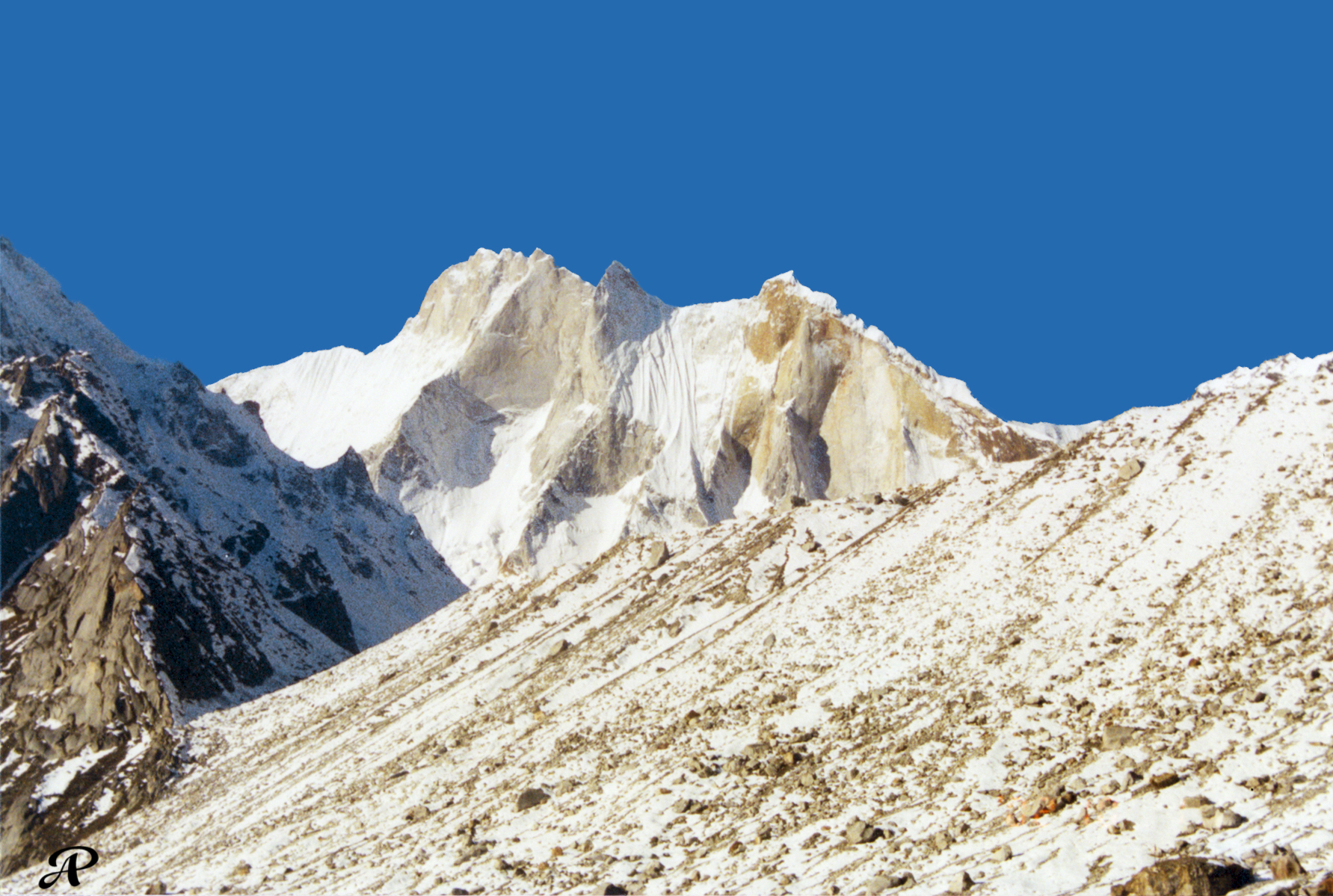
21st – Chowki to Masoori Tal – The morning was clear with sunlight breaking through the peaks in front. Starting at about 5 we reached Khatling snout around 6.30 over a boulder ridden moraine and scree. The clouds had started gathering again, but by the time we reached the snout, the peaks and glacier as if lifting the veil of clouds came right on our face. Shining bright in sunlight the Sphatik and Khatling peaks with the pass in the distance above was very clear. Kedar Dome to our north gave us a good opportunity for photo shoot. Plans were already being made to cross the Pass from the Gangotri / Kedar Tal side which is exactly behind this. As we moved higher we could see the Bhim Tal hidden behind the two ridges on our east. On our way back, while crossing the stream, Singhal slipped over a boulder and hurt himself. Not much but shaken a bit.
Had breakfast and wound up the Chowki-Khatling camp to proceed to Masoori Tal. A straight high ascent through boulders was hard to negotiate. The climb was very exhausting, ridge after ridge, pass after pass, breathless, the passage didn’t seem to end.. we were coming almost on level with the peaks to our left. Dudh Ganga glacier becoming clear and its flow didn’t seem like water but a white frothy milk deep down below. Back breaking loads forced us to stop at a small flat plateau with no sign of water around. Kedar Dome peak now distinct and its glaciers converging to meet Dudh Ganga glacier. Weather had cleared and on our left now we could spot peaks of Khera, the trio of Jogin 1, 2 and 3 together with Masoori peak. It is such a delight to be blessed with amazing views. Behind all this is the Gangotri water shed area of its own glaciers and valleys and peaks like Bhagirathi, Neelkanth and many more. Chilly winds swept our exposed area camping site bringing snow with them, temperature fell sub zero and then there was snow all around us.
22nd – Masoori Tal to Vasuki Tal (15,000 ft 14 km). Last night was very uncomfortable and cold. Couldn’t sleep a wink. Morning was chilly again and windy too. After light breakfast we moved towards Masoori Tal and Mayali Pass. Pious green waters of lake Masoori Tal were just a few hundred meters high surrounded on three sides by mighty peaks on our left. Climbing through the rocky face on east we ridge the top of the ridge to see an amazing view of Kedar Dome on north-east and Puniya glacier on right due-south. Three lakes make the base of Kedar Dome – Panya Tal – Puneeya Tal and Masar Tal. Continuing our trek we descended on Mayali (Puniya) Glacial ice-field for about 2 km, walking south, south-east. Walking on soft fresh snow, we were in nearly knee-deep snow, slowly climbing up to the hardened ice. Our shoes were not meant for this hence all were slipping back and progress was slow. Sun was now shining hard above us creating more problems as the snow started melting and the reflections off the glacier blinded us. Close to the Mayali pass we were at nearly 18000 feet. After the first patch of glacier, Ganga and two porters moved ahead to tie a rope to help everyone manage the next ascent. It was such a relief to reach the pass and the view on the other side was another breath-taking moonscape all the way down a boulder ridden steep slope. Two small lakes to our left greeted us. Huge boulders blocked our way.. it seemed an earthquake had hit this area sometime back. The sheer vertical drop towards Vasuki Tal was amazing. Slipped a few times over boulders, falling and jumping across, we reached Vasuki Tal by 4.30 pm. Another serene lake covered by hills all around. Towards the ridge on the east one could see cairn formation indicating the pass from where we had to get down towards Kedarnath.
23rd – Vasuki Tal – Kedarnath The evening spent at Vasuki was a memorable one. Much singing and dancing culminated with a few games of cards in the tent. Did two rounds of Vasuki Tal. Somehow the night wasnt as bitterly cold as the previous ones. Despite all the hardships the last day of an adventure is always painful. Reaching Kedarnath meant the trek was over. Once again we will be back to the same rut, the same polluted towns and cities, fumes and chaos, work and the daily grind. It was a sunny morning as we lazed around the tent while the porters were packing the tents and other stuff. Nothing will be needed from this today onward. Three rounds of tea and leisurely breakfast. Backpacks ready, the Pass in sight, we slowly moved towards the narrow eastern edge of the lake meeting the glacial melt coming down the pass. Our initial climb was along the stream coming down and after about half a km we moved left over a stiff climb through small boulders. The Pass was never out of sight. It took us nearly three hours to slowly trudge up the ridge meeting Kedar Dome. The top was wind-swept but sunny. From the top of the pass we could see the tiny structures of the habitation scattered around Kedar Nath temple and glacial melt coming down from Gandhi Sarovar from between Kedar peak and . The sheer vertical drop was scary. There was no trail and it seemed nearly 75 degrees. One had to be very careful, a stupid mistake or the shift of the load to front would mean rolling down non-stop for a kilometer or two. Short measured steps, carefully kept one by one, ensuring that the foot will not slip made the progress slow. But who was in a hurry. While the porters were wanting to rush we deliberately slowed down, stopping every ten minutes, sitting and enjoying the peaks facing us. We took a lazy two hours to touch the grounds across Kedar Nath temple. Crossing the bridge we faced the crowds once again after 12 days. It was 4 pm. Crossing the narrow bazaar we approached the temple, sitting in its precinct we thanked the Lords. A few rounds of chai in the bazaar and shopping for tid bits to carry home. An hour later Trepan Singh came back having fixed the place where we would be spending the night. Plans were being shared for the journey back home. Except Singhal and me everyone wanted to stay an extra day at Kedar Nath. We wanted to get back home to Delhi and Chandigarh soon. It was decided that Singhal and me would leave at day break to ensure that we reach the road head well before the last bus left. A comfortable night followed a hot water bath next morning. We were out, ready with our backpacks at 8 am. Friends lined up for last hugs and byes. It was a race against time to cover 16 km down to Gauri Kund and catch the 3 pm bus. We ran… yes literally ran down the wide trail, slipping and balancing over loose wet soil, over the pony poo strewn over smooth pebbles and rocks embedded in the trail. We didnt stop even for one minute any where, not for water, not for tea or munchies. Our heads down, eyes fixed to the trail, not deviating by a degree for the fear of landing any false step, our knees crackling, shoulder torn by rucksack straps, backs seeking forgiveness… there were intermittent showers in patches. Pulling our caps over the foreheads we looked at each other and gave a silent confirmation that we will keep going… and we did. Singhal would look at his watch once every 10 minutes as we were in the last two kilometers, smiling to himself all the time. I knew we were not far from Gauri Kund as no one was climbing up any more… which meant it was past noon, when pilgrims are not permitted to go up. When we hit the real metalled road, Singhal stopped and looked at his watch, he turned looked at me and gave me a big hug pushing the watch in my face. The time was 1.47 pm. We had done the incredible. Having done 16 km down hill in less than six hours. Tickets to the bus purchased, we washed and sat down to have lunch. Trust me, after that half an hour of sitting on the bench our legs refused to carry our load or straighten. We were walking like pregnant women.
Members of the expedition
Govind Pant Raju – Leader 27 March 1959
Ganga Singh Martolia – Deputy 8 August 1957
Prahlad Singh Burphal 8 August 1958
Puran Singh Jangpangi 6 November 1955
Ravi Tandon 1 July 1958
Prem Shankar Shah 29 May 1957
Gopi Sonkar 6 July 1957
Rajendra Nath Rastogi 14 July 1948
Arun Singhal 18 July 1955
Rajinder Arora 25 April 1956




 Ankahi. Unsaid.
You must be logged in to post a comment.