
What if I told you that William Shakespear was born in India!!! What if I added that he was born in Bombay to British parents!!! What if you also find that he was a Captain with the British Indian Army and later a British Political Agent who served not only in India but also West Asia!!! What if I also said that he was an accomplished photographer and an explorer but not so good at poetry. Hold your horses and don’t unsheathe your swords before I tell you that all this is true. Trust me, I am talking about William Henry Irvine Shakespear, the one who didn’t use an “e” as the last character of his last name.
Of course I am not talking about the “Bard of Avon” or the playwright, poet, and actor born in Stratford-upon-Avon in April 1564. I am talking of yet another Shakespear who excelled in many other deeds. It is the similar sounding name, the same country but that is where the similarity ends and they were born 300 years apart.
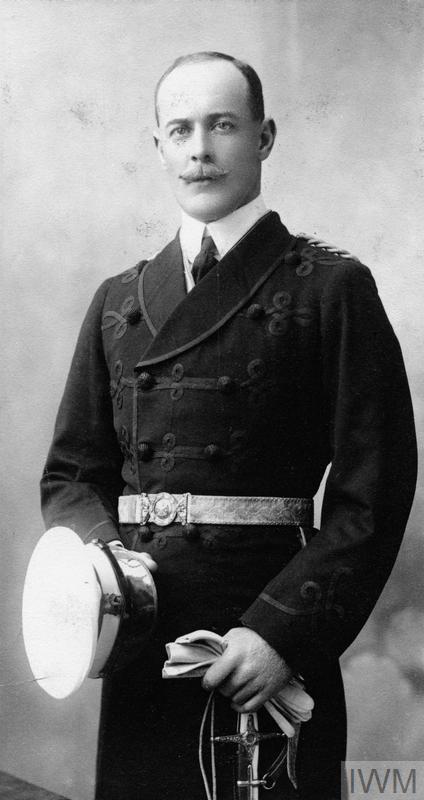
Captain William Henry Irvine Shakespear CIE (29 October 1878 – 24 January 1915) was a pioneering British explorer and civil servant. He also served in the Indian Political Department. He conducted extensive mapping of the Arabian desert, including a notable journey from Kuwait to Riyadh and on to Aqaba in 1914, providing detailed intelligence to the British War Office. “Shakespear of Arabia” was loosely given title to him and was sometimes referred to as a precursor to T.E. Lawrence (of Lawrence of Arabia fame), he was deeply involved in local politics and exploration, capturing the landscape and people with his camera.
Born into a family of British colonial administrators stationed in Bombay, his father, William Henry Sulivan Shakespear, served in the Indian civil service, while his mother, Annie Caroline Davidson, was a homemaker.
As was customary for children of Anglo-Indian expatriates, Shakespear spent much of his early years separated from his parents, who remained in India for professional duties. He received his initial education in England before attending King William’s College, a preparatory school for military or civil service careers. By adolescence, Shakespear had developed an interest in languages and horsemanship, skills honed through the structured yet distant colonial upbringing that characterized many British families in the Raj.
Shakespear was commissioned as a second lieutenant in the British Army and served with the Devonshire Regiment in India. Later, he was transferred to the 17th Bengal Cavalry, continuing his military duties in the region while developing proficiency in local languages and customs essential for Frontier service. At his stint in Bombay Presidency he earned a reputation for marksmanship, including tiger hunting expeditions that led to his nickname “Tiger Henry.”
By 1903, he transitioned to the Foreign Department of the Government of India to pursue diplomatic roles. He became the youngest vice-consul in British India, handling consular affairs amid the empire’s expanding influence in the Persian Gulf periphery. His focus was on intelligence gathering, tribal relations, and language studies including Arabic, Persian, and Hindustani.
As the Political Agent and Diplomat he was posted in Kuwait (1909–1914) where he established crucial, trusting ties with Ibn Saud, the Emir of Najd, and future founder of Saudi Arabia. He served as the military adviser to Ibn Saud between 1910 and 1915 and was instrumental in facilitating the relationship between the British Empire and the House of Saud. A treaty drafted by him was signed shortly after his death, giving the Saudi rule early international recognition. He was known for his familiarity with local Arab rulers and for conducting a journey to England from India in a motorcar, which he later used in his desert explorations. His work involved monitoring regional threats and supporting British interests against Russian encroachment in Central Asia.
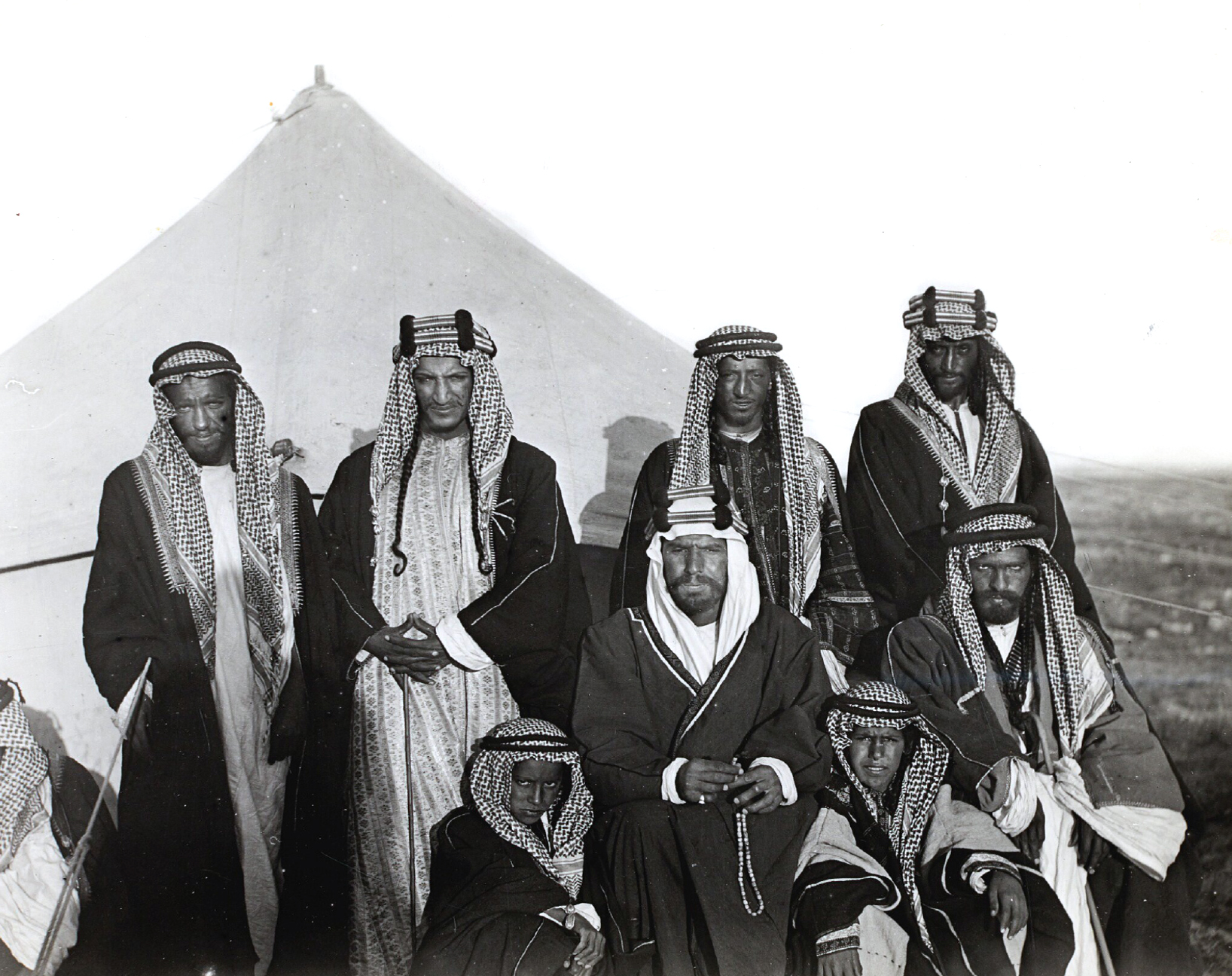
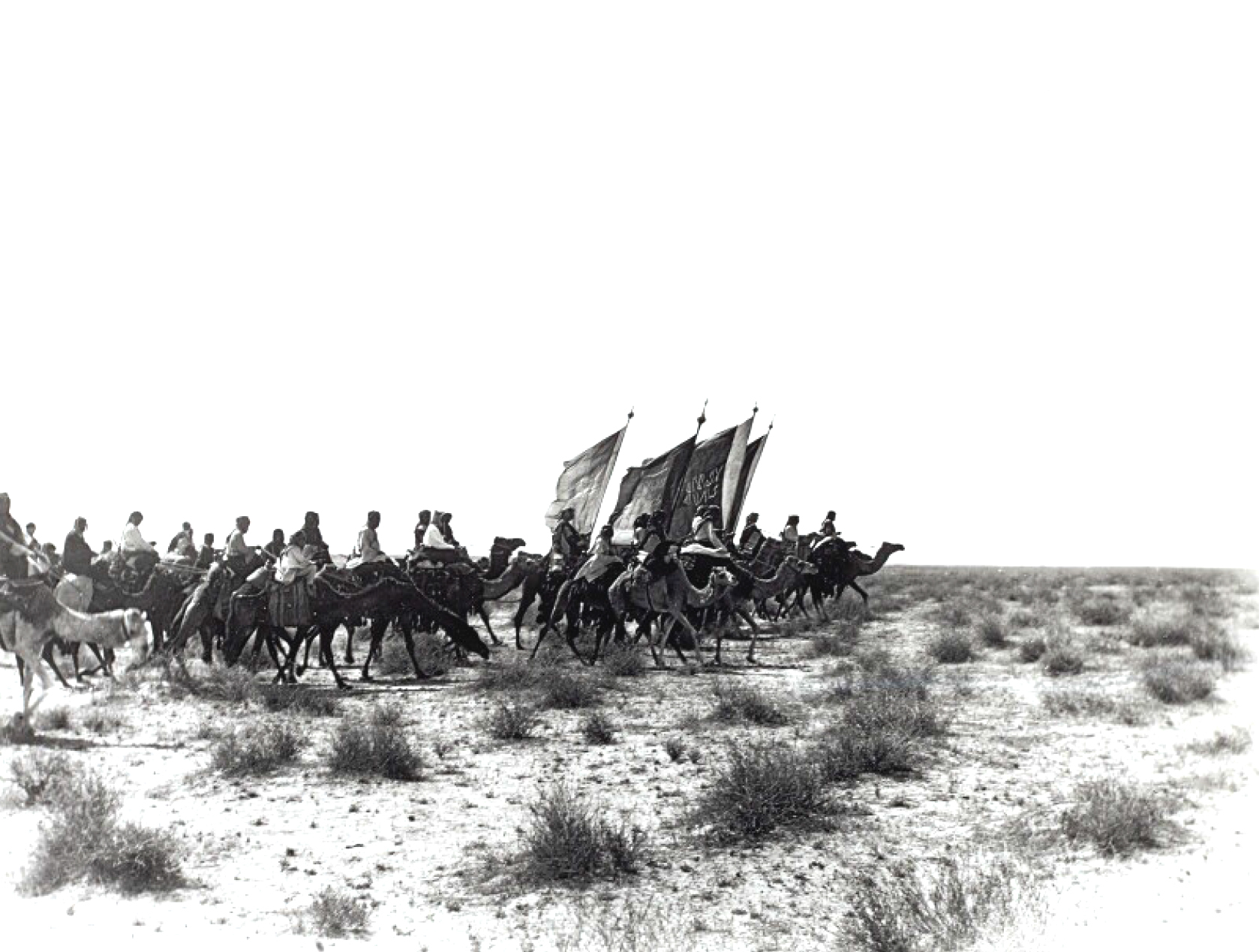
He achieved fluency in Arabic and adopted Bedouin attire and customs, which enhanced his credibility among sheikhs and tribesmen. Shakespear traversed vast desert expanses by camel caravan, often accompanied by Bedouin guides, to map routes, wells, and topographical features previously undocumented by Europeans.
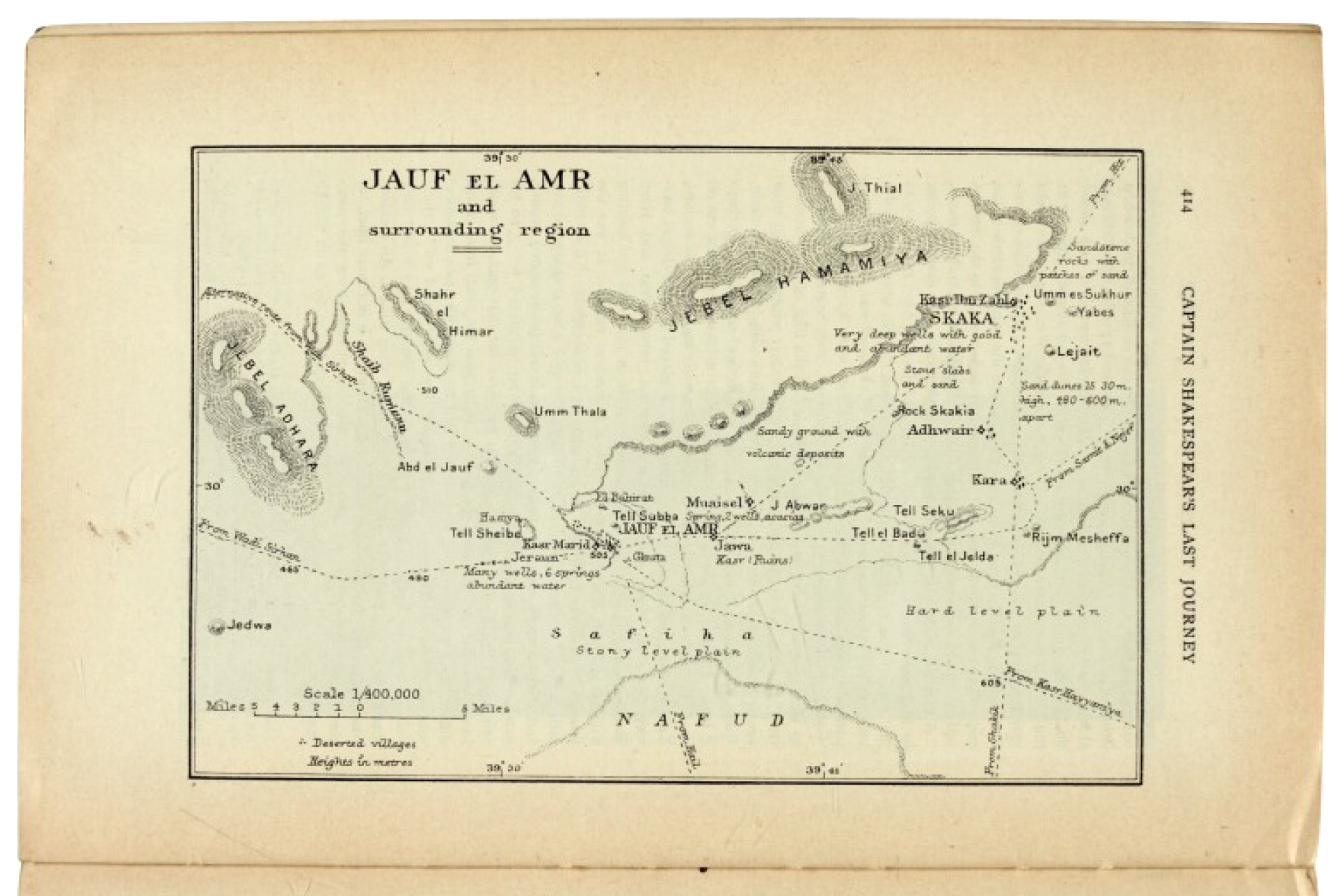
It was Shakespear who arranged for Ibn Sa’ud to be photographed for the first time. Ibn Sa’ud had never seen a camera before. In March 1914, Shakespear began a 2,900 kilometre journey from Kuwait to Riyadh and on to Aqaba via the Nafud Desert, which he mapped and studied in great detail, the first European to do so. In November 1914, the British government in India asked Shakespear to secure Ibn Sa’ud’s support for the British-Indian Mesopotamian Expeditionary Force, which had just taken Basra. Aqaba is a coastal city in Jordan, located in the southernmost part of the country on the Gulf of Aqaba, which is a northern arm of the Red Sea. It now serves as a major tourist destination and industrial port near the borders of Israel, Egypt, and Saudi Arabia.
Shakespear was killed in action on January 24, 1915, during the Battle of Jarrab, while supporting Ibn Saud against Ibn Rashid. He was killed by gunfire by one of Ibn Rashid’s men. At the time of his death he was taking pictures of the ‘live battle’ (from a vantage point on a hilltop) between the two warring groups. He was buried in Kuwait. His grave is located in central Kuwait City, near the modern Al Hamra Tower. Ibn Saud’s trust in Shakespear was evident in his remark “my trust is first in God and then you,” underscoring the personal dimension of their alliance.
Following Shakespear’s death Ibn Sa’ud’s forces suffered a decisive defeat against Ibn Rashid, leading to a rout in which hundreds of men were killed and Shakespear’s personal belongings, including his camera and photographs, were plundered by the victors.
His death was described as ‘a great loss to the cause of the Arab world’, and ‘a disaster to the Arab cause’. It may be reckoned in the small category of events which changed the course of history. Had he survived to continue a work for which he was so eminently suited, it is extremely doubtful whether subsequent campaigns of Lawrence would ever have taken place in the west.
Shakespear documented previously unknown terrain, tribes, and water sources essential for British strategic interests in the region. He achieved fluency in Arabic and adopted Bedouin attire and customs, which enhanced his credibility among sheikhs and tribesmen. Shakespear traversed vast desert expanses by camel caravan, often accompanied by Bedouin guides, to map routes, wells, and topographical features previously undocumented by Europeans.
During his expeditions in central Arabia he documented Bedouin customs, photographed landscapes and settlements, and forged initial contacts with influential sheikhs, laying groundwork for strategic alliances. These ventures yielded precise route surveys and ethnographic insights, enhancing British cartographic records and informing policy on pearl fisheries, trade routes
His work as an amateur photographer produced the first images of the Arab world, provided valuable ethnographic and geographic data that advanced European understanding of Bedouin societies and desert landscapes.He drafted the initial Anglo-Saudi agreement recognizing Ibn Saud’s independence from Ottoman suzerainty shortly before his death.
Shakespear employed photography as a key tool during his Arabian expeditions, utilizing a glass-plate camera equipped with a clockwork mechanism to produce panoramic images, which he developed on-site within a light-tight tent to ensure immediate processing under challenging desert conditions. His work yielded some of the earliest documented visual records of Bedouin encampments, nomadic lifestyles, and vast interior landscapes in Kuwait and central Arabia, captured primarily between 1909 and 1914.
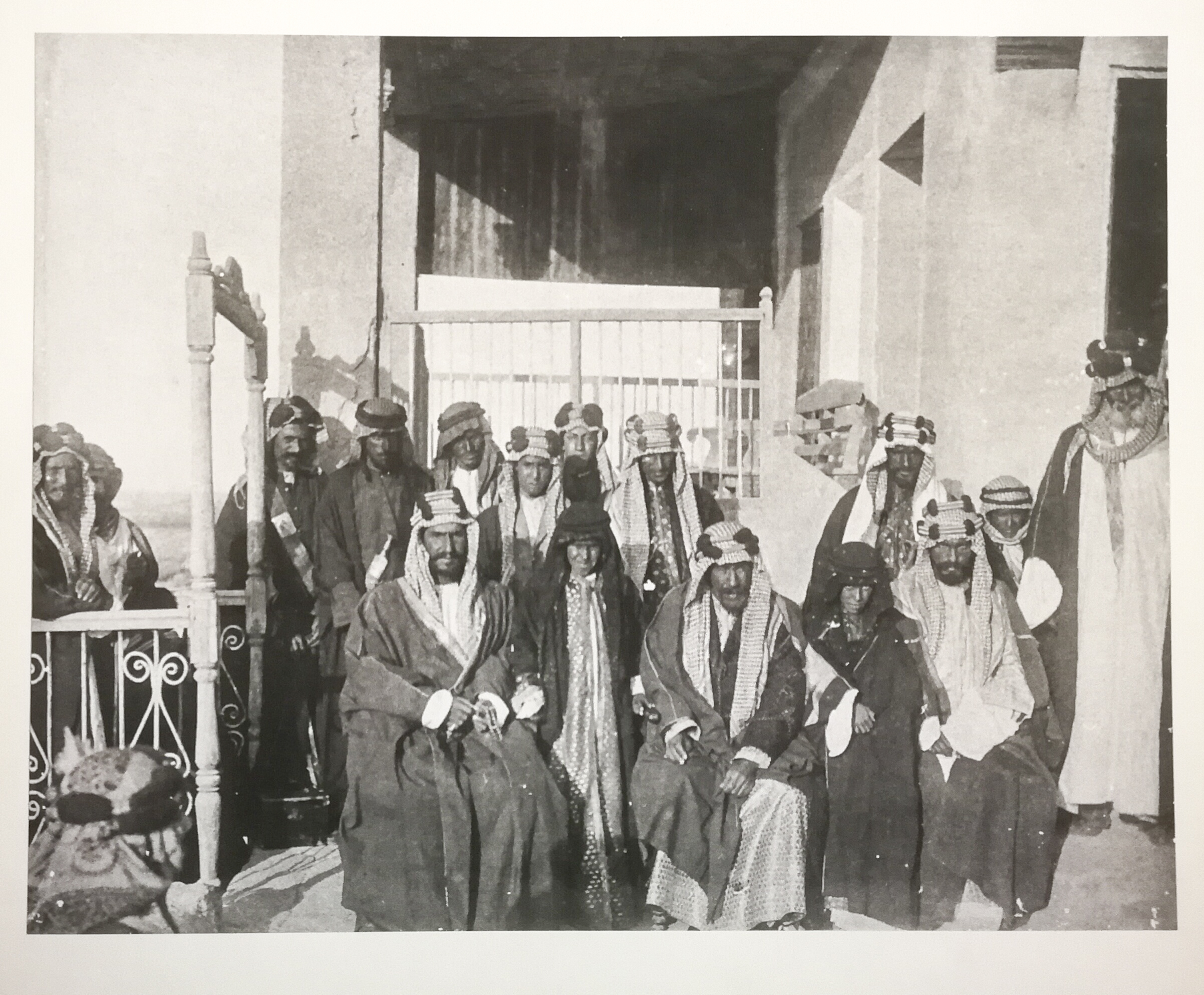
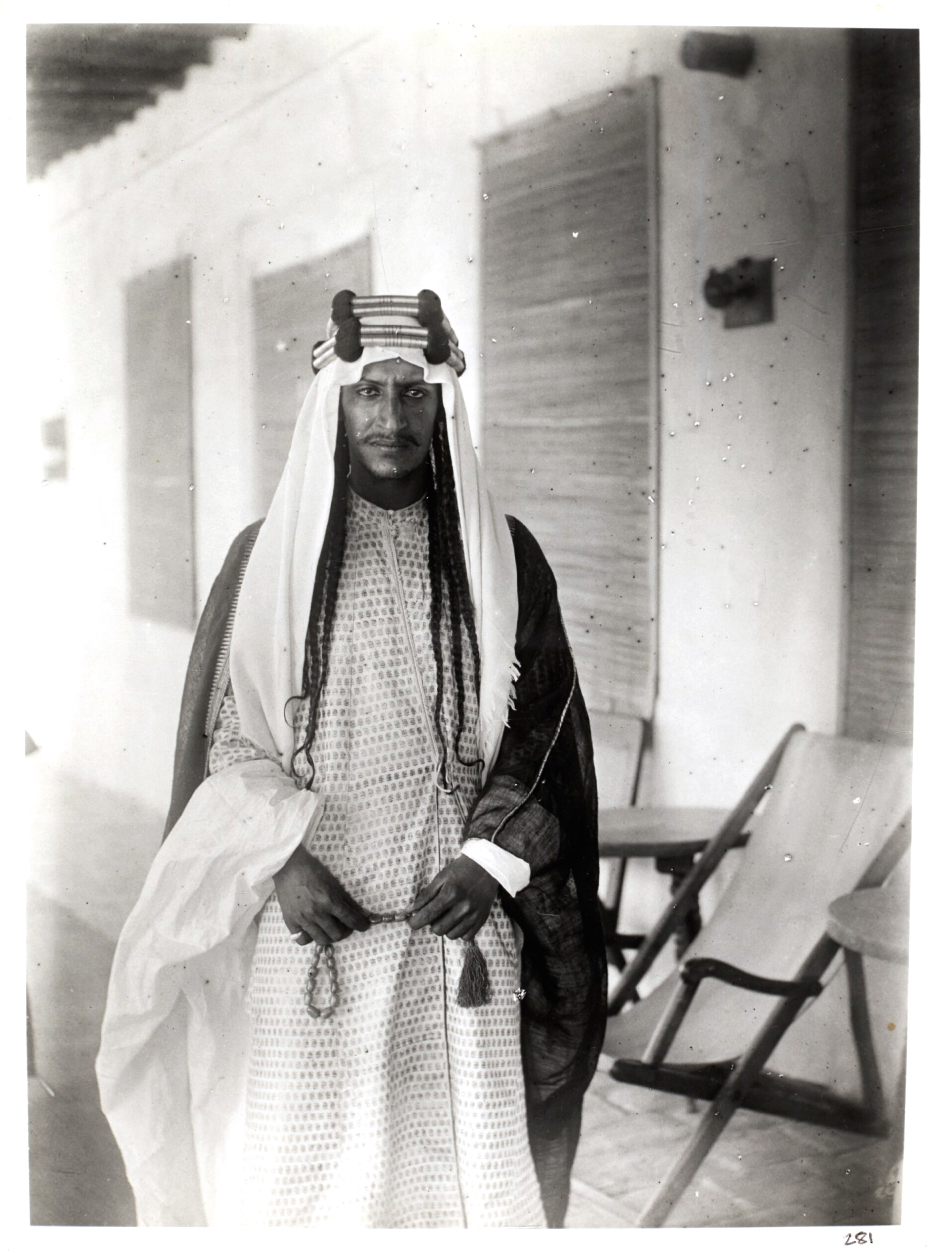
A keen photographer, Shakespeare was responsible for capturing some of the most enduring images of Arabia in the first part of the Twentieth Century. His photographs are among the best-known early images of Kuwait and Saudi Arabia prints of which were later auctioned by Sotheby’s.
He recorded the historic meeting between Abdulaziz Ibn Saud and Shaikh Mubarak al-Sabah, producing the first known photographs of the future Saudi ruler. These portraits, depicting the leaders in traditional attire amid diplomatic exchanges, offer invaluable primary evidence of early 20th-century Gulf politics and tribal alliances. He had met and taken three photographs of the young ruler in Kuwait in 1910. His 1911 journey took him south to the wells of Thaj, technically in Ottoman-controlled al-Hasa, where he conferred with Ibn Saud again and took further photographs of him.
Thirty three photographs (200 x 255mm) of Captain Shakespear, with a copy of the typescript diary of his 1914 trans-Arabian journey, and the 1922 issues of the Geographical Journal containing ‘Shakespear’s Last Journey’ with a map of Northern Arabia charting Shakespear’s travels in 1909–14 were acquired and auctioned by Sotheby’s. Many of these were silver prints from Shakespear’s original glass plate negatives held by the Royal Geographical Society.
Reading about figures like Captain William Shakespear and his likes from the 17th to the early 20th centuries, one cannot help but marvel at the remarkable adventurous and daring spirit of these wayfarers who left an indelible mark and truly shaped the course of history in ways more than one.
Rajinder Arora, 17 March 2026





 Ankahi. Unsaid.
You must be logged in to post a comment.