
Kanwar Mohinder Singh Bedi ‘Sahar’
‘Sahar’, is the Urdu word for daybreak
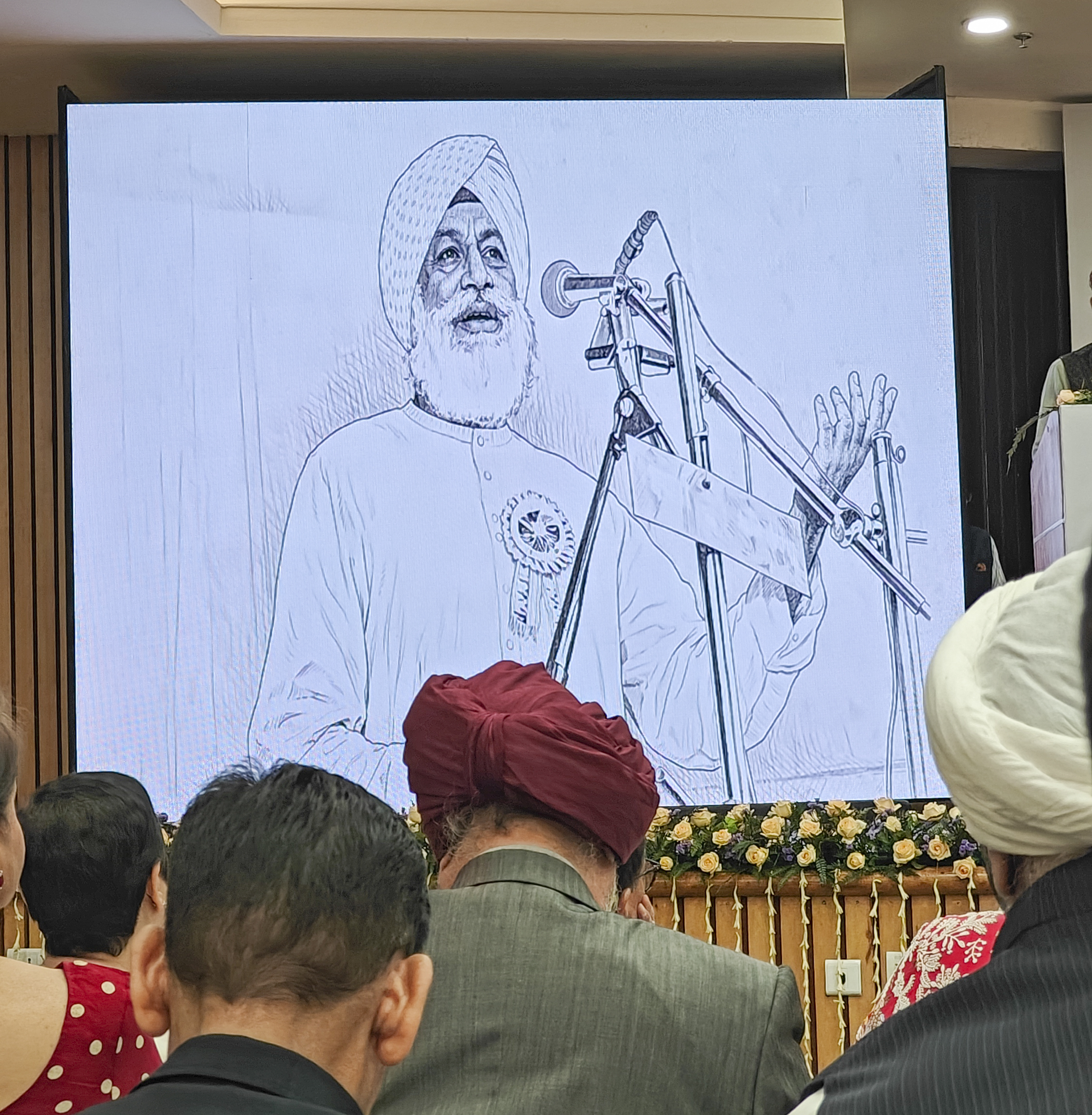
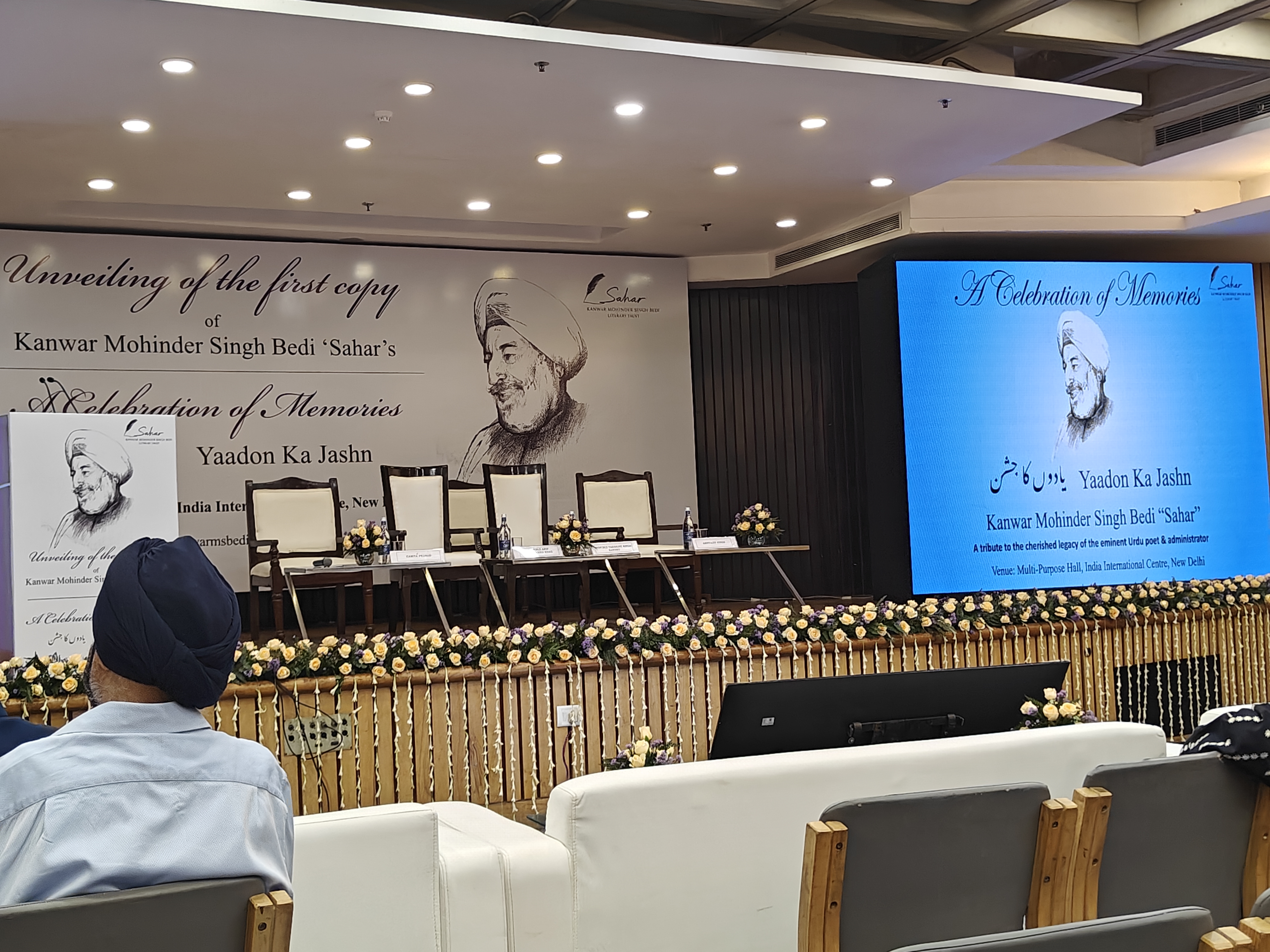
Visualise this scenario. You are at a book launch. The book is an English translation of an original Urdu biography of one of the finest 20th century poets of the Indian sub-continent. Audio clips of filmi and non-filmi ghazals, written by the author, are being played in a loop. On both sides of a large stage, two gigantic LED screens are running visuals of his sombre face. An eminent citizen, an Urdu poet, a Sikh, a high-ranking civil servant and the well known bridge between two warring nations is looking at you tenderly through those screens. The smiling face in an elegant turban has probing eyes which seem to be scanning every face in the jam-packed hall.
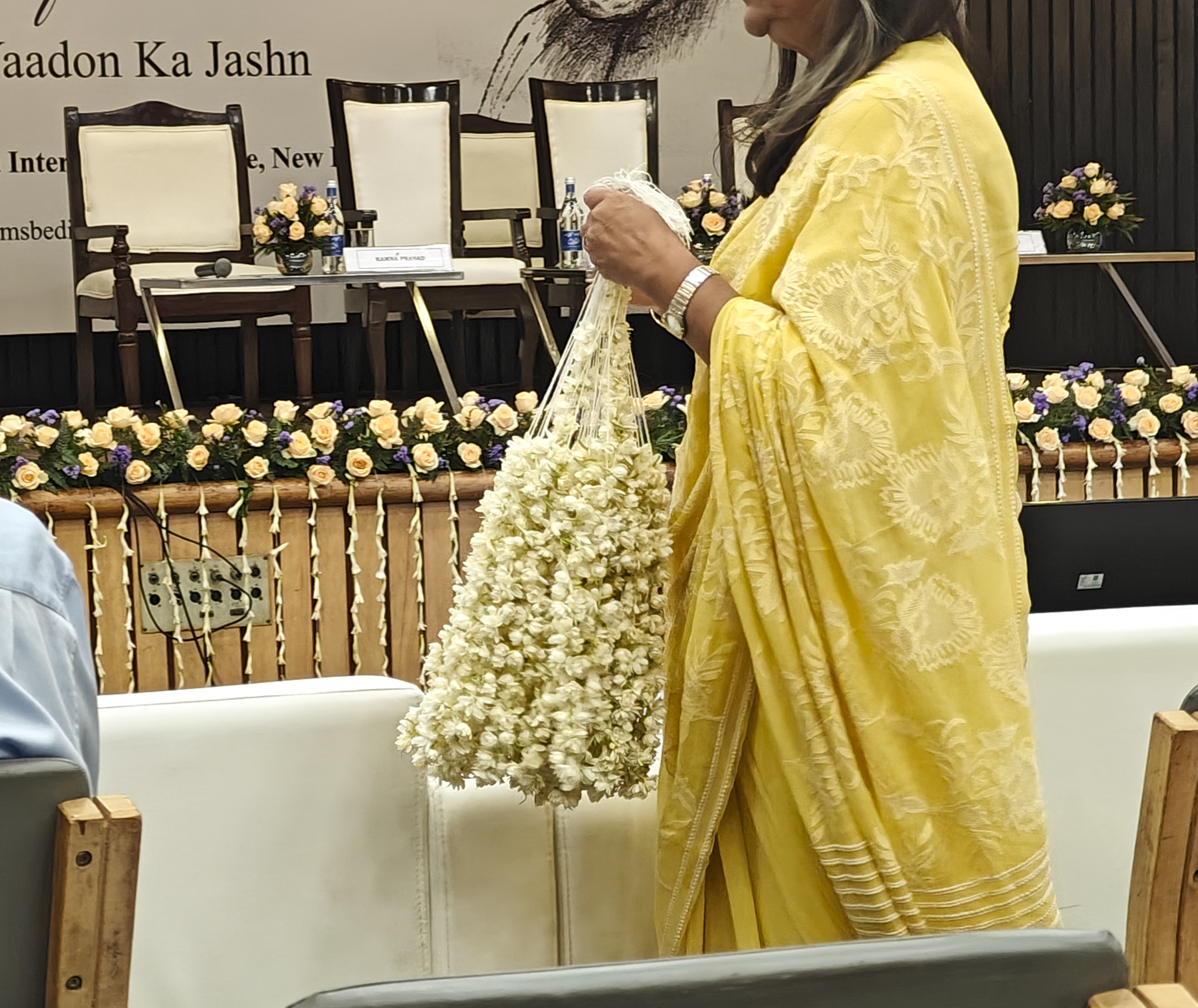
A fine spray of scented vapours waft through the air from the two large fans kept across the hall. An elegantly dressed lady is welcoming the patrons with short jasmine gajras which people roll on their wrists. I am looking at the door watching each entrant. A ghazal breaks the reverie.
ख़ुदा ही जाने, यार आए ना आए .. मेरे दिल को क़रार आए ना आए
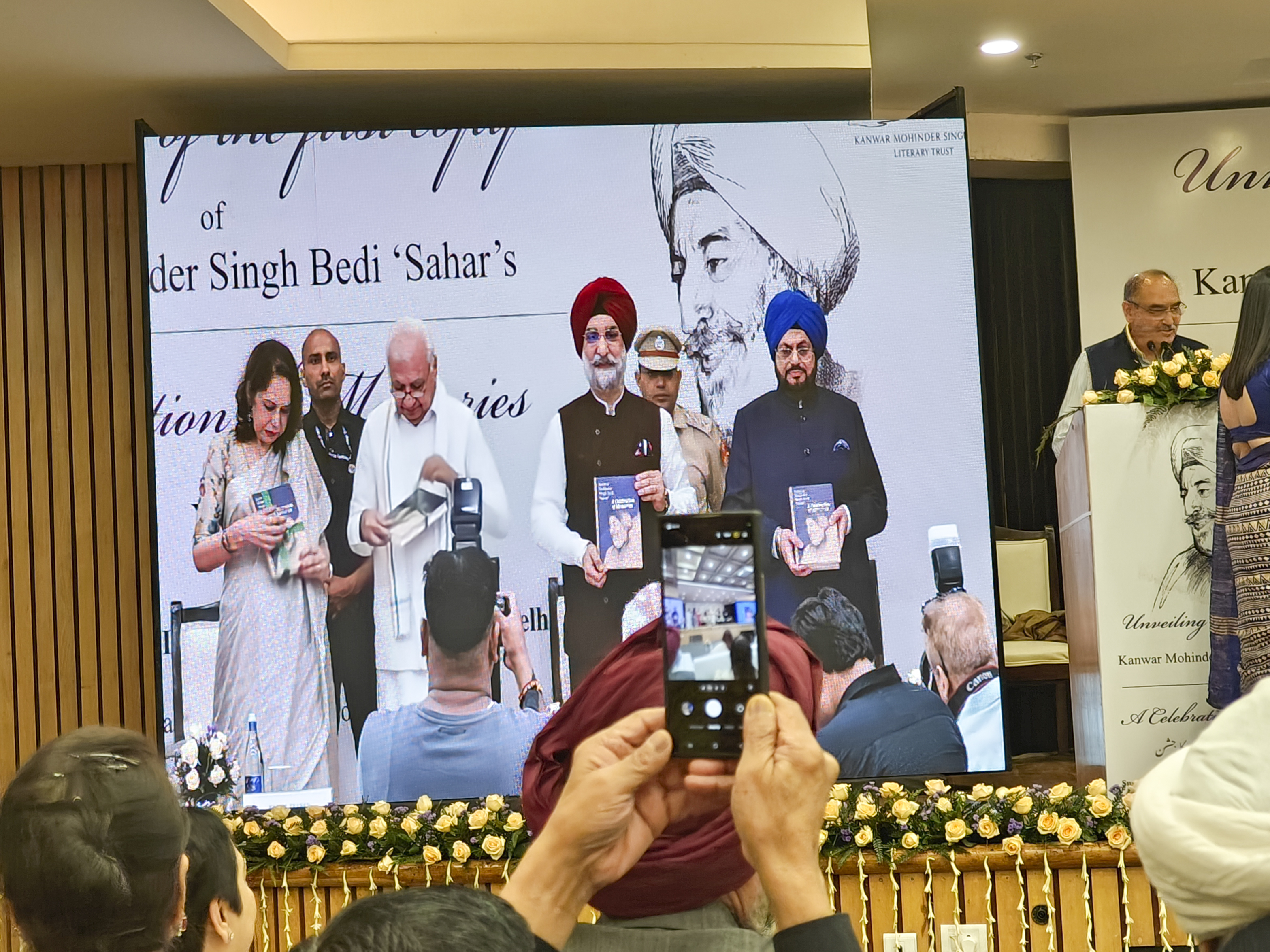
There is a sea of turbans around. Suddenly, an announcement jolts me out of my dream. The grandson of this man, holding a copy of the anthology of his Urdu poetry, transliterated to Hindustani/Devnagri says, “Bedi Saheb, my Nana, was the 16th generation (pusht) direct descendent of Baba Guru Nanak Dev Ji.” The hall erupts in a huge round of applause while the words freeze me on my seat. I wants to get up and offer obeisance, respect and homage to the man I last met about 35 years back. All these years I did not know, nor did he tell me, he was the descendent of the first Sikh Guru. I skip a heart beat.
I recall my last meeting with him in Connaught Place. The tall frame of the 6 feet 4 inch man in a multi-colour turban was holding on to his stomach slightly bent over his Fiat car. Even at the 80+ the man would drive all by himself from Asaf Ali Road to Greater Kailash One without flinching an eye. I am reminded of probably the last conversation I had with him. Showing concern about him losing weight, I enquired about his ailment. Jovial that he was, he replied in Punjabi, “Not much my son, it is age…. And now I can’t digest the 10-egg omelette in breakfast.” Smiling, he sat in the car and drove off. A month or so later I was told that he was admitted to a hospital diagnosed with lymphoma.
That was Kanwar Mohinder Singh Bedi ‘Sahar’, of whom none other than Khushwant Singh said, “The stoutest bridge between the people of India and Pakistan…” and “…someone who effortlessly found his way into everyone’s heart”. The poet-connect between two nations, two zabans, two cinemas and millions of stories of our subcontinent. Kanwar Mohinder Singh Bedi ‘Sahar’ called himself Khadim of Urdu zaban.
Such was the love and affection people had for him that even the doyen of Indian cinema, the tragedy-king, Dilip Kumar saheb said of him on his demise, “He was far more than a friend to me. Kanwar Mohinder Singh Bedi was like my brother. His kindness and sincerity were such that even a silent exchange of glance felt like a heartfelt greeting. His presence left an impression that words could never describe.’
Born in a family of zamindars of Chak Bedi, Montgomery District (now Sahiwal), Punjab, in undivided India, the Bedi clan owned more than 25,000 acres of land and commanded immense respect and clout in Chak Bedi named after the clan.
The well-built Kanwar saheb grew up with interest in wrestling, archery, shooting and an immense love for Urdu poetry which he inherited both from within the family and his ustads. Having qualified as Punjab Civil Services Officers (IAS) he trained as an administrator. At the time of Partition he was the Asstt Commissioner in Dharamshala, Kangra District of what is now Himachal Pradesh.
The seniors of the family share that after the Partition when the riots broke out in Delhi, Pandit Jawaharlal Nehru personally called on him to take the charge as the City Magistrate in Old Delhi area to bring about peace and quell the anger of the murderous mob. Talking about it one of the dignitaries on the dias said, that while taking charge of the office Mohinder Singh Bedi called an Imam of the area to be witness to the Oath he took and promised that he will personally ensure that no Muslim is killed in his area under his guardianship.
He just didn’t believe and practice pluralism, secularism and the idea of shared human dignity, brotherhood, peaceful living he was progressive in all that he approached with clear heart. Poetry was the very foundation of the love he had for humanity. For him poetry required no more effort than breathing. Imagine, a practising Sikh writing a na’at – a poem in praise of the Prophet – was not just literature but pure devotion.
इश्क़ हो जाए किसी से कोई चारा तो नहीं
सिर्फ़ मुस्लिम का मुहम्मद पे इजारा तो नहीं
As riots subsided and the pain of Partition eased, Bedi saheb found solace in writing poetry, bringing about peace among two new nations and started organising people level meets among various communities. Being a known poet his first attempt was to organise poets on both sides of the line and bring them together on one platform of Indo-Pak Joint Mushairas.
Among the two Mushairas that are worth mentioning here, the first is the historic “Jashan-e-Jamhooriat-Mushaira,” held at the Red Fort, in February 1950. The Lal Qila Mushaira is a historic Urdu poetic symposium, originating under last Mughal emperor Bahadur Shah Zafar revived under Anjuman Taameer-e-Urdu. This mushaira was inaugurated by Jawaharlal Nehru which continues till date
The second Mushaira was organised by Mohinder Singh Bedi ‘Sahar’ in 1954, together with Sir Shankar Lall, Shri Shankar Pershad, ICS, Sahir Hoshiarpuri and Gulzar Dehelvi as founder-organisers which was later to be knowns as Shankar Shad Mushiara.
His persuasive yet authoritative baritone would garner attention as he proceeded to say ‘Haazareen!’ because of which he became the natural choice for Nazim-e-Mushairaat at each gathering. His elegant white, starched Kurta and Churidar pyjamas, that serene gaze with a colourful turban and an overall aristocratic demeanor would ask for immediate attention. Just like his poetry, tenderness flowed in his words and deeds.
Together with his duties, his poetry had found many lovers and fans in the Indian film industry. He was a popular figure among the top stars of the day including, Dilip Kumar, Raj Kapoor, Dev Anand, Manoj Kumar, Sunil Dutt, Dharmendra and almost all singers, lyricists and music directors. Voices like Mohammad Rafi, Lata Mangeshkar, Mukesh and later Jagjit Singh worked closely with him in singing Bedi saheb’s shayri. Much later Mohd Rafi saheb came to Delhi specially to sing at his sons wedding.
Having earned respect and the high stature Bedi saheb commanded among the poets of the subcontinent, the retired senior civil servant came forth to produce Hindi films. During 1970s Mohinder Singh Bedi produced three films, namely: Man Jeete Jag Jeet (1973) (also acted a cameo); Dukh Bhanjan Tera Naam (1974, Dharmender in a guest role); and, Charandas (1977). All three films fared well on box office.
By late seventies, ghazals as a form had found the love of new generation in India. Eminent performers from across the border found a humongous Urdu loving audience in India who were inclined and ready-to-grab popular poetry that was easily understood here. Among the greats of the period from Pakistan were Mehdi Hassan, Noor Jahan, Farida Khanum, Abida Parveen, Amaanat Ali Khan, great master Nusrat Fateh Ali Khan and Ghulam Ali Khan Saheb together with Jagjit and Chitra Singh, Talat Aziz, Bhupinder and Anup Jalota from India.
Remembering an incident from his college days, Bedi saheb’s grandson Ashwajit Singh said “I was the President of the college students’ union at the Shri Ram College of Commerce. We planned a ghazal evening with an eminent singer but couldn’t get one as we didn’t have required funds. When Kanwar Mohinder Singh Bedi ‘Sahar’ got to know of it, he picked up the phone and called Ghulam Ali Khan Saheb, who happened to be in India that time and said ‘…you are like my father and I cannot say no to your order.’ Not only did Ghulam Ali Khan saheb performed at SRCC, he did not take a penny for the concert. That was the respect and love Bedi saheb commanded all his life.
Ashwajit Singh, the grandson, further mentioned that ‘Insaniyat, Shauq and Rishte’ were three pillars of the life of great Kanwar Mohinder Singh Bedi ‘Sahar’. He helped anyone in need, irrespective of his social or economic status. Bedi saheb was polite to a fault and made friends easily with anyone and everyone.
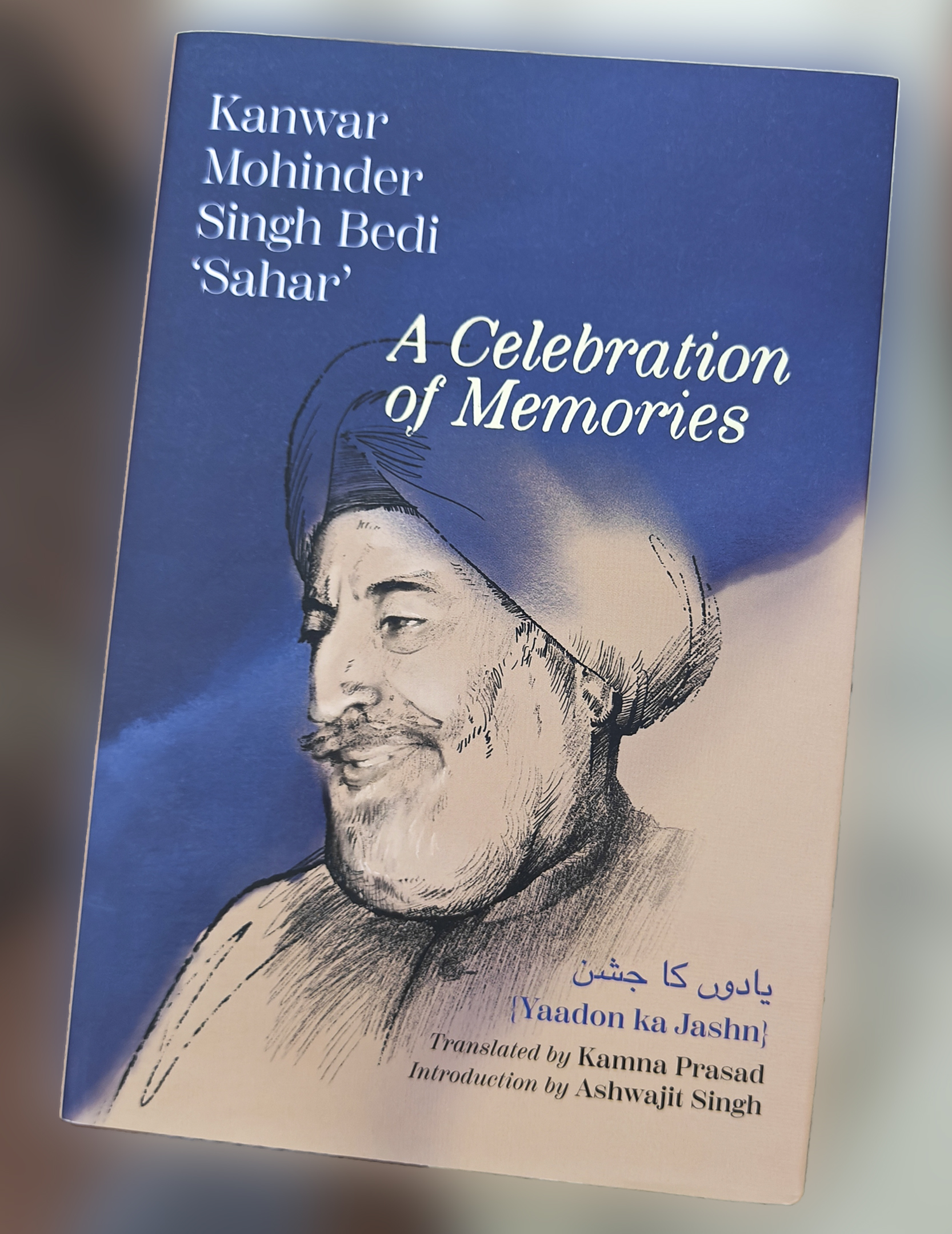
In 1983, Kanwar Mohinder Singh Bedi ‘Sahar’ published a collection of autobiographical poetry titled Yādon̲ kā Jashn (A Celebration of Memories) in Urdu.
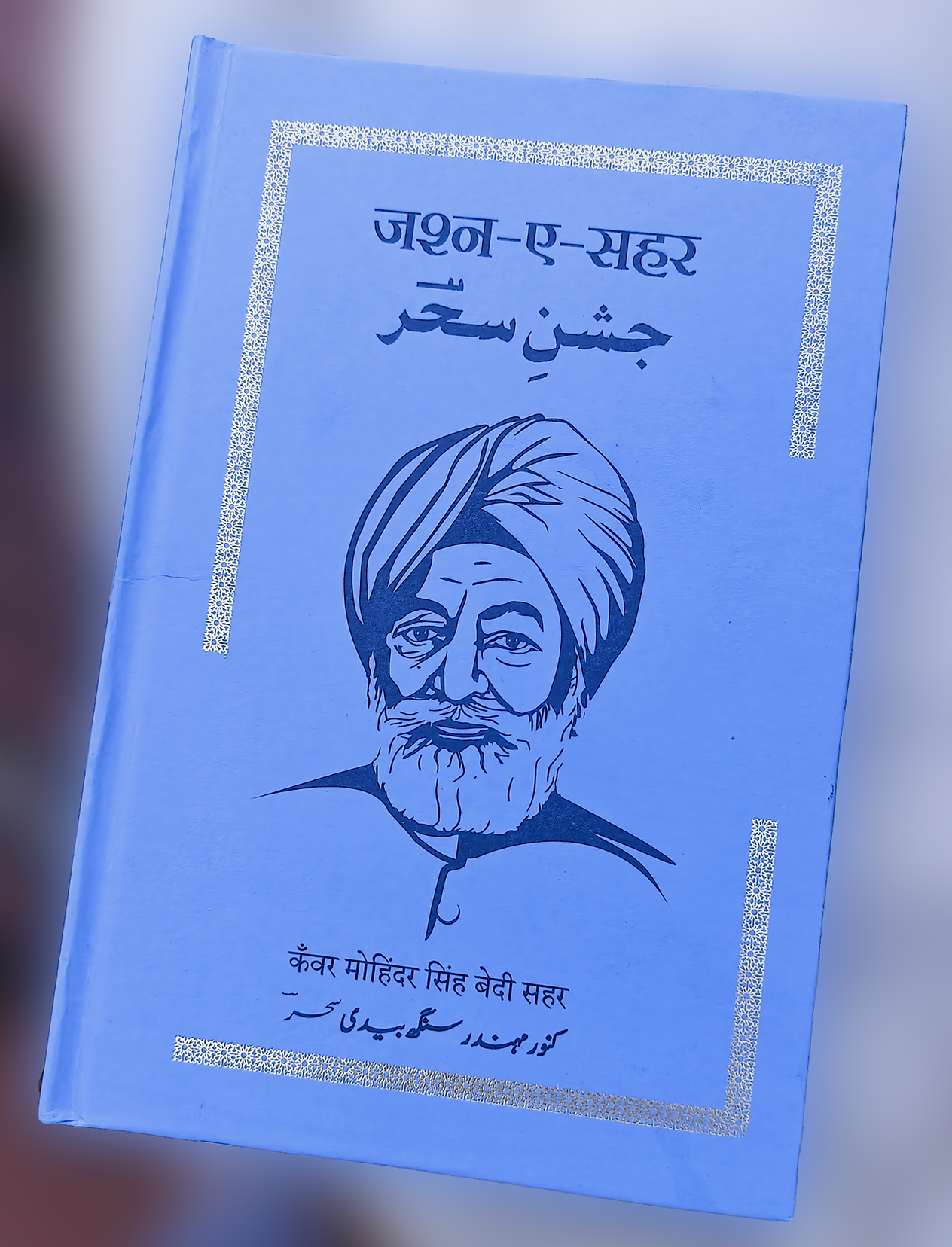
An international event to celebrate his poetry, called Jashan-e-Sahar (A celebration for ‘Sahar’), was held in the UAE in 1992 to honour him. ‘Kanwar Mohinder Singh Bedi Award’ was announced in his honour by the Haryana Urdu Akademi.
His son mentions that after Bedi saheb passed away Jagjit Singh, the eminent singer, came home seeking permission to do an exclusive album based on the Bedi saheb’s ghazals – singing and recording some of the most lyrical poetry of Bedi saheb in album titled “Forget Me Not”.
Sitting on the dias, Mr Arif Mohammad Khan, former Lt Governor recalled how he had seen and met Kanwar Mohinder Singh Bedi ‘Sahar’ in Nainital while walking on the Mall Road; and how well Bedi saheb treated his group and spent nearly two hours with young students even treating them to evening tea and pakoras.
Bedi saheb’s interest in sports was well known. In his youth he was a wrestler, an expert archer and a marksman. He organised Bharat Kesari Dangal and even an archery competition. He was the Chairman of the Wrestling Federation of India. He must have been in love with animals too which can be gauzed from the fact that much after partition he went back to Lahore only to see and pat a baby elephant named ‘Benazir’ at the Lahore zoo whom Bedi Saheb had seen being born before the Partition.
Rekhta, the popular web portal of Urdu adab and writing, in its short description of the poet says, “A renowned figure of Urdu poetry and culture, and a traditional-style poet, who also served in the Indian administrative services.” On Rekhta portal you can find 52 Ghazals, 3 Nazms, and 18 Sher by Kanwar Mohinder Singh Bedi ‘Sahar’.
“His poetry is varied and includes traditional themes of love and yearning but also themes of unity, peace between India and Pakistan and humor. His poetry is considered to belong to the same trans-religious and transnational tradition as that of other well-known poets from the Indian subcontinent such as Muhammad Iqbal, Faiz Ahmad Faiz and Ahmad Faraz. Sahar’s first book of poetry was T̤ulūʻ-i-Saḥar (1962) (trans Advent of Daybreak). In 1983, he published a collection of autobiographical poetry titled Yādon̲ kā Jashn (A Celebration of Memories)
Another interesting incident was mentioned by Ashwajit Singh about Kanwar Mohinder Singh Bedi ‘Sahar’s poetry. “During Covid lockdown days someone started sending me a recorded ghazal or a nazm of my grandfather each day. Very few of my grandfathers’ poems have been translated to Hindustani, so I was not much acquainted with the entire body of his work. Initially I thought it was someone trying to connect with us. When I shared the recorded versions with friends who understood Urdu nuances, they told me that the reading and recitations were par excellence. Thats when I connected with Abdul Raheem saheb who was sending me the poetry. At his instance we created a website dedicated to my grandfather which over time will collate all possible poetry, publications and various other details of the life of my grandfather.’ The website is http://www.kanwarmsbedisahar.com
One cannot read Bedi ‘Sahar’ without entering the intricate emotional landscape of the 20th century India, the Partition of India – that uprooted and killed millions and had deep impact on him – and the anti-Sikh riots of 1984 in which he barely escaped with his life hiding under the seat of a car.
In his Foreword to the English biography titled ‘Kanwar Mohinder Singh Bedi ‘Sahar’: A Celebration of Memories’, a Solicitor and young poet Saif Mahmood says, “Sahar embraced the classical structures of Urdu, especially of the ghazal, and believed that this inherited form can carry modern ethical insight. His language is pellucid, and his poetry direct and without any veiled meaning. He renders the universal human condition with humour and wit, turning even profound truths into playful images:
Nit nit kā yeh anā jānā mere bas ki bat nahiN
DarbānoN ke naz uṭhānā mere bas ki bat nahiN
Ishq o muhabbat kya hote haiN kya samjhauN waiz ko
Bhains ke äge bin bajānā mere bas ki bat nahiN
These daily visits of obeisance (to the powerful) are not my thing
Putting up with their gatekeepers’ airs is not my thing.
Could I ever explain to the preacher what love and passion truly are?
Casting pearls before swine is not my thing.
Death is certain, let me live till it comes.
To die before death comes is not my thing.”
In his Introduction to the book, his grandson, Ashwajit Singh says, “Few lines capture his spirit better than his own verse:
“Marna to lazim hai ik din jt bhar ke ab jt laN
Marne se pahle mar jana mere bas ki bat nahiN
Death will come one day it is inevitable,’ he says. ‘So let me live life to the fullest now. To die before death actually arrives’ he says with defiance, ‘that is something I am simply not capable of. These words mirror the way he lived-fearlessly, generously and with a deep commitment to humanity. This book is not only a tribute to his poetry and accomplishments, but also a celebration of a life lived fully and meaningfully in the service of others.
This book is perhaps even more relevant in today’s troubled and conflict-ridden world. We live in times when nations stand opposed to one another, when violence, extremism and terrorism continue to take innocent lives, and when enormous human and financial resources are spent on destruction rather than on building a more humane world.”
In the Translator’s Note, titled ‘A Life, a Vision, a Presence’, eminent cultural curator, writer, editor, translator, and media producer, Ms Kamna Prasad says, “Kanwar Mohinder Singh Bedi ‘Sahar’ was, above all, a poet at heart – lyrical in temperament and romantic in sensibility. His voice, marked by refinement and emotional intensity, moves naturally from the worldly towards the spiritual – ishq-e-haqiqi. When he turns to ishq-e-majazi, the delicate theatre of earthly love, the mood becomes gently flirtatious and playful. In one couplet, he playfully observes:
Äg se ag na lag jaye kahiN
Tum hasiN ho to jawaN han maiN bhi
One flame may well awaken another.
If you are beautiful, I too am young.”
As the book says, “Perhaps the greatest irony, as well as the greatest hope, of this timely publication is that ‘Sahar’ will find readers even among those who stand on the other side of the inclusive ethos he championed. If even a fraction of his vision of humanity reaches them, it will be a vital service to the idea of India, and to the broader cause of shared humanity and in hope we live.”
Kanwar Mohinder Singh Bedi ‘Sahar’ was a close friend of my father-in-law, BK Bhagat. They would meet almost every second day and play bridge or other card games at the Chelmsford Club. Dad also enjoyed poetry and the anecdotes Bedi saheb recited. They partnered to produce a Hindi film. In a few meetings that I had with him he almost become my KHair-KHwah, asking about my well-being and reciting his new writing to me every time we met.
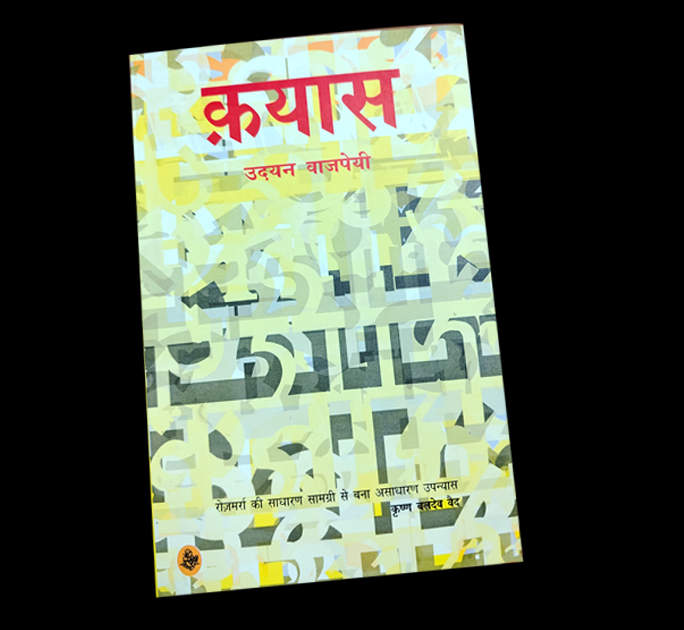
At the event, to my surprise, I found three more known people connected to the book and to Kanwar Mohinder Singh Bedi ‘Sahar’, was this some kind of a sign that nature was sending, I wondered . The translator Ms Kamna Prasad is dear friend from long back. Saif Mahmood, an acknowledged poet and a Constitutional Lawyer, is a close friend and comrade; and, the cover for the book has been designed by yet another bright youngster close to me, Shiraz Husain, whose studio Khawab Tanha, does amazing art.
To close this piece I am reminded of two of my favourite ghazals of Kanwar Mohinder Singh Bedi ‘Sahar’. The first one is poignantly sung by Mohammad Rafi and the second one which was a rage in the 1990s is sung by none other than Jagjit Singh and Chitra Singh ji.
ख़ुदा ही जाने, यार आए ना आए ..
मेरे दिल को क़रार आए ना आए
वो आए भी तो अब शिद्दत-ए-दर्द
ख़ुदा जाने, क़रार आए ना आए
इबादत तो है पीरी में भी मुमकिन
जवानी बार-बार आए ना आए
– गायक: मुहम्मद रफी https://www.youtube.com/watch?v=RGQNFcG9Kog
आए हैं समझाने लोग, हैं कितने दीवाने लोग
वक़्त पे काम नहीं आते हैं, ये जाने-पहचाने लोग
दैर-ओ-हरम में चैन जो मिलता, क्यूँ जाते मयख़ाने लोग
– गायक: जगजीत और चित्र सिंह https://www.youtube.com/watch?v=-lc_T-83tUk
April 2026
Friends interested in reading the same piece in Hindi will find it at the following link:






You must be logged in to post a comment.