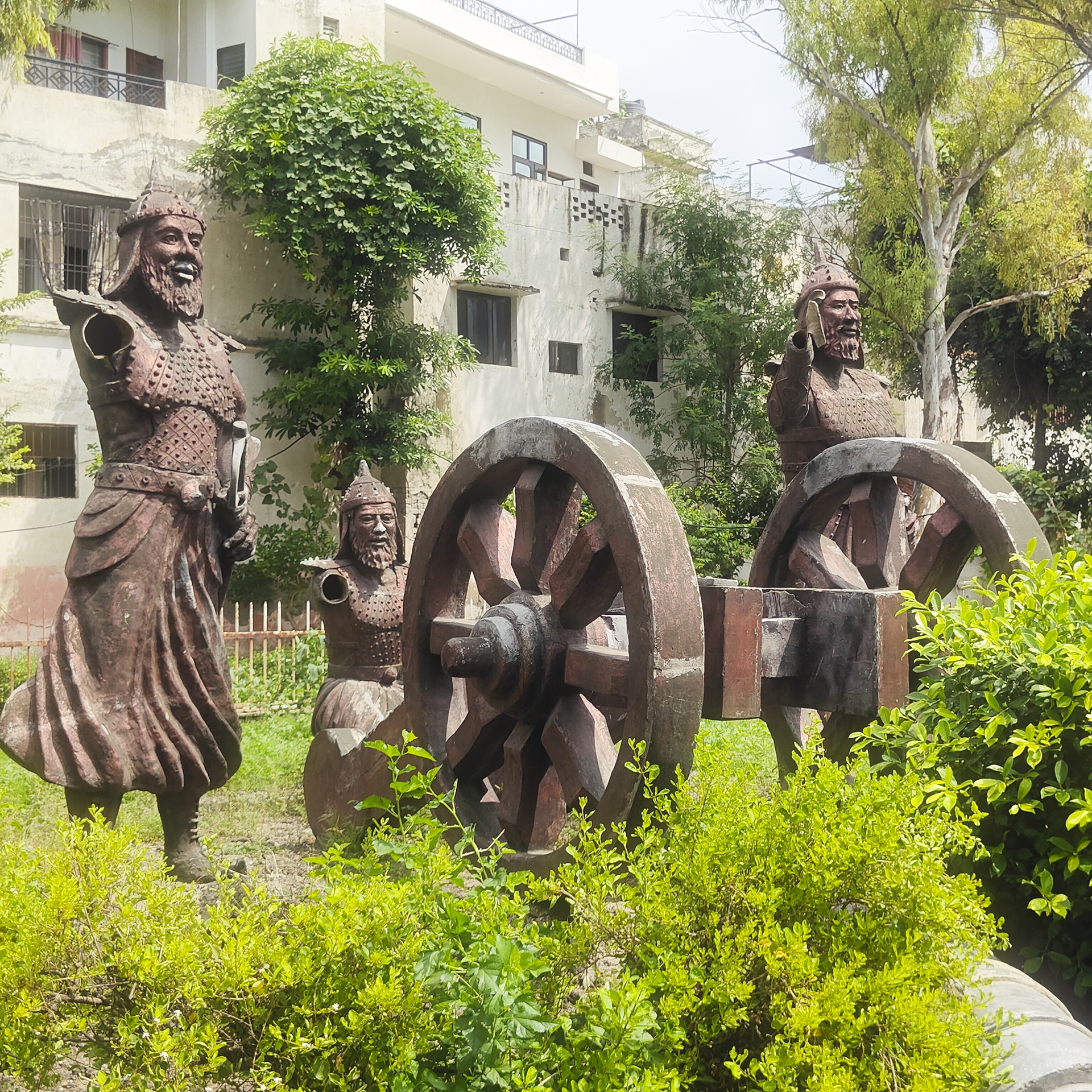
These weathered metal sculptures of medieval warriors and a large artillery carriage, supposedly celebrate Mughal victory over Sultan Lodi in the First Battle of Panipat, 1526.
In tatters, rusted and ill-maintained, today these sculptures are in a pathetic condition. The hands of two warriors are broken, while the turret of the artillery gun lies damaged on the ground; they look morose and tired. Maintained by the Municipal Corporation of Panipat (MCP, is their acronym), the park itself is unclean and in a sad condition. Considering the fact that this is the tomb of Ibrahim Lodi the last Sultan of Delhi, couldn’t it have been maintained better.
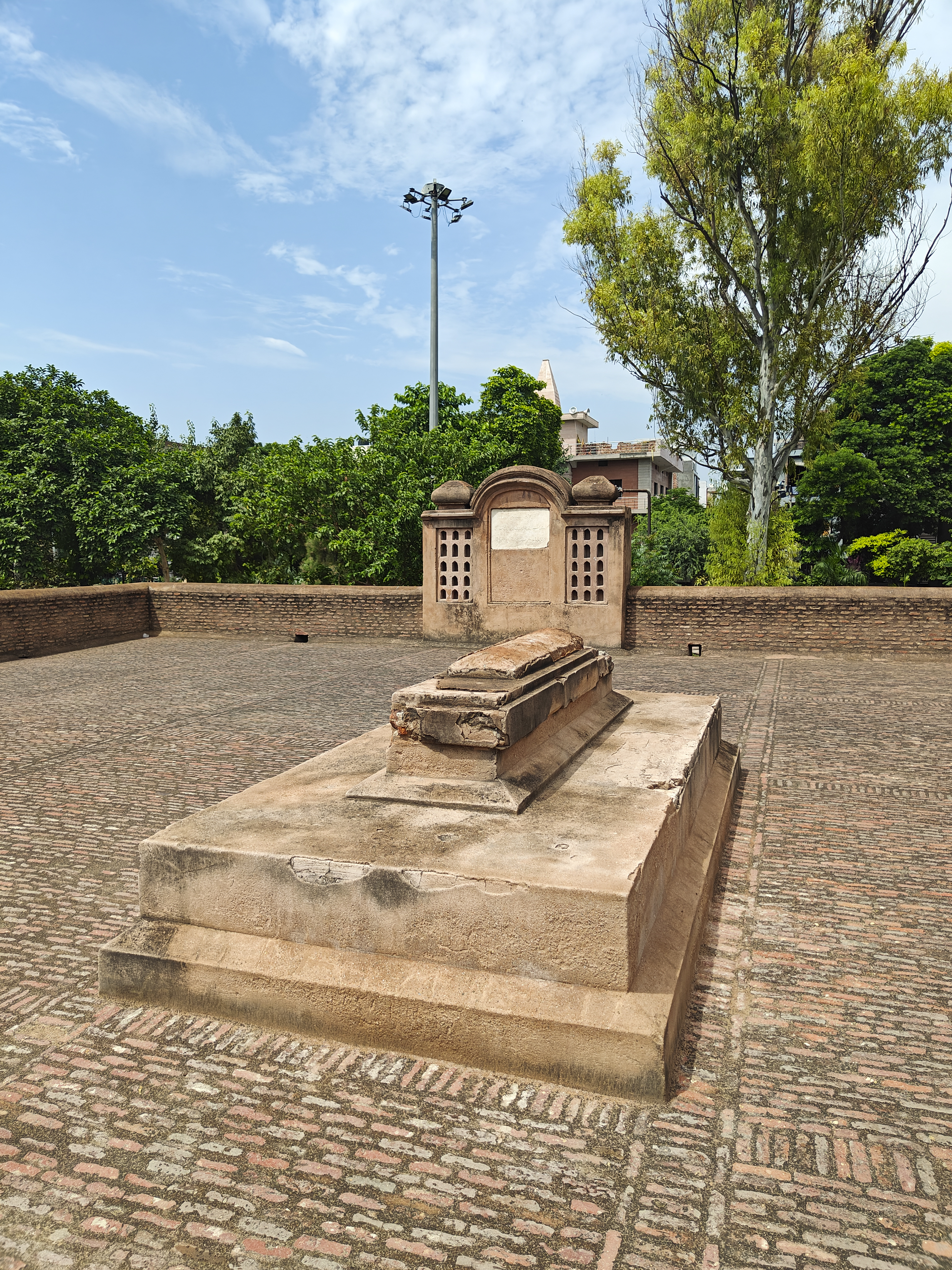
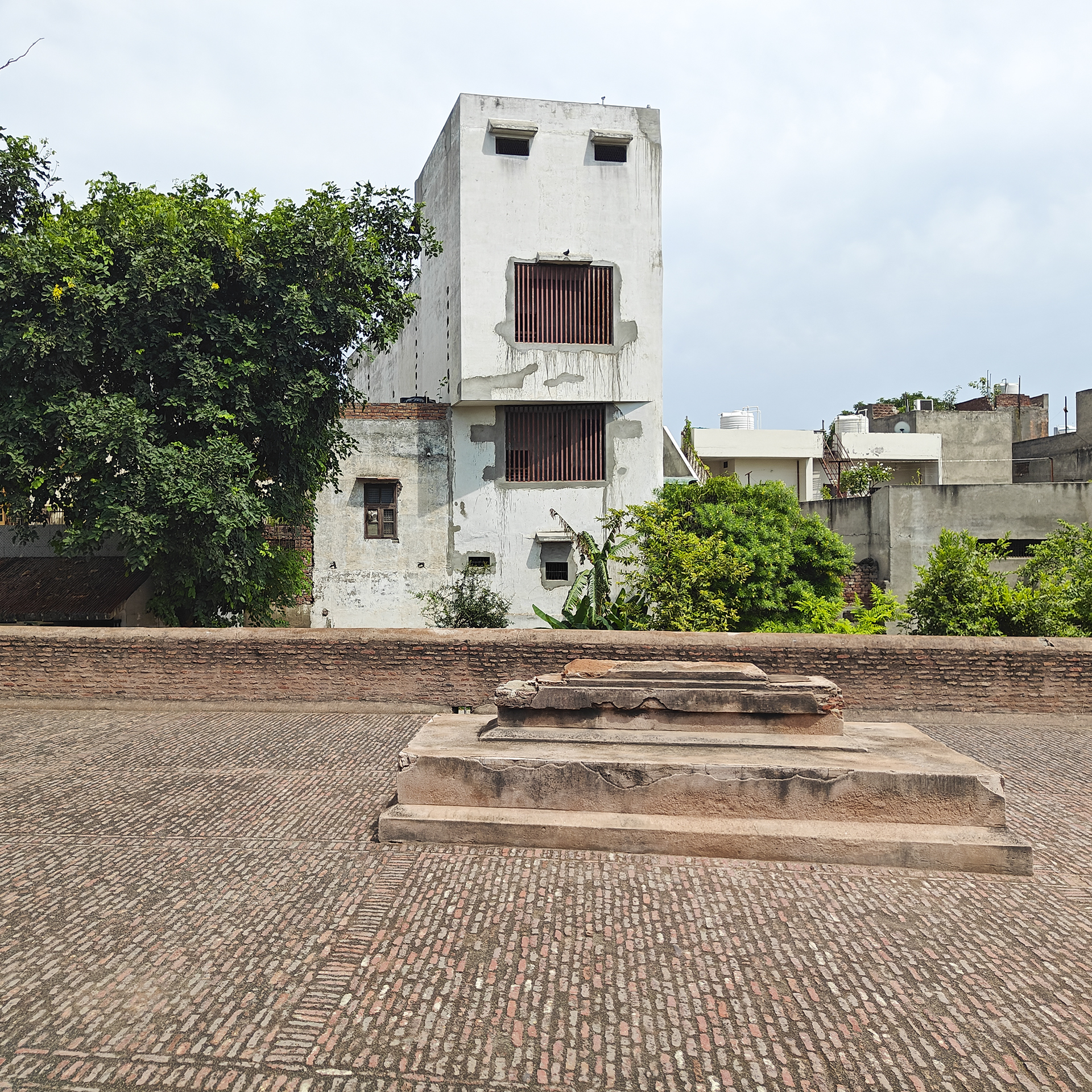
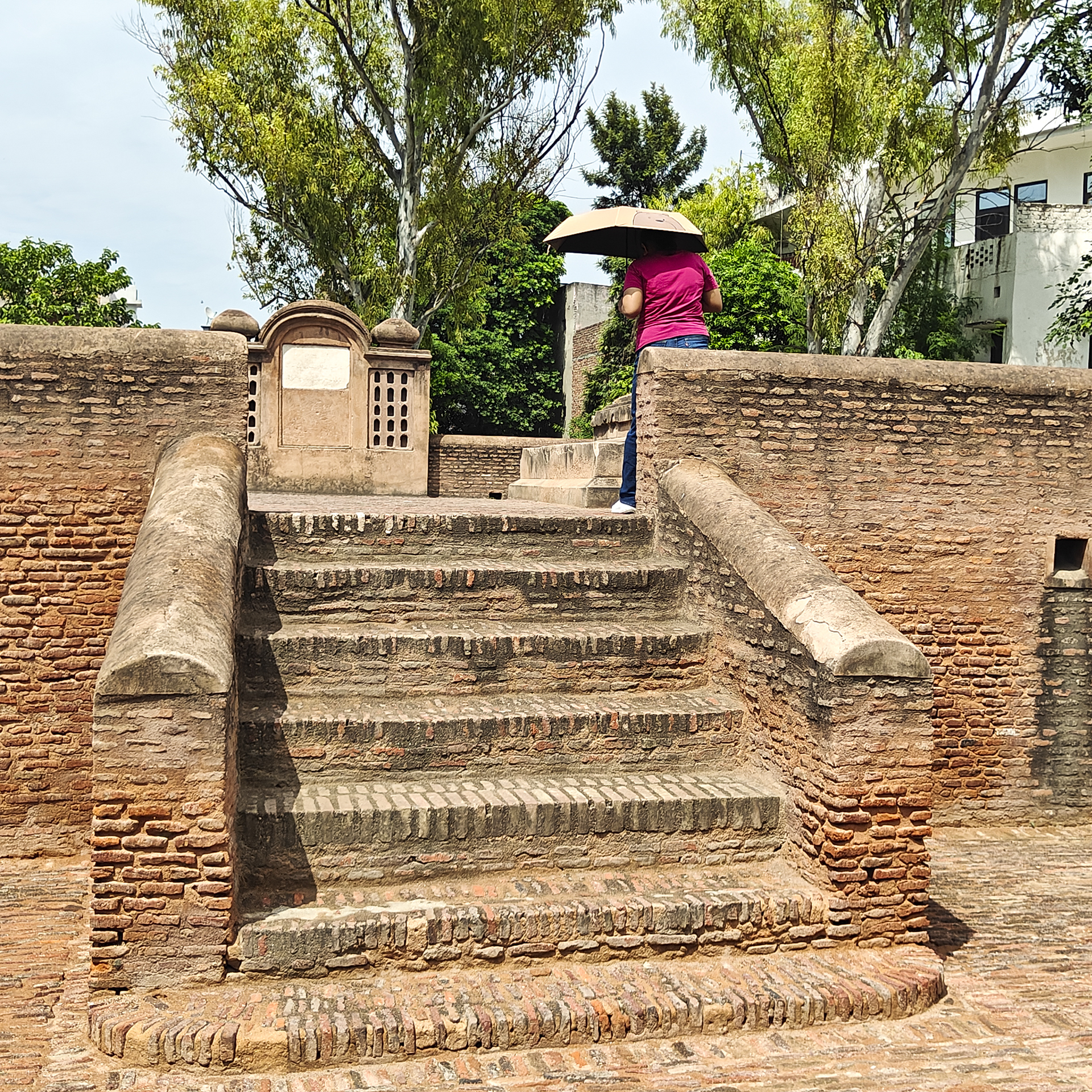
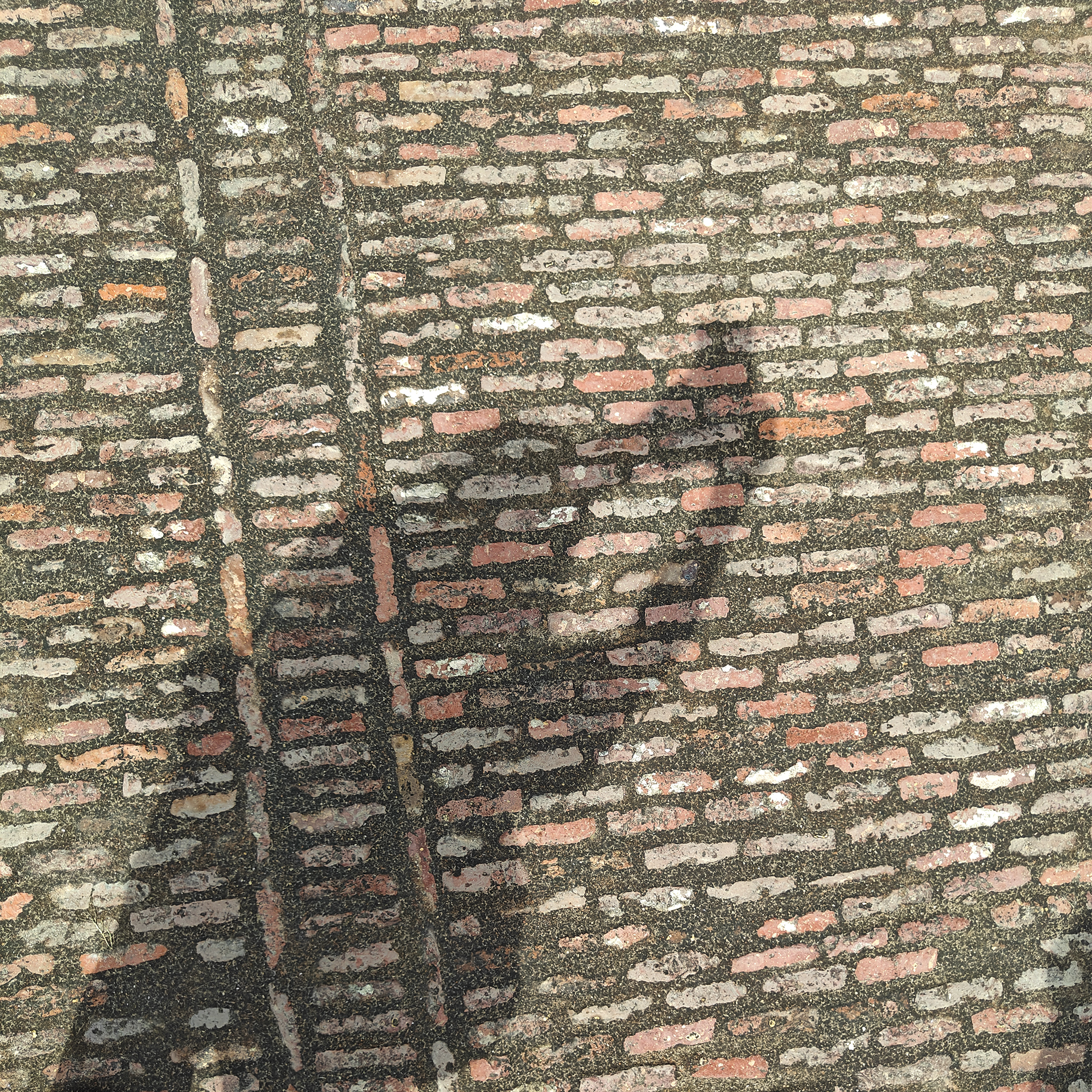
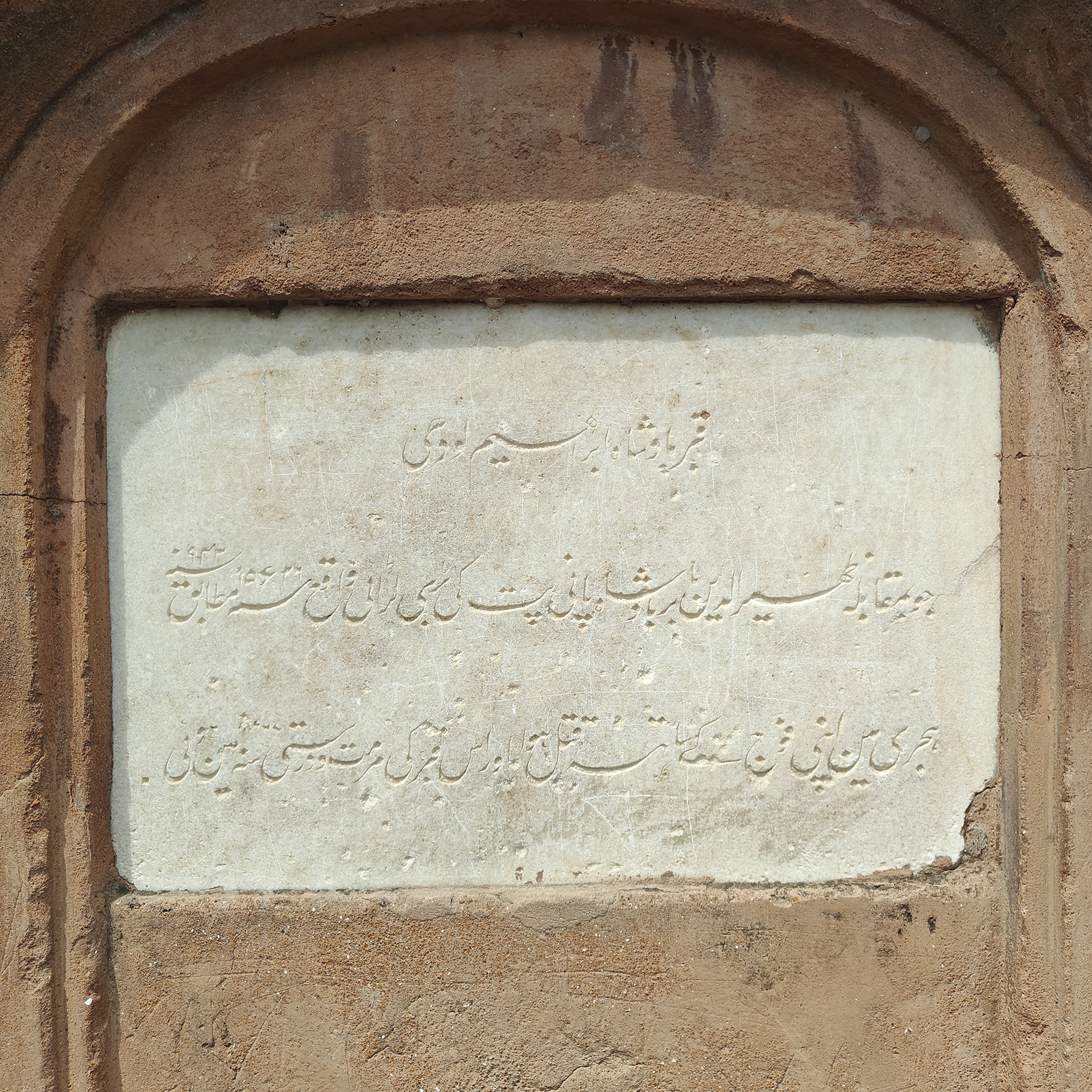
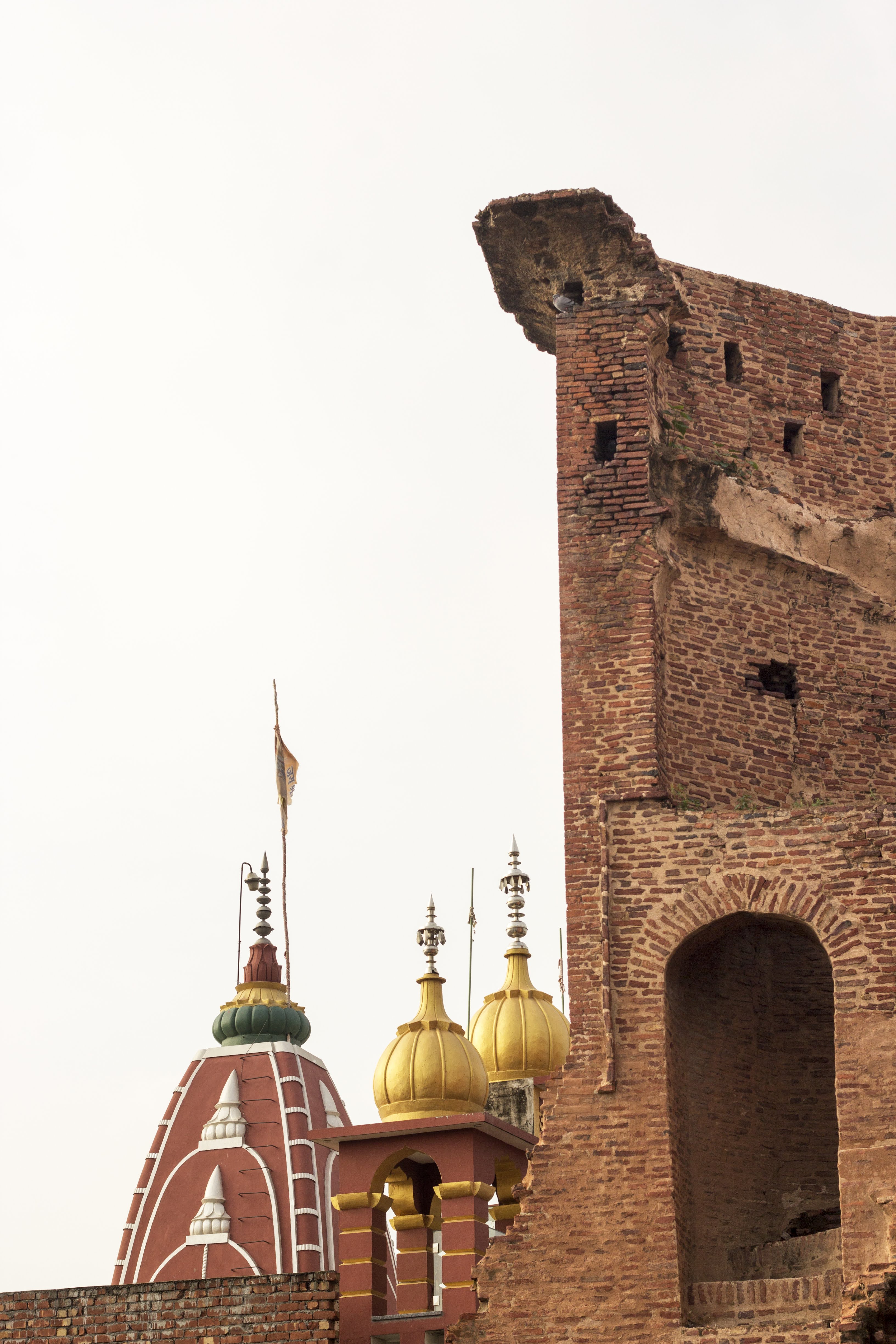
Ibrahim Lodi, the last ruler of his dynasty – a draconian king, rests here in the soil of Panipat. His open to sky tomb is on a double platform at a park in Tehsil Camp. The tomb, marked by a rectangular grave on a raised platform, was built using Lakhauri bricks. An inscription on a niche near the grave declares that it was repaired and restored by the British in 1867 AD.
There must be something special about the plains of Panipat that it saw three major battles – the First Battle of Panipat was fought on April 21, 1526, between last ruler of Delhi Sultanate Ibrahim Khan Lodi and the Mughal Zahir-ud-din Babur. Ibrahim Lodi, the was killed in this battle. Babur used his artillery to emerge as the victor.
The Second Battle of Panipat was fought on November 5, 1556, between Akbar (under Bairam Khan) and Hemu Vikramditya, the last Hindu emperor of Delhi during which an arrow struck Hemchander in the eye causing his army to retreat, following which Akbar won the battle.
The Third Battle of Panipat was fought on January 14, 1761, between the Marathas led by Sadashivrao Bhau and Ahmad Shah Abdali. The Marathas suffered a devastating defeat in this battle.
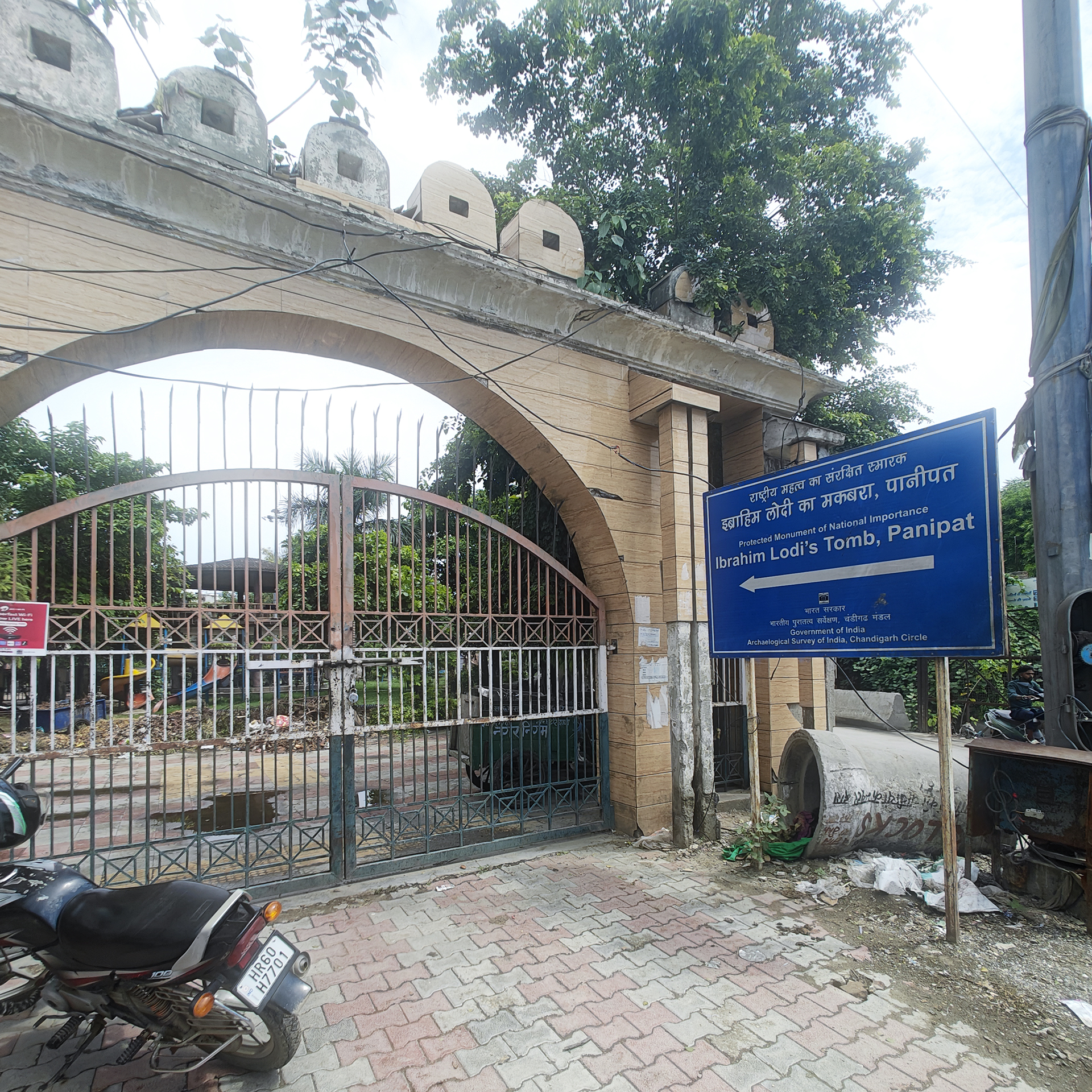
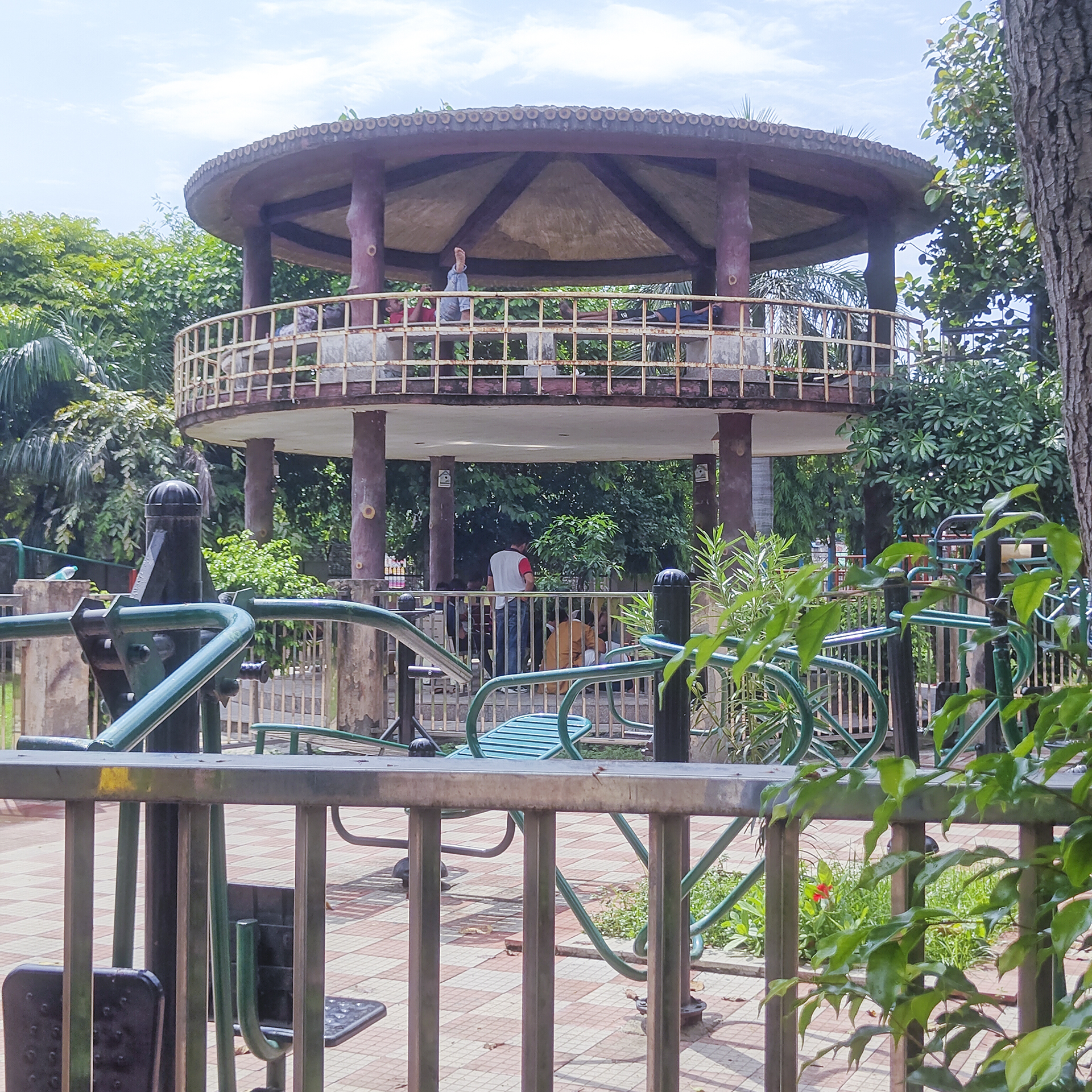
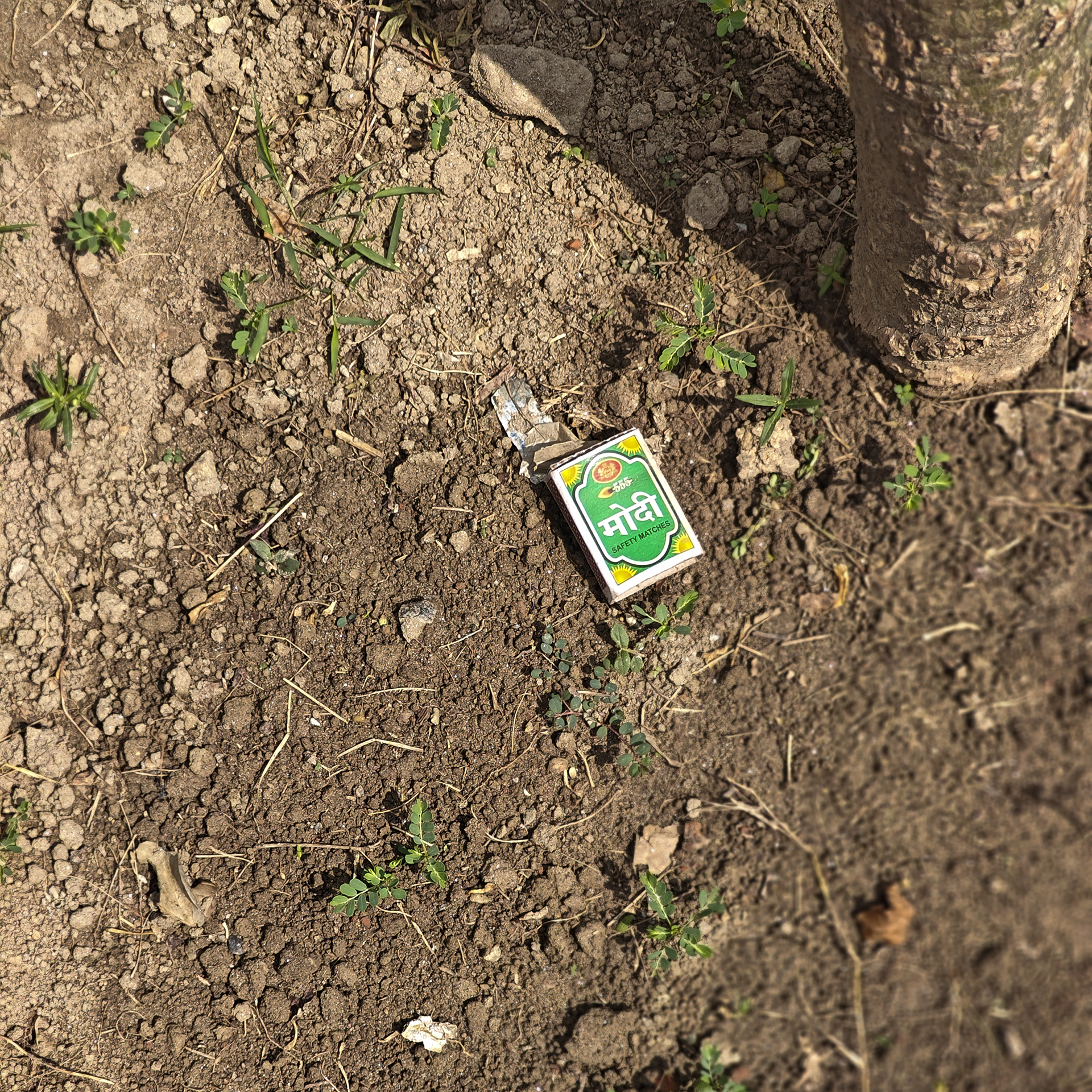
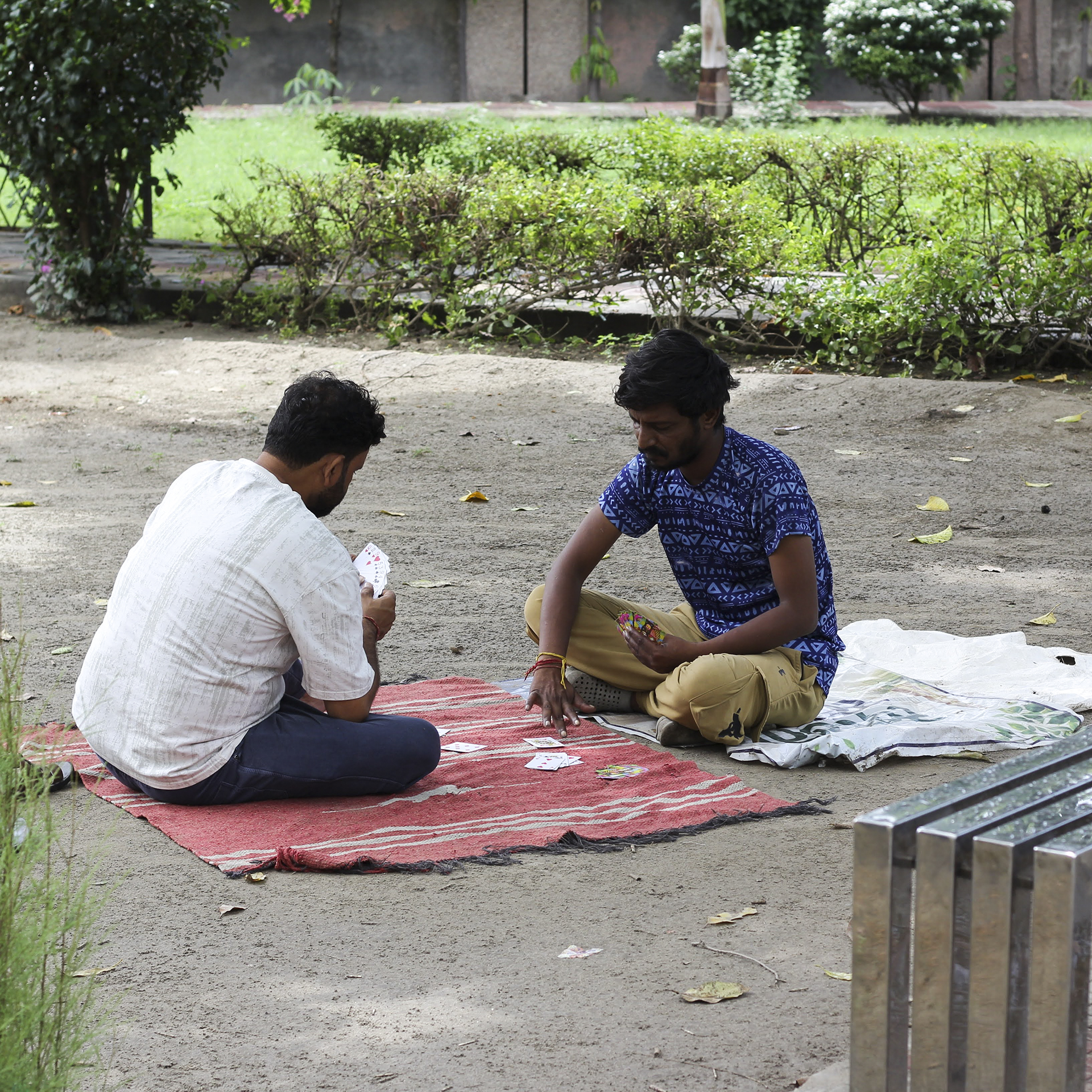
Though the sign outside the park says it is Protected Monument of National Importance, the fact remains that there was not one attendant in or around the Tomb. The main gate was locked and parked inside the gate was a garbage collecting cart beyond which was a big waste dump of leaves and other junk material. I wondered what is the purpose of the double level circular platform from which one couldn’t see more than 200 meters ahead. Groups of people were seen smoking and playing cards inside. Someone had left washed clothes to dry on the grass; food and leftovers were scattered in another corner while the entire grass patch was littered with cigarette butts, bidi stubs and empty matchboxes. A matchbox named after a leader lay there in dirt under an Ashoka plant.
From a distance it looked like any other children’s playground with plastic-ki slides and swings though partially broken and dirty. As usual it was ill-maintained, unkempt, with garbage and waste dumped around. But for the blue ASI sign you would miss the tomb easily. The main gate to the so called ‘monument’ is permanently locked which faces an open sewage drain that spreads the stink for meters ahead. In the narrow side lane cars and scooters are parked of the residential habitat touching it. The side gate to the tomb/park is designed for hurdle race practice that can only be cleared by athletic bodies – possibly keeping in mind the Lodis or the Mughals.
Sculptures of medieval warriors at Ibrahim Lodi’s tomb, PanipatIbrahim Lodi’s tomb and inscriptionThe grave and the residences facing itoplus_1048608The double platform tomb and its approachLakhauri brick floorThe inscription plaquethe circular resting areathe matchbox under Asoka plant/tree
Gharaunda sounds like a dainty toyhouse or a dollhouse-like nest, offering the safety of a mother’s hug. I wonder who named this small town in Karnal district as Gharaunda—a town desperately trying to unhinge itself from its past and join the mainstream madness of our stunted cities. Located on NH44, the town is choking not only with dense habitation and heavy traffic but also with the petroleum fumes that permeate its air.
Nearly 400 years ago, the Tughlaqs, the Lodis, and then the Mughals cleared part of the dense jungle to create a road connecting Bengal to Afghanistan and from there to Uzbekistan, Iran and beyond. Along the road they built Kos Minars, piaos, and Sarais. While some of the Kos Minars still survive, most of the sarais have scummbed to time or illegal occupation.
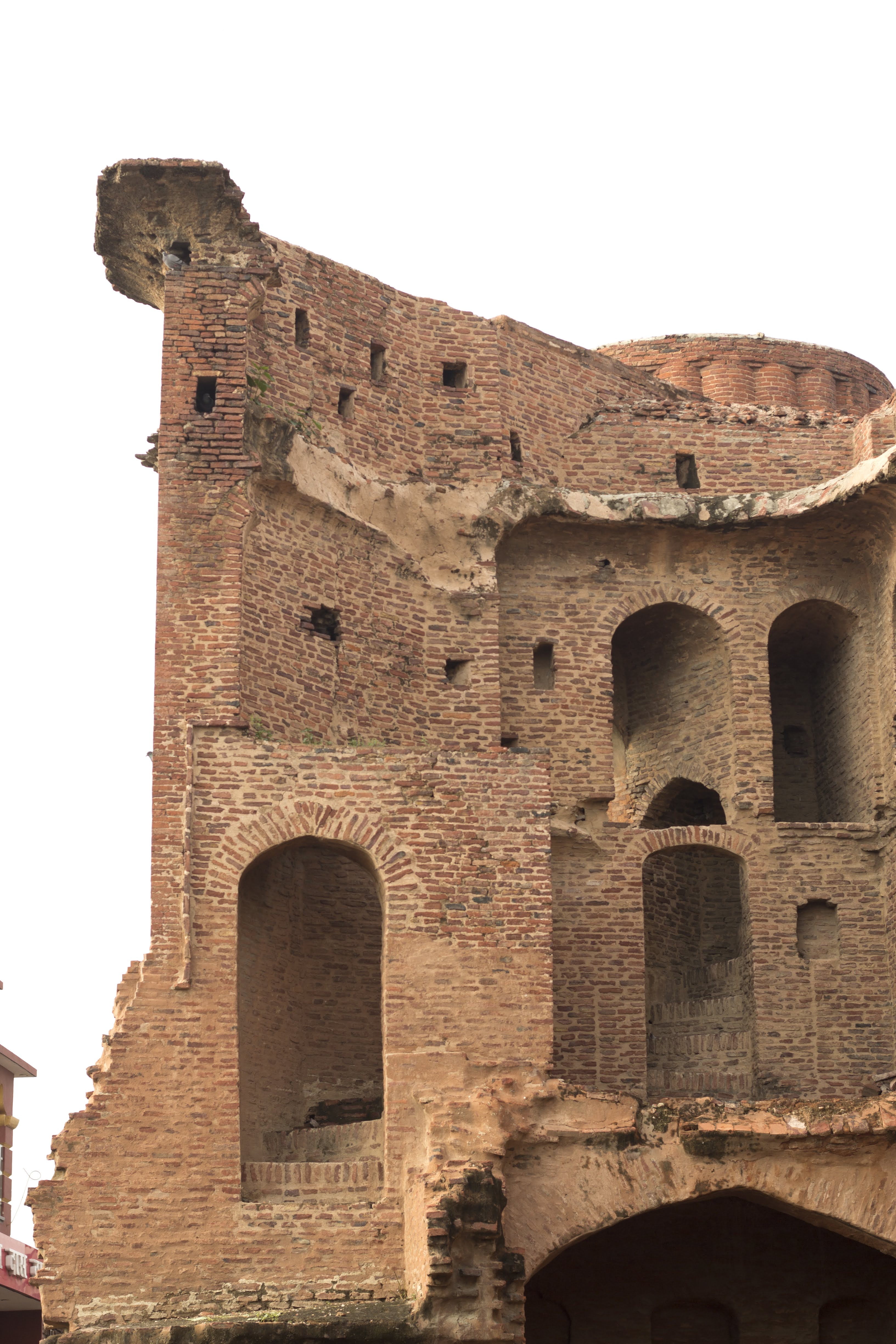
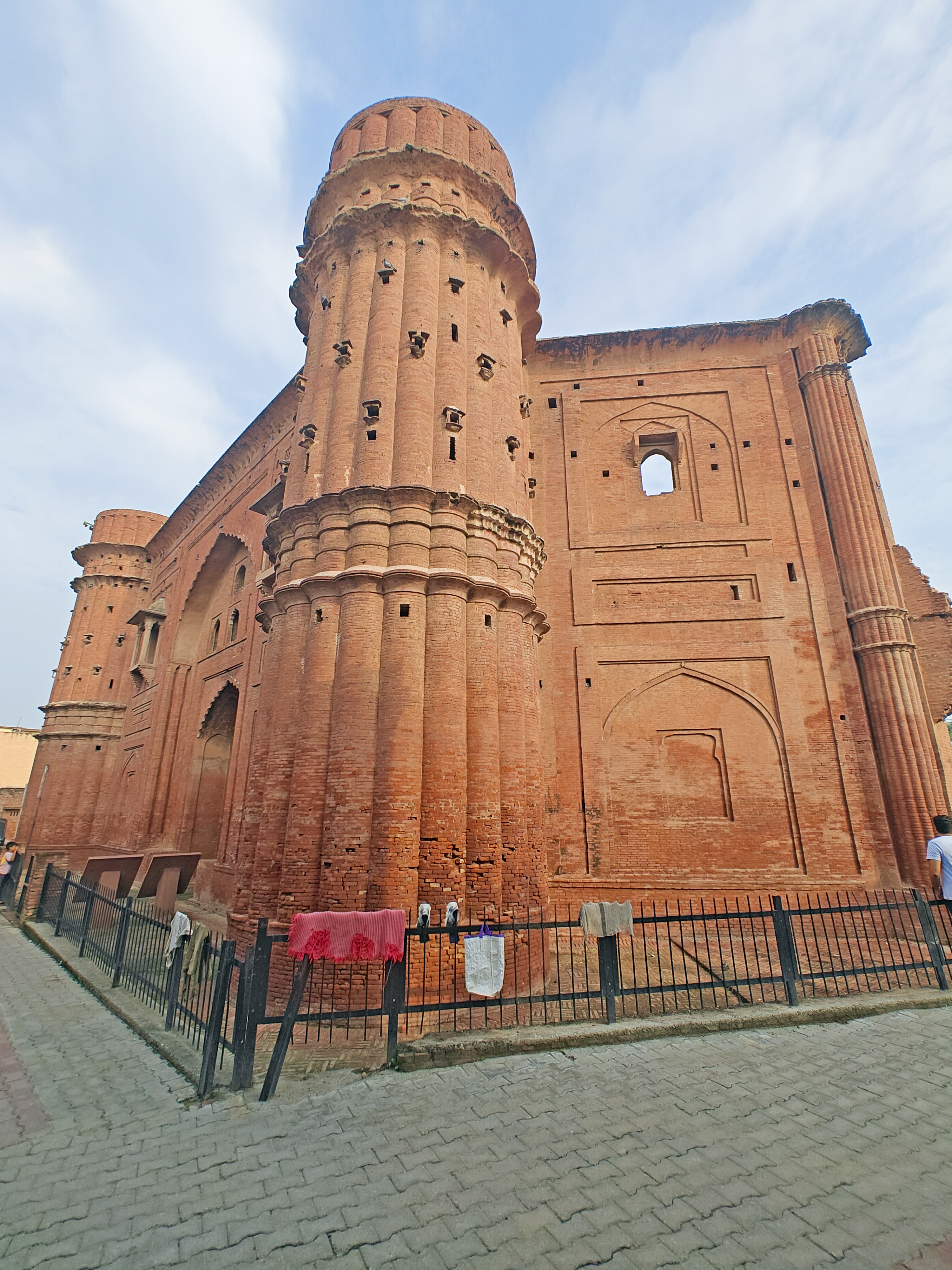
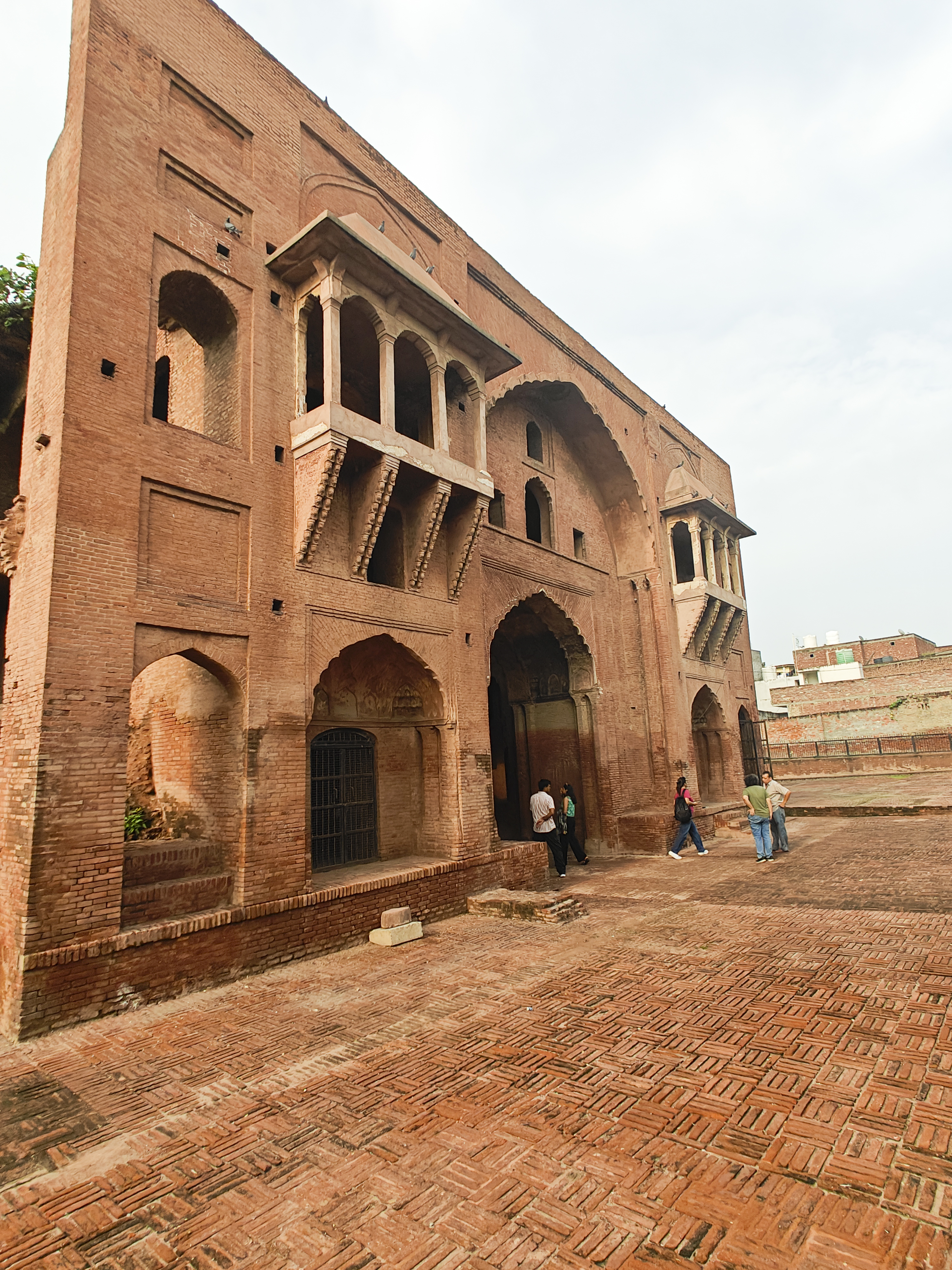
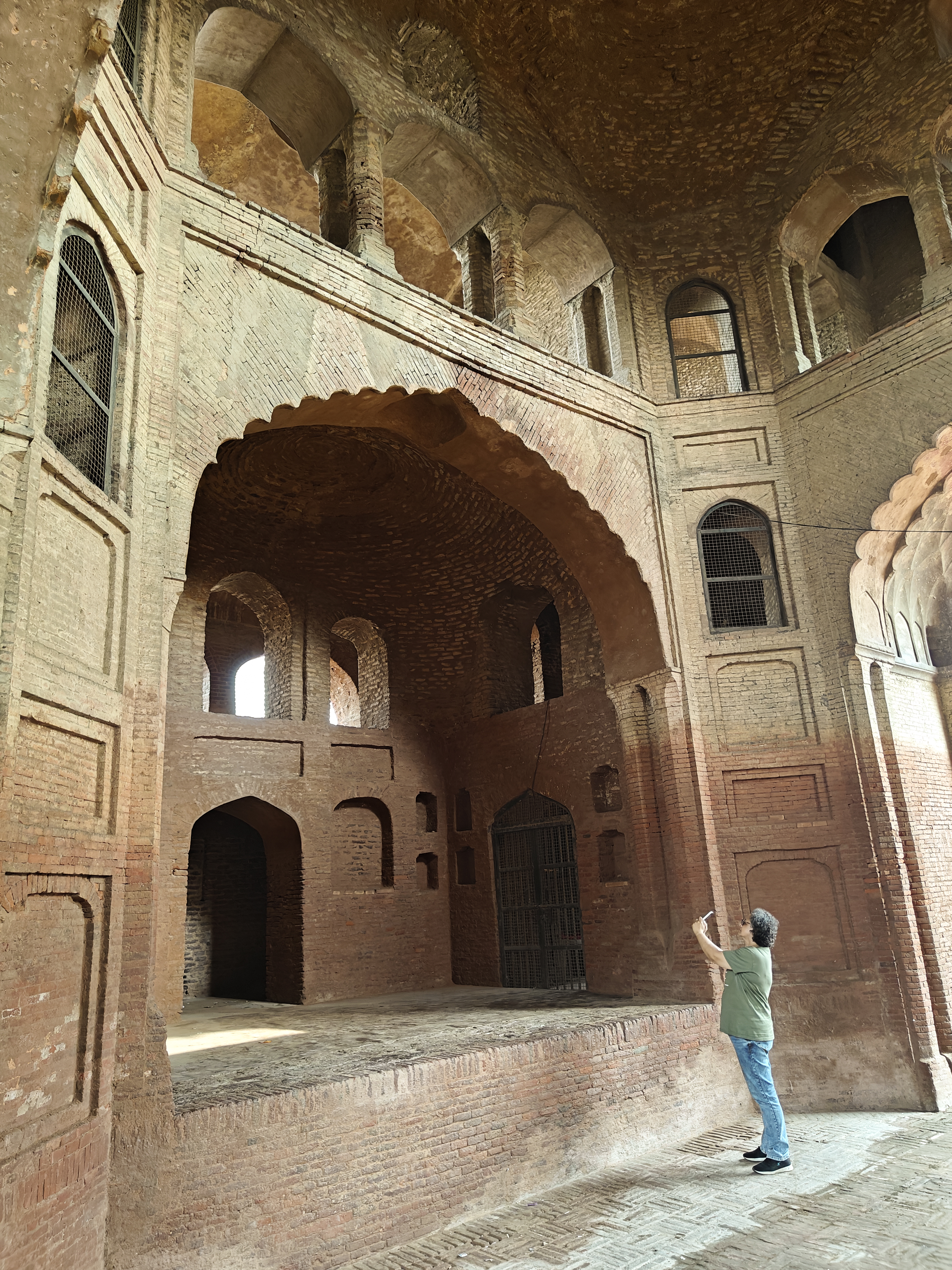
One dazzling Sarai defied all and has stood tall through the centuries – in fact it looks as fresh as the day its three stories were constructed. It is one of the finest examples of decorative brick structures that have survived the test of time and the onsualght of expanding urban areas.
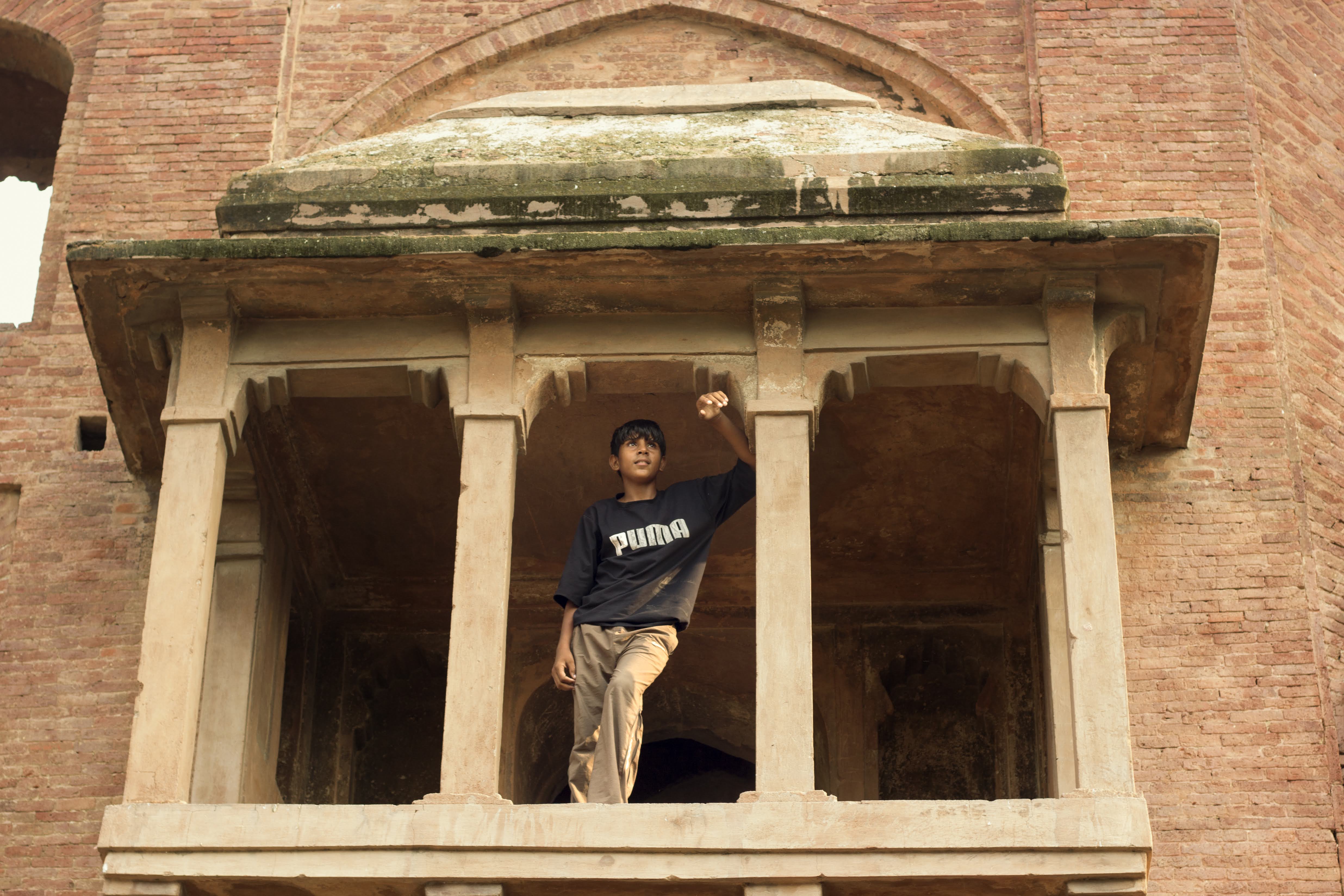
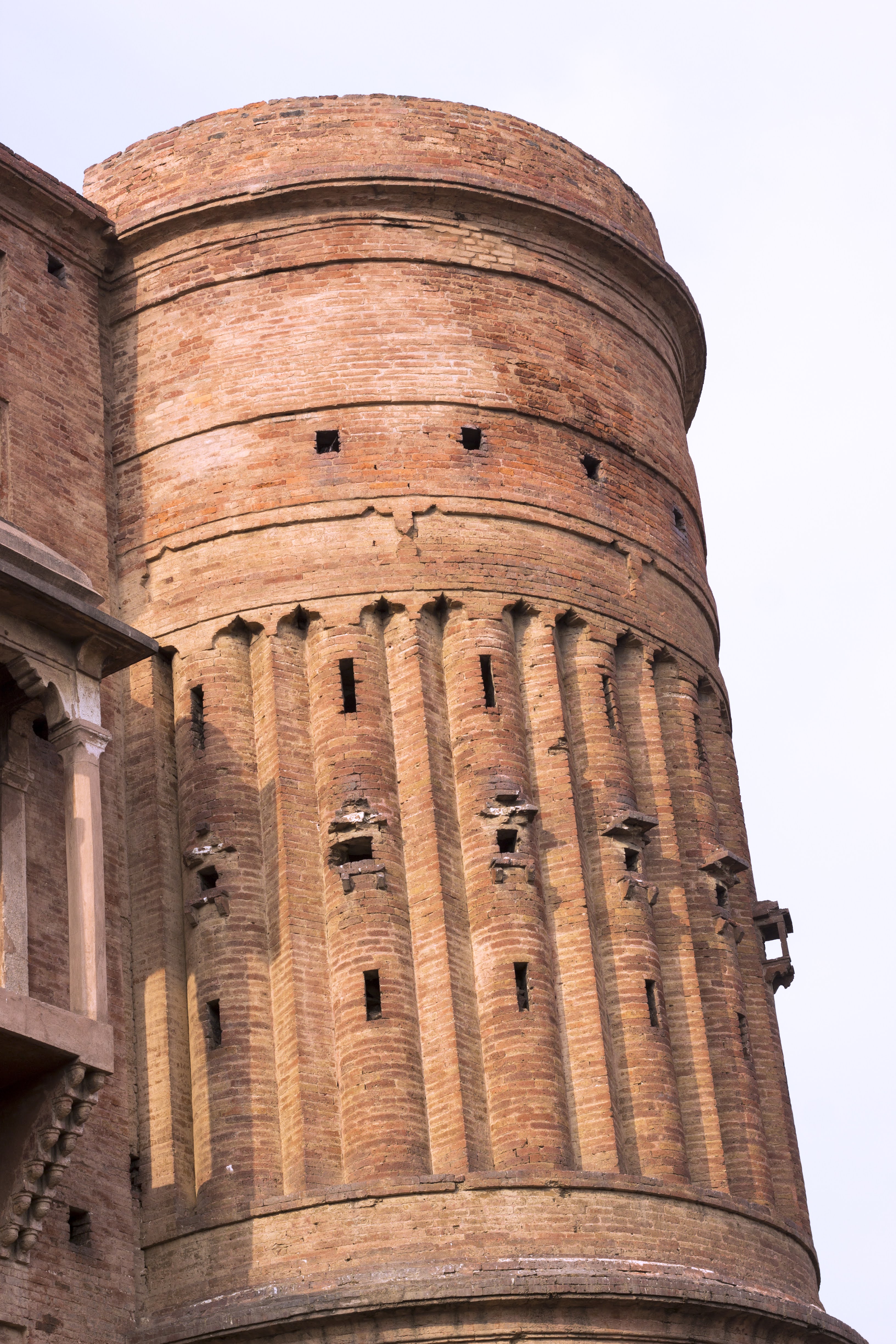
The ‘Mughal Sarai,’ as it is called, is a protected monument under the Archaeological Survey of India, though it is ill-maintained. A narrow lane leads to the vibrantly amazing structure; however, the front facade of which can’t be seen or photographed in totality because there is very little depth available. Crane your neck hard to see the tall circular turrets on each end of the gateway. The western portion of the Southern gateway, part of which has fallen apart, appears to be an Ebrahim Alkazi theatre set where a Mughal dastan is set to be played.
Built in 1637 AD by Feroz Khan during the reign of Mughal Emperor Shah Jahan, this quadrangular Sarai (rest house) naturally came to be named after the Mughals. The historic site of Gharaunda, where the Sarai stands, also served as a campsite for Babur prior to the First Battle of Panipat.
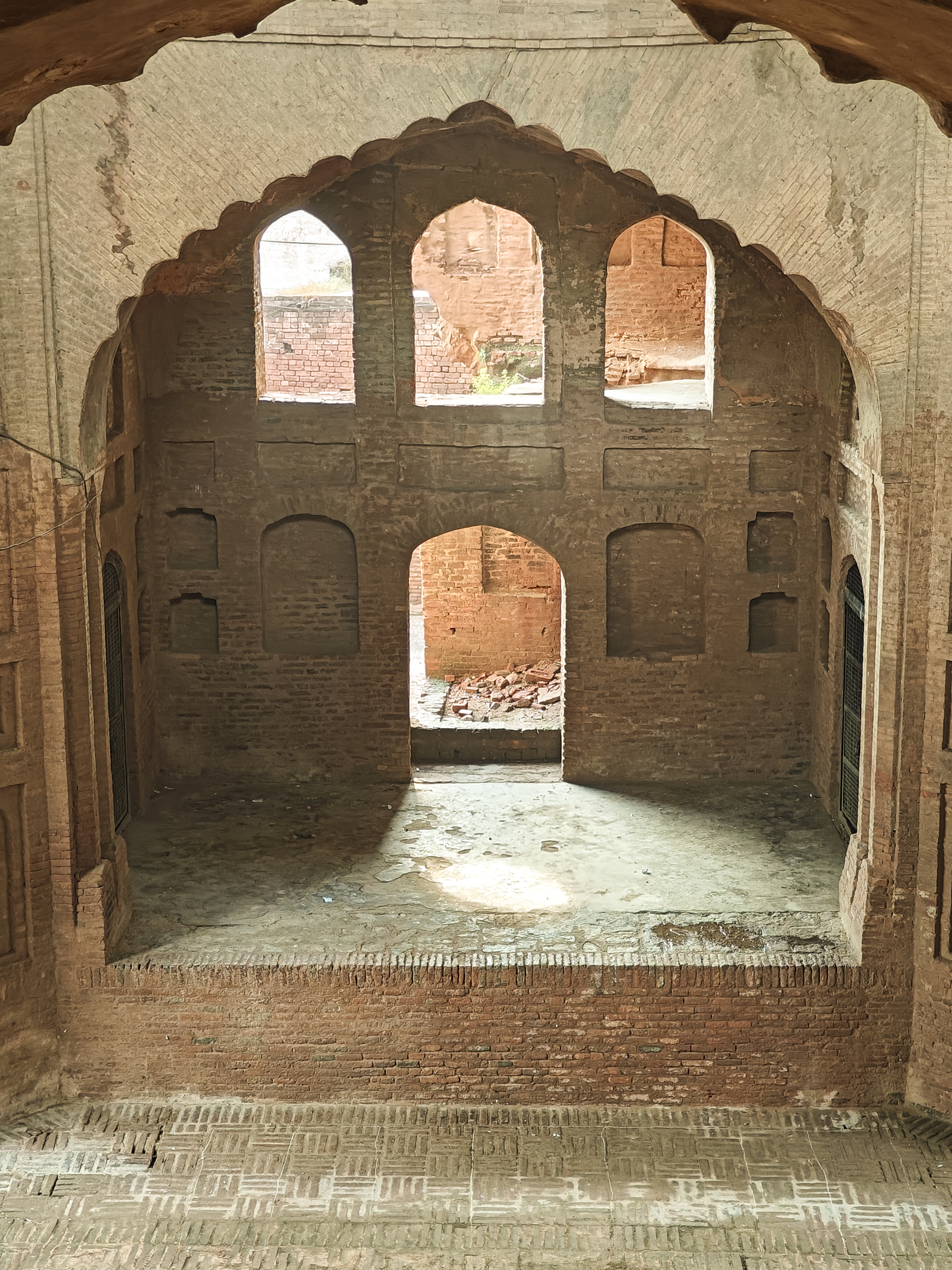
Today, two of these three-story gateways still stand within the area, positioned roughly 100 metres apart along the remains of the Northern and Southern walls. Constructed from traditional Lakhauri bricks, these structures feature an enclosed design with cells lining all four sides of the quadrangle. The surviving gateways are highly ornate, decorated with intricate panels, balconies, rounded towers, and angular flutes.
A must visit site if you are passing by Karnal or surrounding areas.
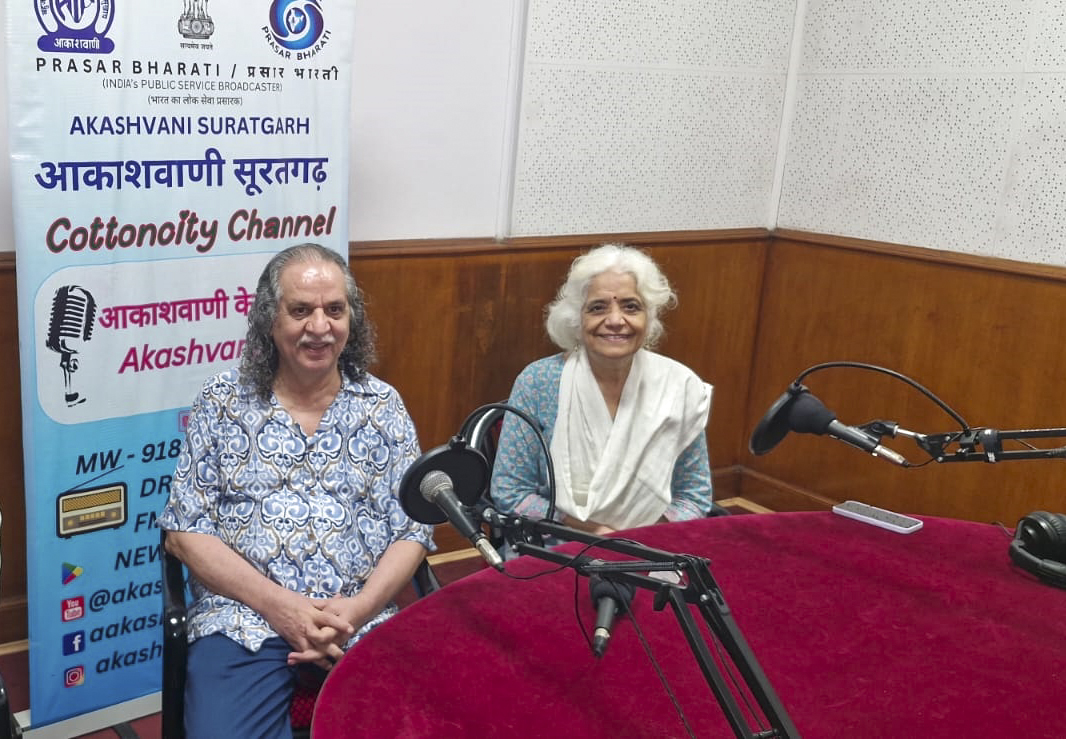
“All India Radio Suratgarh welcomes you to the Cotton City Channel on 918 kilohertz. You can listen to our programmes on Medium Wave and AM frequencies.”
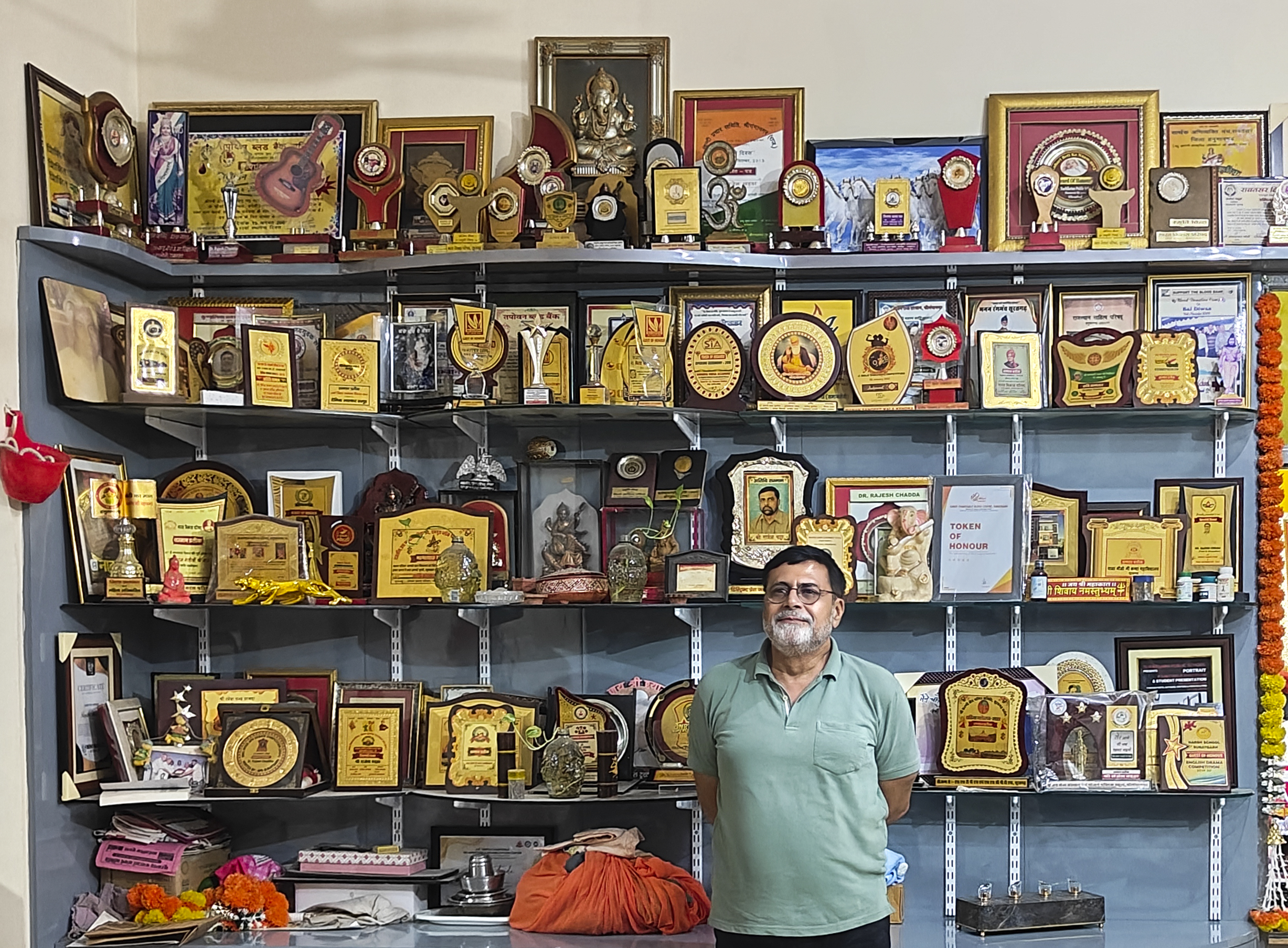
It had been ages since I entered an AIR studio. The last time, I recorded a Radio Play and this time, I recorded Memories, trust me it was fun. The visit was courtesy of brother Raajesh Chadha who served as the Programme Director here for nearly 36 years. During his illustrious career Raajesh’s baritone was much in demand as evidenced by over 500 trophies displayed at his home (picture).
What I thought was a small station, with just about three studios, turned out to be broadcasting on a massive 300 kW transmitter which reaches far beyond India’s borders (AIR Delhi uses only 200 kW). It is one of the most clearly heard Indian radio stations in Central Europe during the winter months. The station relays news, film songs, phone-in programs, world round-up, and Rajasthani folk belted out under the tag line “One voice. A billion hearts.” Programmes for local farmers include weather updates, crop prices, and expert advice on modern farming techniques.
Known as “Cotton City” and “Bowl of grain” of Rajasthan, Suratgarh is 77 km south of its district headquarters Sri Ganganagar city. Maharaja Surat Singh founded the city. Hindi, Bagri, Rajasthani and Punjabi are the widely spoken languages of the city. Well connected with decent highways and a railway station Suratgarh still awaits air connectivity. Other than the desert heat and the sandy dust I am certain the city would be a pleasant place in winters. Thanks bhai for our picture in the studio. <Suratgarh sojourn>
Suratgarh was a significant arena of historical incidents in the ancient past. The city was once called Sodal. Around 3000 BC Suratgarh is believed to have been a lush, green place due to the presence of two big rivers, Sarasvati and Drishadvati. Present sand possessed various botanical and zoological species within the basins of chaste Sarasvati and Drishvati. The emergence of Kalibangan and Barod civilizations was facilitated by the geographical and environmental complements of the Sarasvati, and Suratgarh was a noteworthy testimony to this. The traces of ancient civilization near Rangmahal, Manaksaar and Amarpura show the historical significance of Suratgarh where the Sarasvati civilization receded after 1500 years of stability.
Suratgarh developed greatly under the rule of Maharaja Ganga Singh who built a hunting lodge at Suratgarh and ensured the connectivity of Suratgarh to the train service. Hanumangarh and Bikaner came under the Suratgarh District when the district was established. Establishment of the Ganges Canal in 1927 helped Suratgarh develop; it became a city after partition when refugees from Pakistan came and settled here. An air and military base station, Akashvani and various offices have been established at Suratgarh.
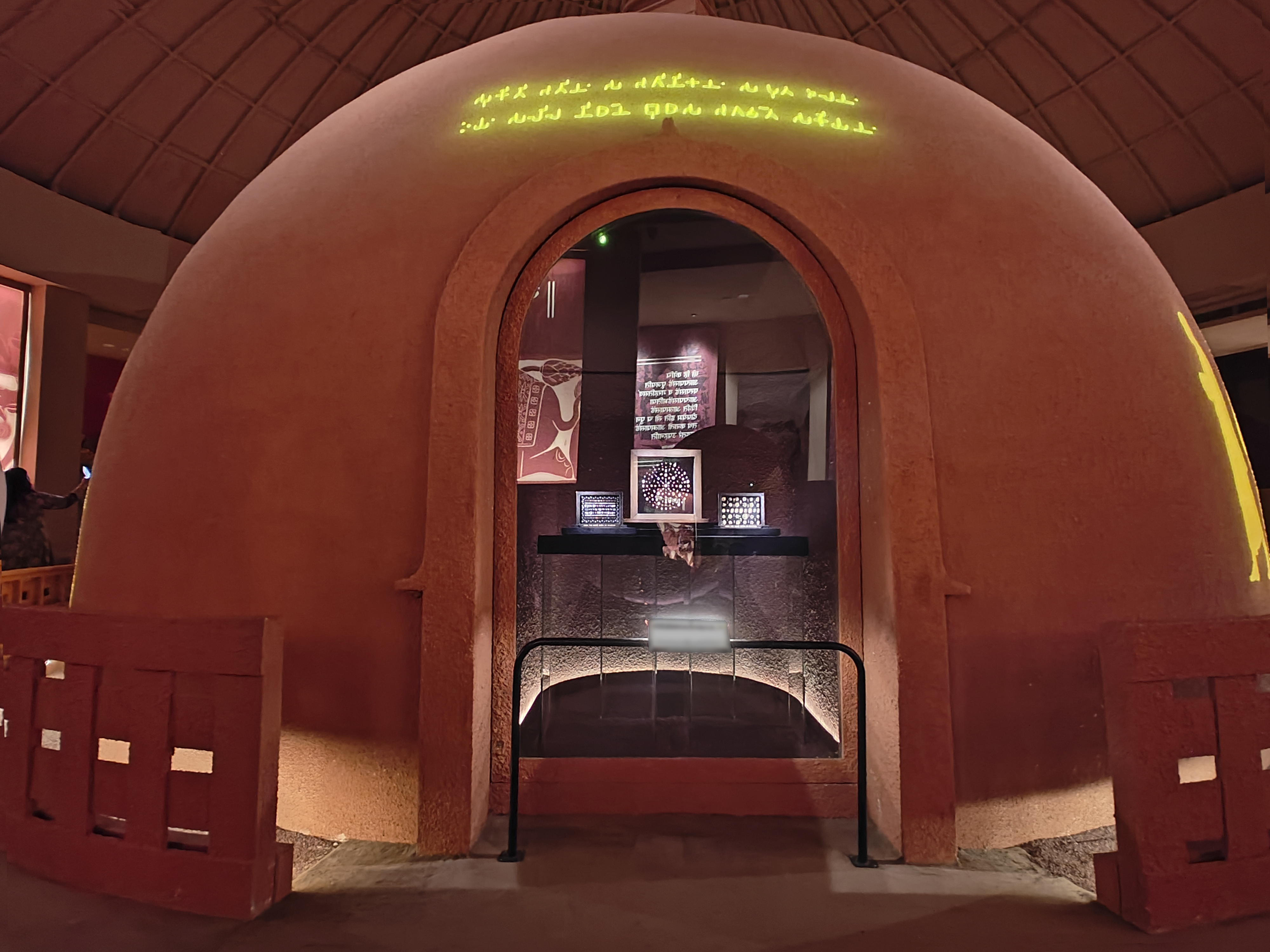
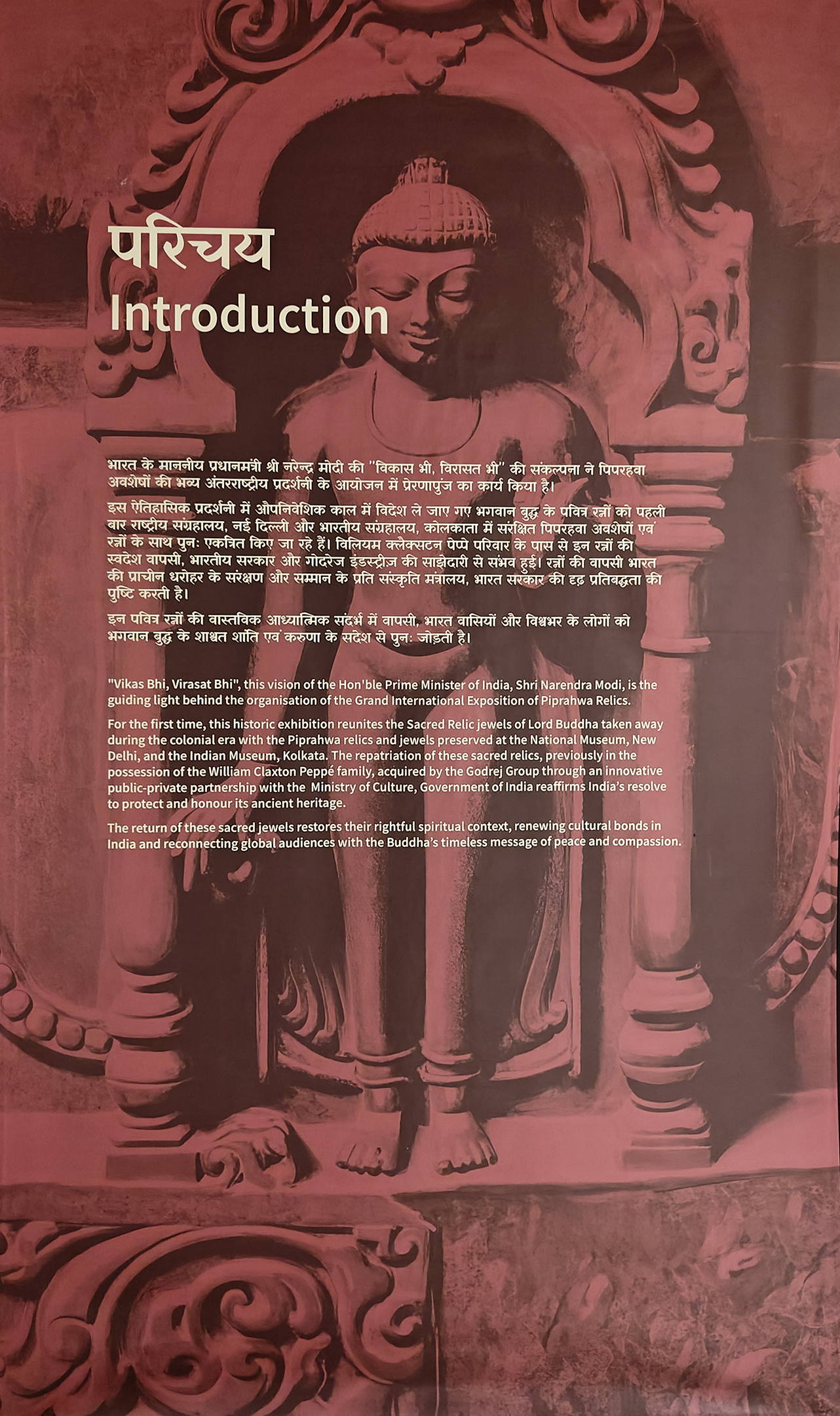
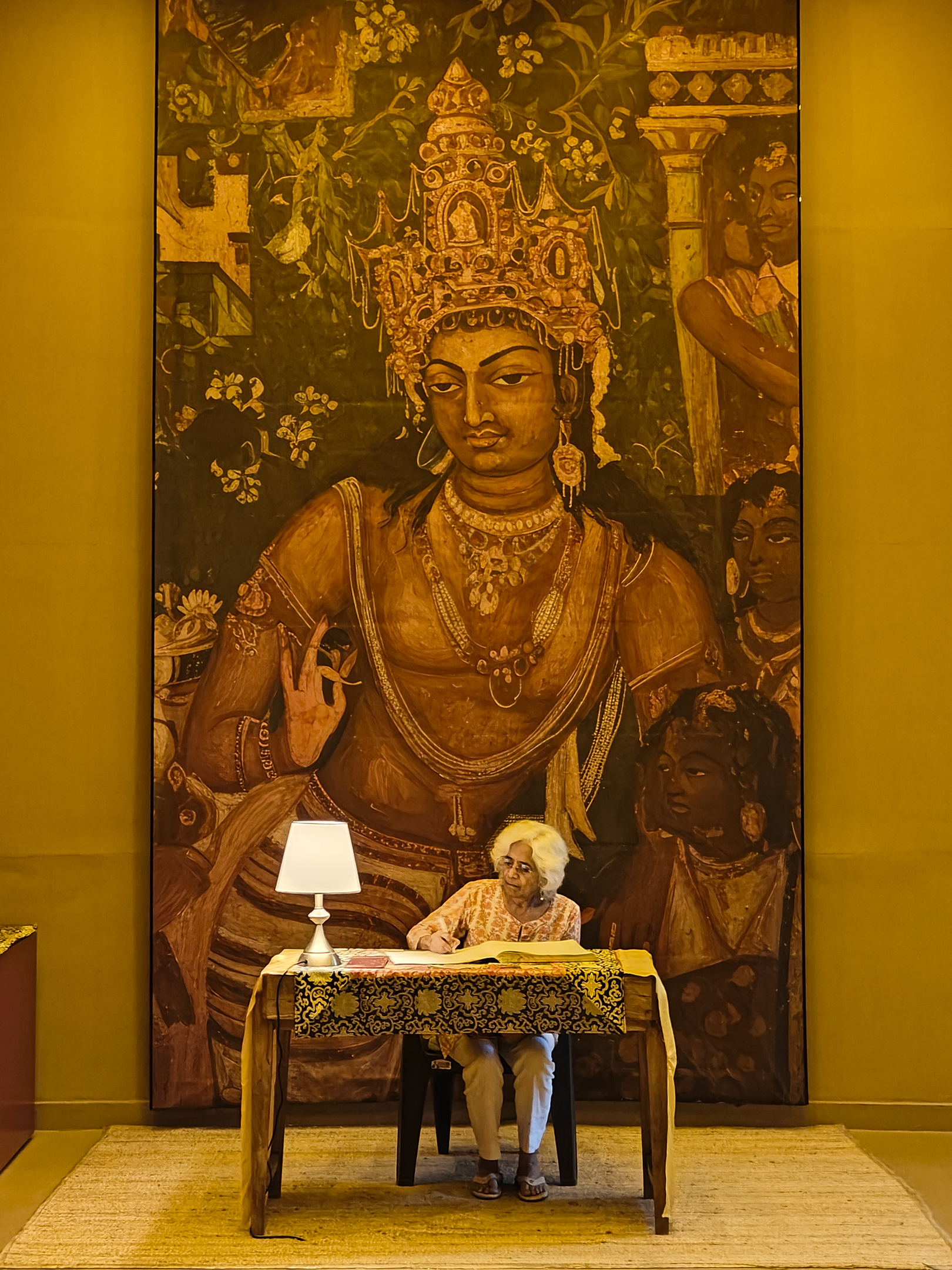
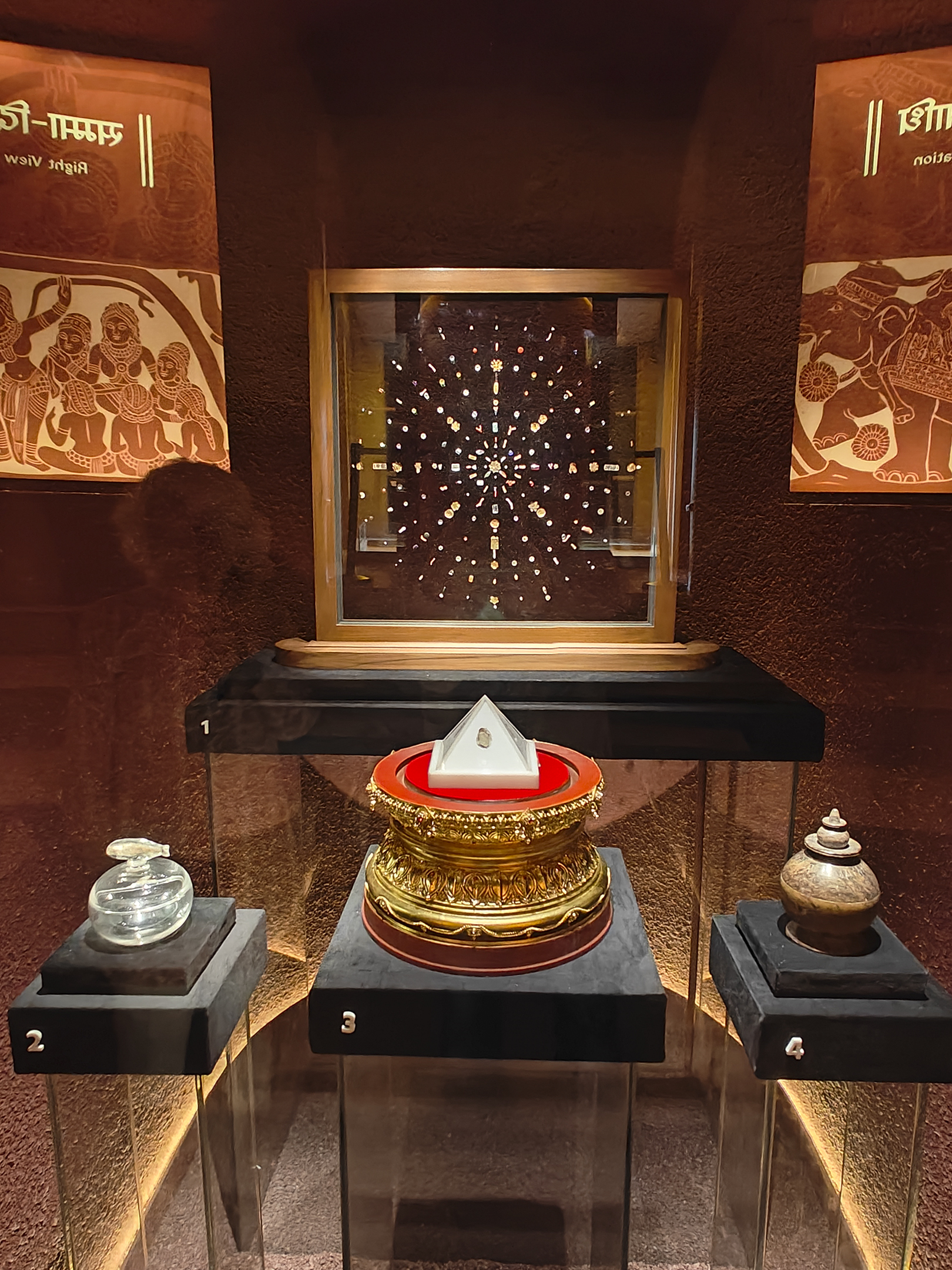
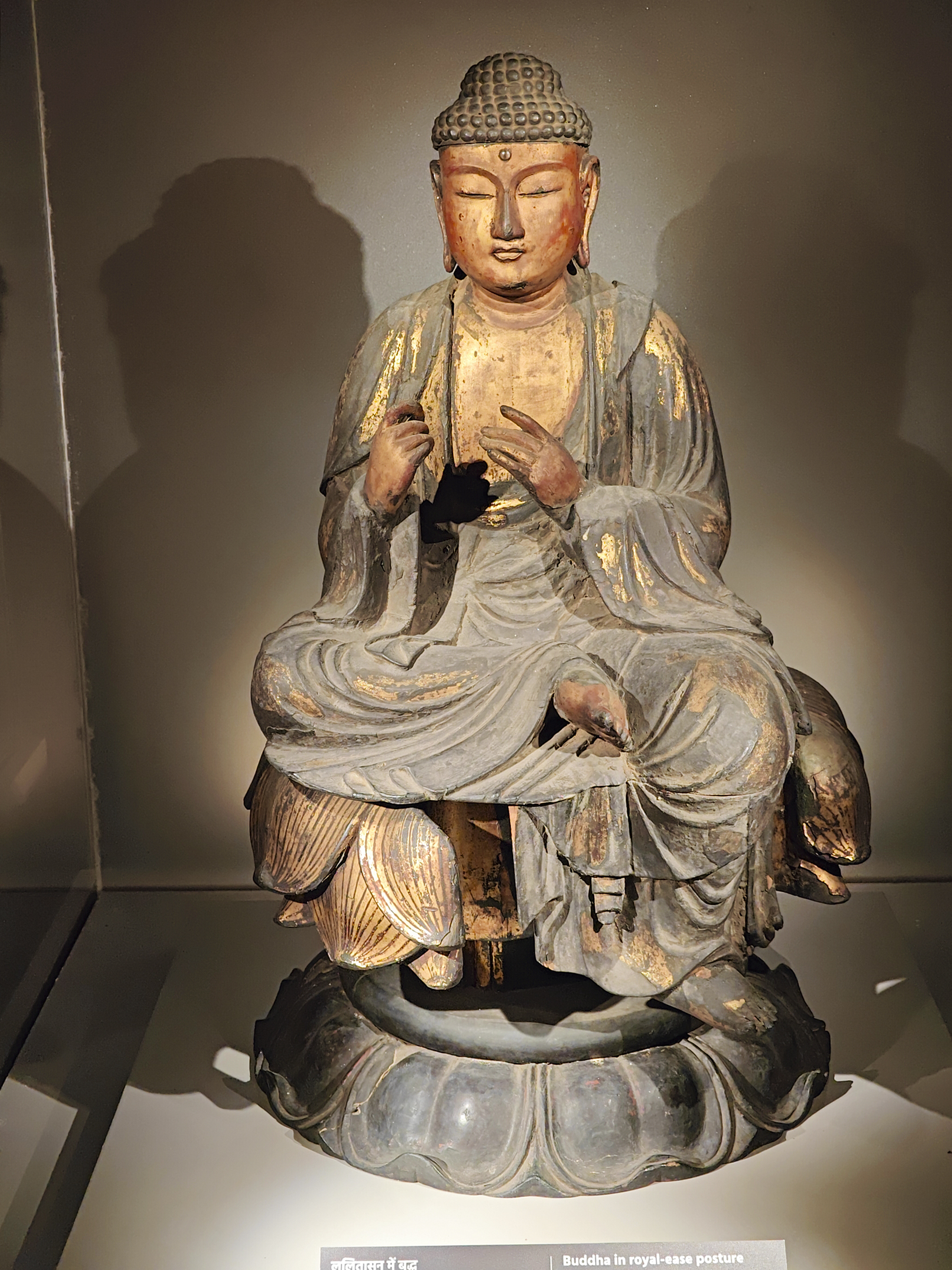
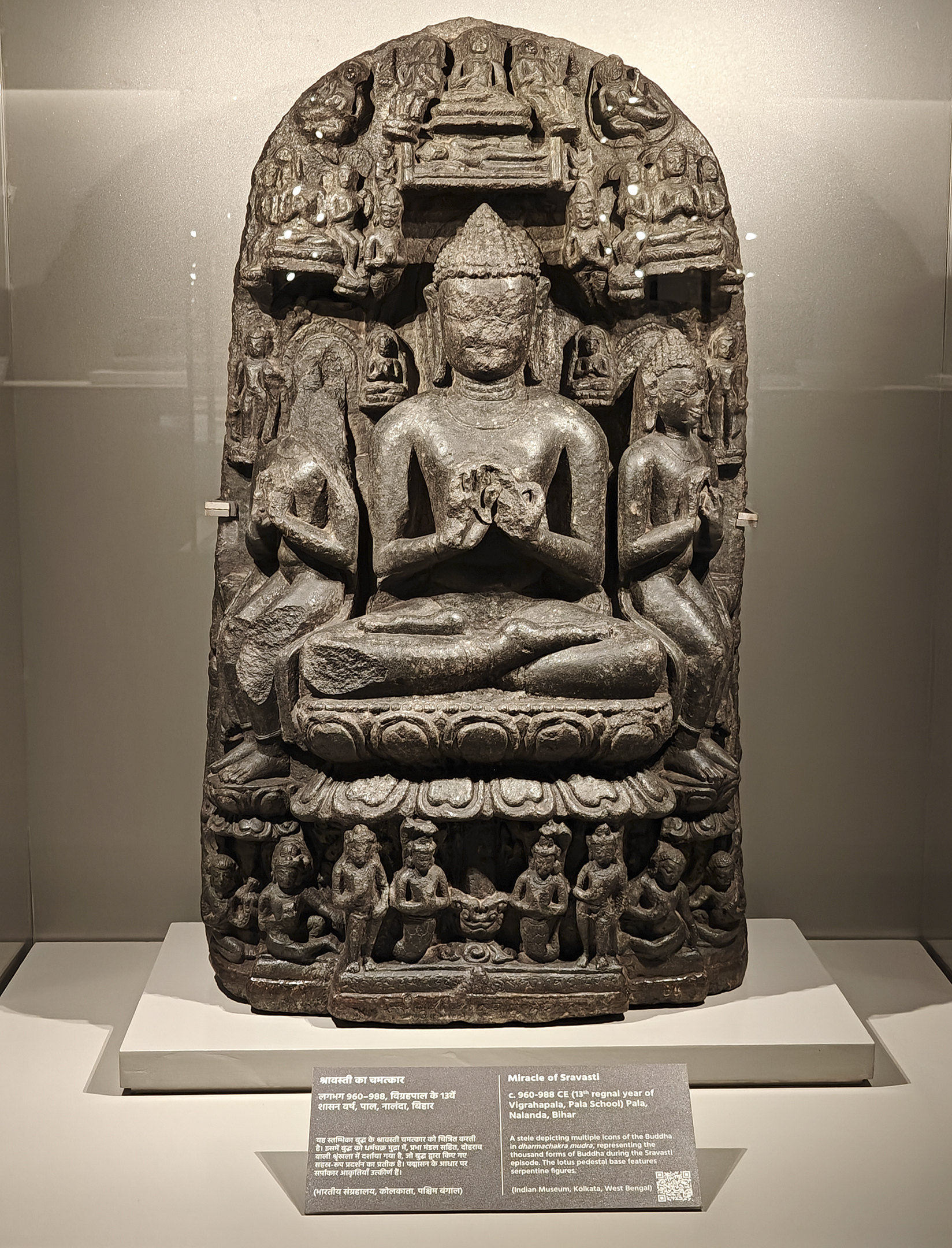
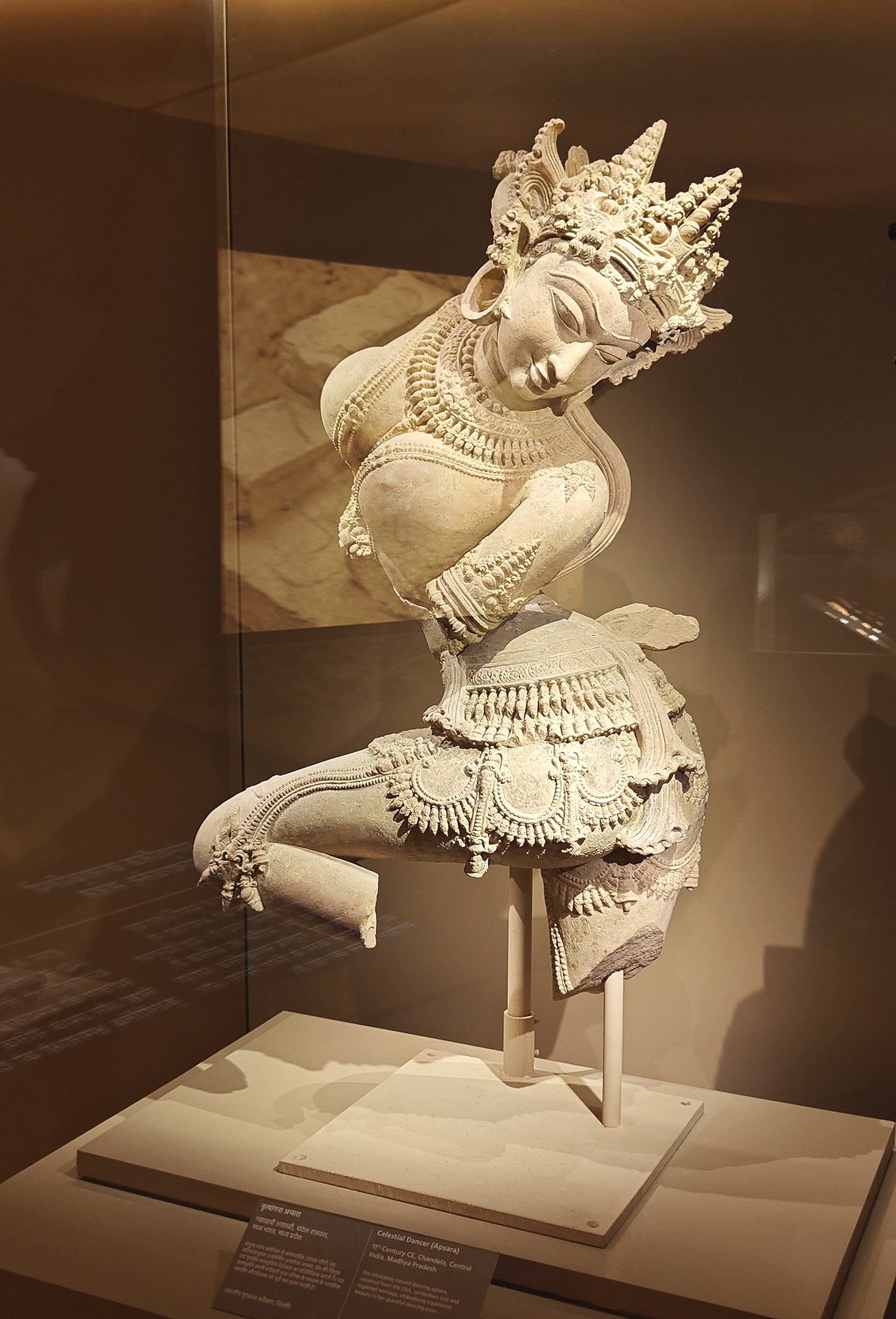
An excellent opportunity to promote the importance of the Science of Archaeology was wasted amid the din of overemphasizing faith. Bringing home the gems and relics of Buddha may indeed be a cause for celebration, yet the audio-videos were focussed only on the present master and the government of the day. In a text panel buried under heavy jargon is a line that says these relics have been ‘acquired by the Godrej Group through an innovative public-private partnership.’ Also, can the museum manager please buy a better megaphone for the guide and ask the gentleman to speak more softly? Seriously, it’s not a wedding venue!! Besides the gems and the relics – my find of the day was Elizabeth Brunner’s Walking Buddha (oil on woven mat) which transforms the Buddha-pada into dynamic steps with its soft forward march, and the Buddha painting by none other than Nandalal Bose. Do visit the show, only three weeks left of what is called as Piprahwa gems exhibition but is officially named ‘The Light of the Lotus: Relics of the Awakened One’, at the Qila Rai Pithora Fort and Cultural Complex, Lado Sarai on Press Enclave Marg, in Delhi. *Piprahwa, in Siddharthnagar, U.P. is what was known as Kapilavastu.
The official statement posted by PIB on: 02 JAN 2026 says The Ministry of Culture is hosting a landmark exposition showcasing the Piprahwa Relics, Reliquaries and Gem Relics, recently repatriated to India, at the Rai Pithora Cultural Complex. The exposition is set to be inaugurated by the Prime Minister, Shri Narendra Modi on 3rd January 2026 at 11.00 AM. This historic event marks the reunification of the Piprahwa gem relics of Lord Buddha, repatriated after 127 years, with relics, gem relics, and reliquaries from 1898 and then 1971-1975 excavations at the Piprahwa site. The exposition, titled “The Light and the Lotus: Relics of the Awakened One,” thematically showcases relevant antiquities and works of art from several cultural institutions under the Ministry of Culture. These relics represent the most extensive assemblage attributed to the Buddha, symbolizing profound philosophical meaning, masterful craftsmanship, and global spiritual significance. The exhibition features over 80 objects spanning the 6th century BCE to the present, including sculptures, manuscripts, thangkas, and ritual objects. This unprecedented gathering commemorates the Ministry of Culture’s successful repatriation of the relics in July 2025, achieved through a public-private partnership, halting an auction at Sotheby’s Hong Kong. For the first time since the 1898 excavation, the exposition brings together:
Relics from the 1898 Kapilavastu excavation
Treasures from the 1972 excavations
Reliquaries and jewelled treasures from the Indian Museum, Kolkata
Recently repatriated relics from the Peppé family collection
Monolithic Stone Coffer within which the gem relics and reliquaries were originally found.
The sacred Buddha relics were discovered in 1898 by William Claxton Peppé at the ancient stupa of Kapilavastu. Following their discovery, portions were distributed globally, with one part gifted to the King of Siam, another taken to England, and a third preserved at the Indian Museum, Kolkata. In 2025, the Peppé family portion was repatriated through decisive intervention by the Ministry of Culture, supported by Buddhist communities worldwide. The exposition underscores India’s role as the birthplace of Buddhism and reinforces its position as a global spiritual and cultural leader. Under the leadership of Prime Minister Narendra Modi, India’s global engagement increasingly draws upon its civilizational and spiritual inheritance, 642 antiquities have been repatriated to India, with the return of the Piprahwa relics standing as a landmark achievement.
The inauguration will witness participation from Union Ministers, Ambassadors and members of the diplomatic corps, venerable Buddhist monks, senior government officials, scholars, heritage experts, esteemed members of the art fraternity, art aficionados, followers of Buddhism, and students.
The exposition reaffirms the Ministry’s commitment to heritage preservation and cultural leadership while celebrating India’s spiritual legacy and its significance as the birthplace of the Buddha Dhamma, reflecting India’s enduring commitment to preserving and sharing its civilizational heritage with the world.
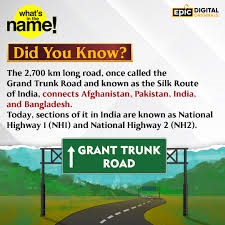
Somewhere between Gurgaon and Chandigarh, while cruising along the smooth expanse of National Highway 44, I realised that the road beneath my wheels had quietly lost its name. What was once the legendary Grand Trunk Road—a highway that had carried emperors, armies, traders, caravans, and pilgrims for more than two millennia—now survives officially as little more than a number on a signboard.
The transformation while being logical was an administrative activity leading to some efficiency, but it also erased something far older than asphalt.
A Road Older Than Empires
The origins of the Grand Trunk Road reach deep into antiquity. During the era of the Mauryan Empire, more than two thousand years ago, an important trade route connected the fertile Gangetic plains with the north-western frontiers of the subcontinent.
Over centuries successive rulers maintained and expanded this route, recognising its strategic importance. But it was the Afghan ruler Sher Shah Suri who transformed it in the sixteenth century into a truly organised imperial highway.
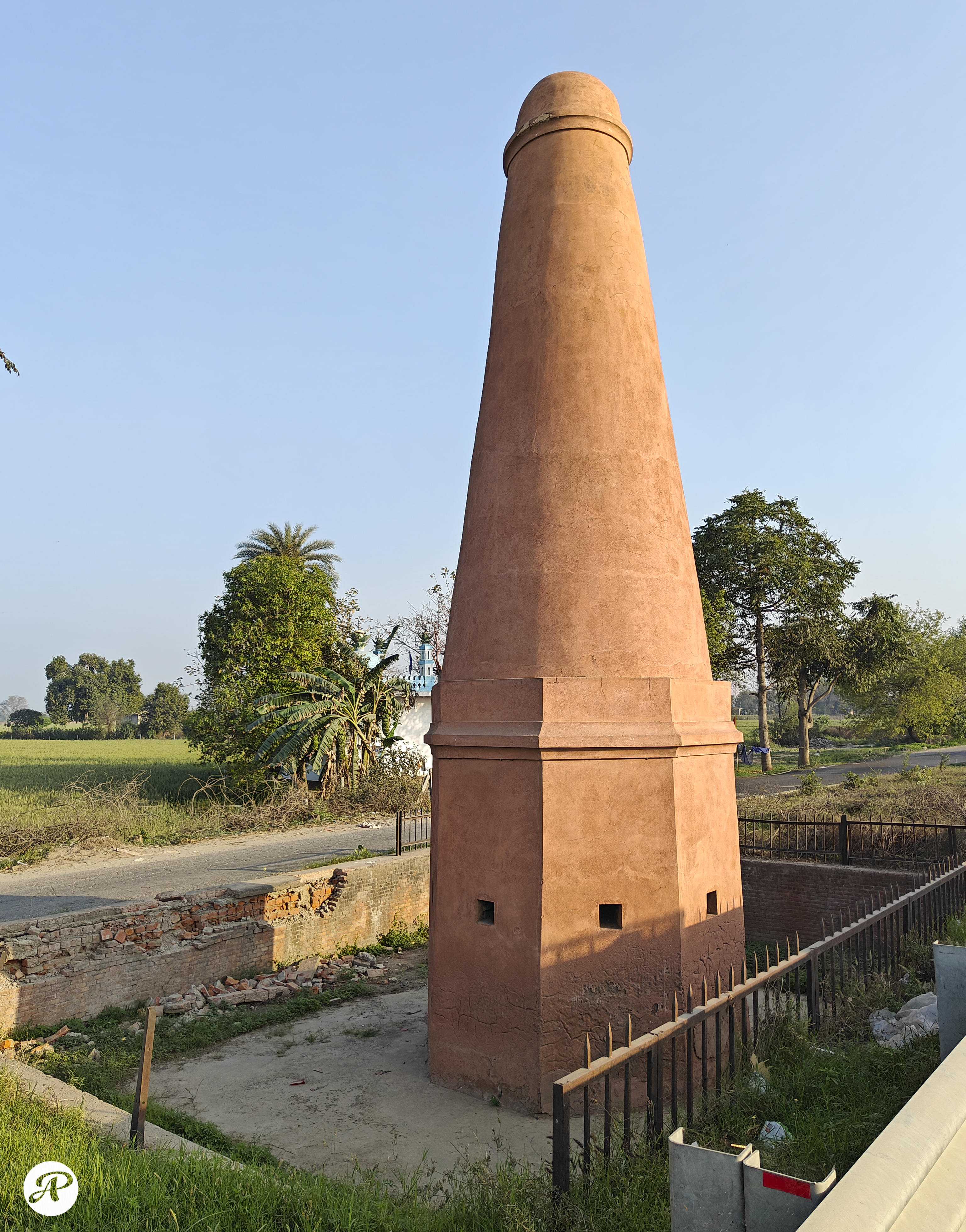
He planted trees along the route, built caravan serais, dug wells, and ordered the construction of distinctive distance markers called Kos Minar. These cylindrical towers, erected at intervals of roughly one kos—about three kilometres—allowed travellers to measure distances across the long road stretching from Bengal toward Lahore and the Afghan frontier.
Under the Mughal Empire, the road flourished further, linking great imperial centres such as Delhi, Agra, and Lahore. For centuries the Grand Trunk Road functioned not merely as a highway but as a moving artery of civilisation—carrying commerce, ideas, languages, religions and armies across the northern plains of the subcontinent.
The Silent Sentinels: Kos Minars
Even today the past occasionally reveals itself beside the highway. Every now and then a traveller may notice a cylindrical brick tower rising unexpectedly beside the modern road. These are the old Kos Minars—once lime-plastered pillars nearly thirty feet tall that marked distances and guided travellers along the imperial highway.
Between Delhi and Ambala alone nearly thirty such structures still survive, though many remain half hidden behind encroachments or modern construction. Some have been restored, albeit somewhat crudely, by the Archaeological Survey of India.
During my recent drive one such tower caught my attention near the village of Khandra in Panipat district. Standing quietly beside the roaring traffic of NH-44, the restored pillar seemed like an old sentinel from another century, watching the modern highway rush past. These modest structures once helped guide caravans, royal messengers, traders, and pilgrims along one of the great roads of Asia.
Where Myth and History Meet
This corridor has witnessed not only historical events but also the echoes of far older stories. Near the town of Karnal lies the ancient landscape of Kurukshetra, revered in the epic Mahabharata as the battlefield where the great war between the Pandavas and the Kauravas was fought.
Whether viewed as mythology, sacred narrative, or distant historical memory, the geography of that epic is unmistakably rooted in these plains of Haryana. Long before imperial highways were formally built, ancient pathways must have crossed this landscape, linking settlements and kingdoms.
Thus along this single corridor, memory stretches from the mythic age of the Mahabharata to the medieval battles of Tarain and onward through the empires of Sher Shah, the Mughals and the British. Few roads in the world carry such layered echoes of time.
A Road That Shaped History
Near Taraori, close to Karnal, the decisive Battles of Tarain were fought. Control of this corridor meant control of the road leading to Delhi and the Gangetic heartland. When Muhammad Ghori emerged victorious in the second battle, the route to Delhi opened before him, paving the way for the establishment of the Delhi Sultanate.
From Panipat to Kurukshetra, this highway runs through landscapes where history has repeatedly changed the course of the subcontinent.
The Disappearance of a Name
Yet this ancient road met a curious fate in modern India. In 2010, India reorganised its highway network into a systematic numbering grid, creating hundreds of national highways across the country. Under this system the historic Calcutta–Delhi–Amritsar stretch of the Grand Trunk Road was absorbed into NH-44.
In one quiet administrative act, a road whose name had echoed across centuries was reduced to a number on a map. Travellers speeding along NH-44 remain largely unaware that they are moving along one of the most historic corridors of the subcontinent.
Perhaps the road itself might echo the melancholy sentiment expressed by Faiz Ahmed Faiz:
“Nisār main terī galiyoñ pe ae watan ke jahāñ, Chalī hai rasm ke koī na sar uṭhā ke chale.”
“निसार मैं तेरी गलियों पे ऐ वतन कि जहाँ चली है रस्म कि कोई न सर उठा के चले।”
I bow before the streets of my homeland, Where it has become the custom to walk with lowered heads.
The lines seem almost prophetic for a road where millions travel each day, unaware of the history beneath their wheels.
Remembering the Road
Many ancient roads survive today only as archaeological memory—Rome’s Via Appia, China’s Silk Road, Persia’s Royal Road, and the Inca Qhapaq Ñan; all these are relics of the past and not used as roads any longer, however, the Grand Trunk Road is different. It remains alive.
Millions of vehicles travel along it every day across India and Pakistan, unknowingly retracing a route that has carried caravans, armies, traders, pilgrims and ideas for more than two thousand years.
Numbers may organise roads on a map but names carry memory. Restoring the Grand Trunk Road’s historic name alongside its administrative designation is not merely an exercise in nostalgia. It is about preserving civilisational memory.
At a time when cities, towns, and streets across India are frequently renamed for political or ideological reasons, the name “Grand Trunk Road” stands apart. It carries neither sectarian identity nor political affiliation—only the accumulated weight of history. Perhaps NH-44 could remain its official administrative designation while the historic name of the Grand Trunk Road is proudly displayed along its length.
And sometimes a civilisation is remembered not through its monuments, but through the roads that once connected its people, its stories, and its history across time.







You must be logged in to post a comment.