
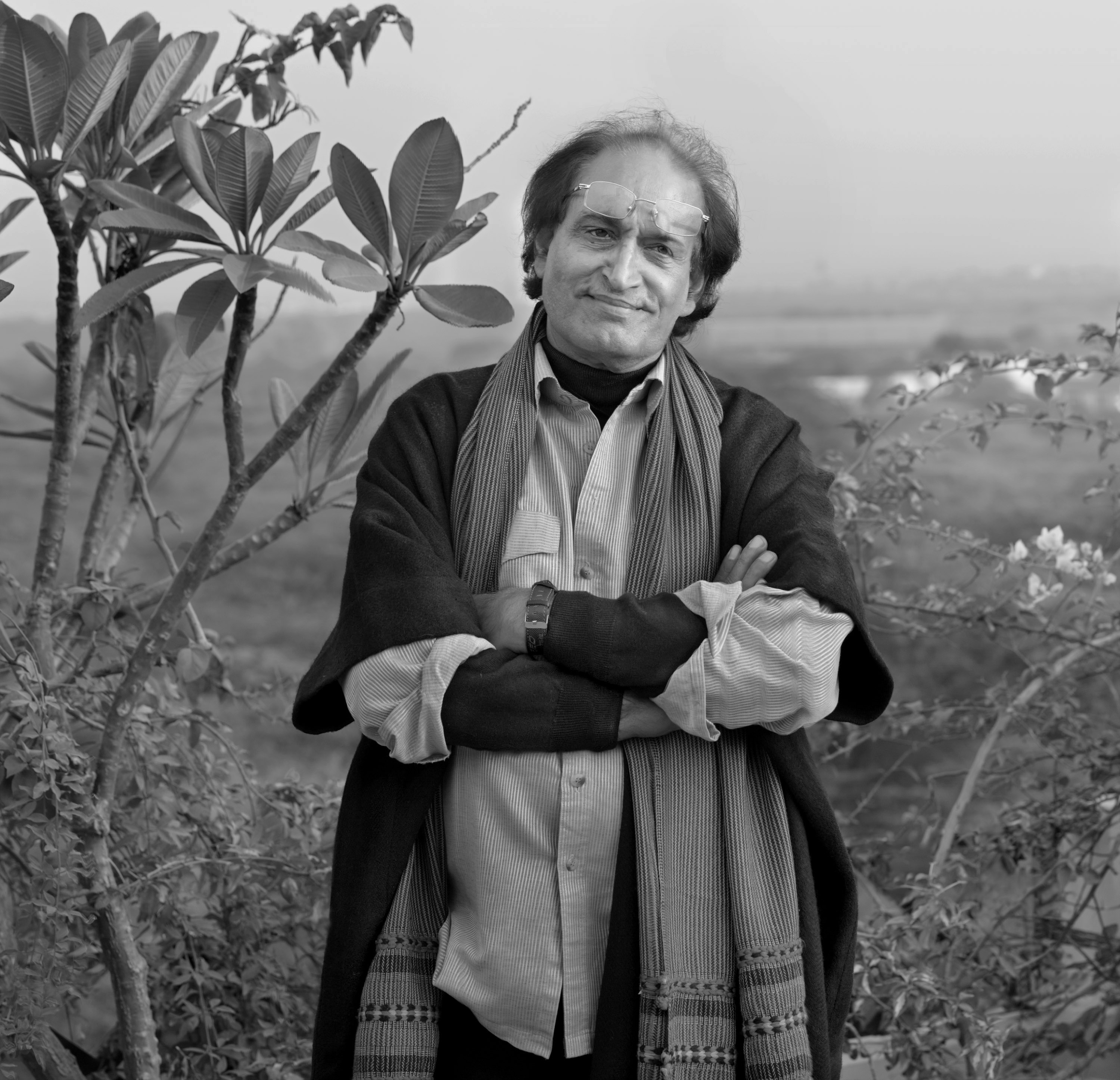
In the last 24 hours I have seen more portraits and pictures of Raghu Rai (on digital platforms) than I had ever imagined they even existed. It is sad that Raghu Rai is no more. He had been suffering for a few months. It is nice to see friends and acquaintances pouring out their love for him, and in turn, projecting their proximity to Raghu Rai. It is a veritable RR show online, an exhibition of his pictures some of which he wouldn’t even have known people cherished so much – friends, peers, fan, and acquaintances.
While a photographer is in the process of making a picture or when he is busy composing them, he doesn’t realise that he too becomes a subject of curiosity, an image himself. People knew him, people loved him as an icon, a star photographer and people adored him wherever he went. He would talk, he would explain politely and share the nuances of an art of which he was undoubtedly a master. Amateurs and youngsters in photography community addressed him as Guru and Ustaad and wanted to record their meeting with him. Undoubtedly his was a photogenic face too, handsome and his smile too could launch a few ships.
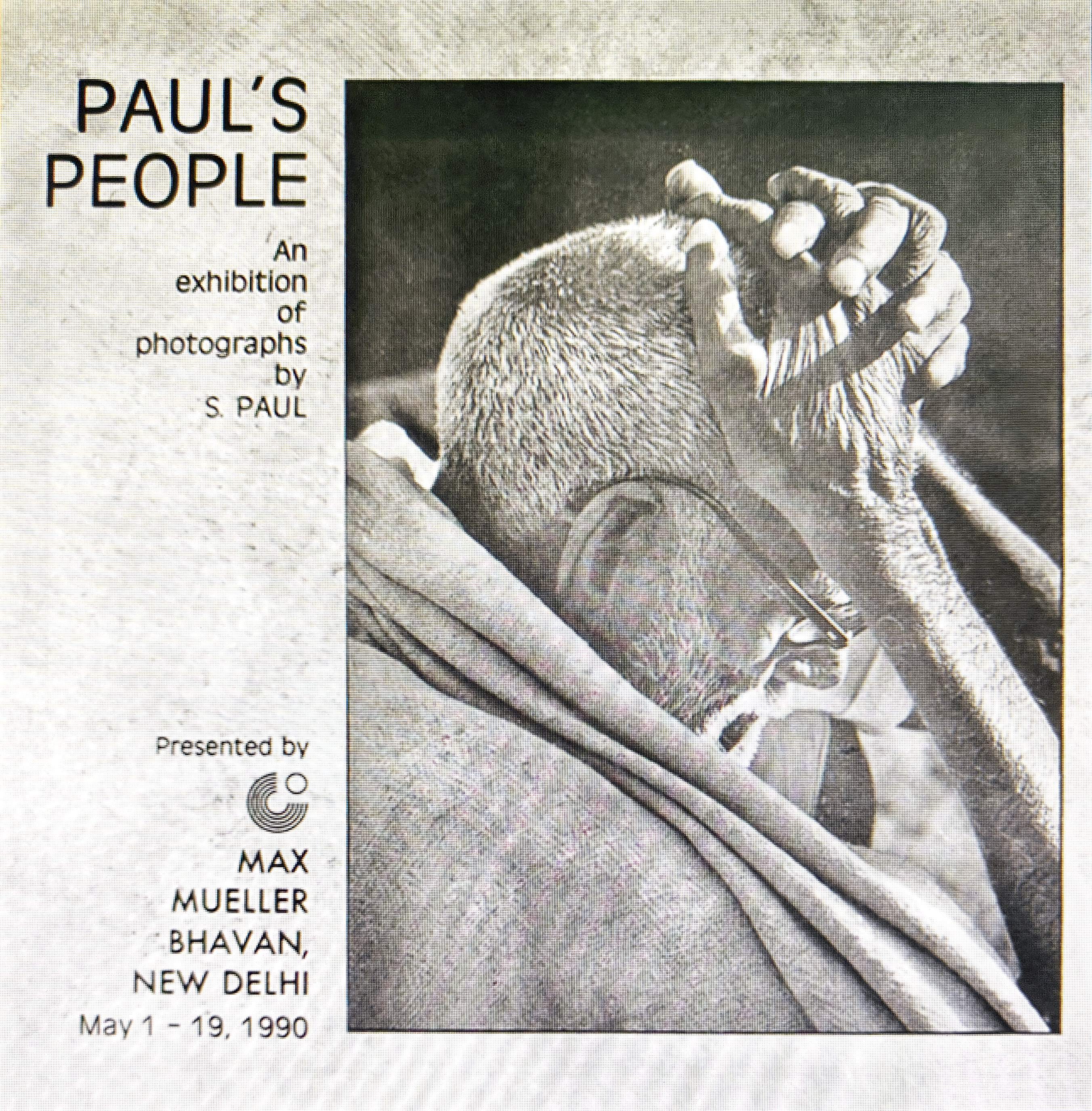
I can’t claim that he was my friend, yet our association and connection was such that we did treat each other as a friend. The first time I met him was in 1989 at his house in Rabindra Nagar next to Khan Market, Delhi. A UK based client of ours insisted on using one of Raghu’s Taj Mahal picture on the cover of his travel catalogue. Those were the days when film was used in cameras, pre-digital days. I had to pickup a 35mm colour slide from him and hand over a big amount for ‘one’ picture. He was a celebrity then and he is a celebrity now, thirty-seven years later. Even before I met Raghu Rai or had any association with him I had known his older brother S. Paul for whom we had designed and published a catalogue of his pictures. A show of S Paul’s pictures was organised by Max Mueller Bhavan, Delhi. I must say his pictures were very impressive.
As an advertising agency we are dealing with big names in photography all the time, whether for arranged shoots (industrial, architectural, food, fashion, product) or to buy stock pictures. That one meeting brought us closer and we kept meeting at art shows, galleries, social dos or at events organised by Kodak or Fuji. Ever since our meeting at SAHMAT events we got even closer.
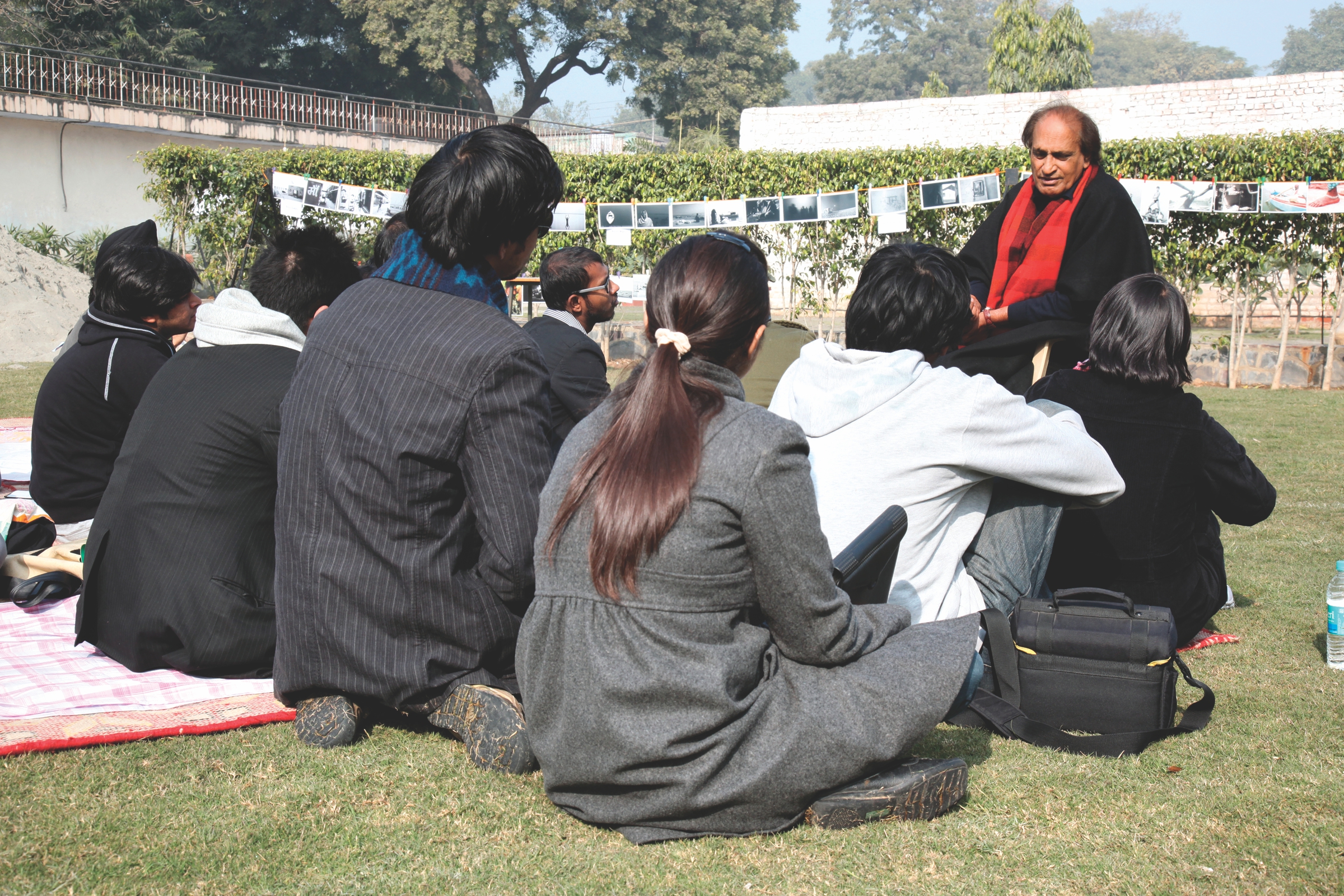
For some strange, and unknown reason I addressed him Prabhu (lord of photography??) and he would shoot back ‘Lal Pari’. About this moniker he once explained, “I have seen you many times wearing different red kurtas. Long back I saw you with your long hair bouncing off the shoulders, thus the name.” I nodded; you couldn’t argue with Raghu. I attended one of his photography workshops which he conducted open-air at the gorgeous location of Ojas Art gallery in Mehraulli. A large manicured green lawn, anchored around a banyan tree with its entangled roots hanging from its strong branches and its large leaves reaching for the earth. A tree that itself is associated with many renowned folklores was an aptly location for the master storyteller whose ‘pictured tales’.
I had never imagined that there was even a remote chance to see so many of Raghu Rai’s pictures in one go, one day without having to move from house or visiting a gallery. A very large number of Raghu’s pictures are being shared online today; pictures that are artistically superb, iconic and are a story by themselves. These pictures are being shared because they are liked by masses and are a part of public memory. Thats a way condolences are shared.
One can’t disagree with people posting his marvellous pictures but then RR was known for his keen eye, the game he played with his subjects, the locale, the foreground and background, the light and shade and the very story that moment had. RR was known for capturing a story in his pictures – sometimes those were poetry or a song; an ongoing movement that brought forth a particular moment that he captured – the one that had both, the before and after in it. And then he hung that picture for all of us to see and feel the fierceness of a sand storm, a village rising from the dust and embracing air travel,
Just like my mother, his family also came to India from Jhang where he was born. He shared it with with me after I had visited Lahore with my parents on a trip looking for their parental houses before the Partition. Raghu was eight years younger to my mother and they had shared the same mohalla. His keen eyes must have observed the ever changing subcontinent and the trauma of the uprooted families. He mentioned that he had been to Lahore long-long back in 1978 to locate their house and that for him too it was hugely emotional moment. Yet, he made full use of the opportunity and mingled with the crowd as he went about taking hundreds of pictures of the people and localities. There is very touching picture of him riding a donkey on a street, crowded with people surrounding him while he enjoyed all the attention – which all Indians get across the border.
His pictures were defining visual voices of modern India. Impressed by an exhibit of his work in Paris in 1971, Henri Cartier-Bresson, possibly the world’s greatest photographer in his day, nominated Raghu Rai to join Magnum Photos in 1977.
Today, photographers across the country are grieving a loss, but are also celebrating the life of a giant that rose above others to make his images immortal or outlive time.
Raghu Rai was not only a photographer with a keen observant eye but an artist who brought forth the aesthetics of a moment in his pictures. One can find RR pictures of almost all important events of the country from the 1970s onward. In mid-seventies, he was at the Maharishi Mahesh Yogi Ashram in Rishikesh photographing the phenomena in pop-music called the “Beatles”. His eyes found art where his contemporaries only found news. Like someone said, “Raghu’s evolution was meteoric. He raised news pics into world art. This was independent of his exceptional eye on the Taj Mahal, Mother Teresa, Dalai Lama, all the contemporary musicians. No war photographer had mixed valour, victory with a deep sense of tragedy as in his coverage of the Bangladesh war.” For those of us who shared a space in social and cultural activism, Raghu would be found standing with all for any cause. His haunting picture of a half-buried child after the Bhopal Gas Tragedy or the labour movement or even the plight of the migrants during Covid are silent sentinels of our times.
He was there, almost everywhere. Raghu Rai was in Ayodhya at the pivotal moment in Indian history when the Babri masjid was demolished. Not just that he documented the tragedy for posterity, he was at the receiving end from the Kar Sevaks who assaulted him and other photographers and his camera equipment was also damaged.
Not that I ever went with him on a photo-sortie, but I know by his sheer demeanour in all else that he did—that Raghu was never in a rush. He almost mathematically calculated every aspect of composing a shot and taking a picture I saw him taking pictures of the display of his own show in such thoughtful ways that one wonders what formule or theorems went on in his mind while making a frame.
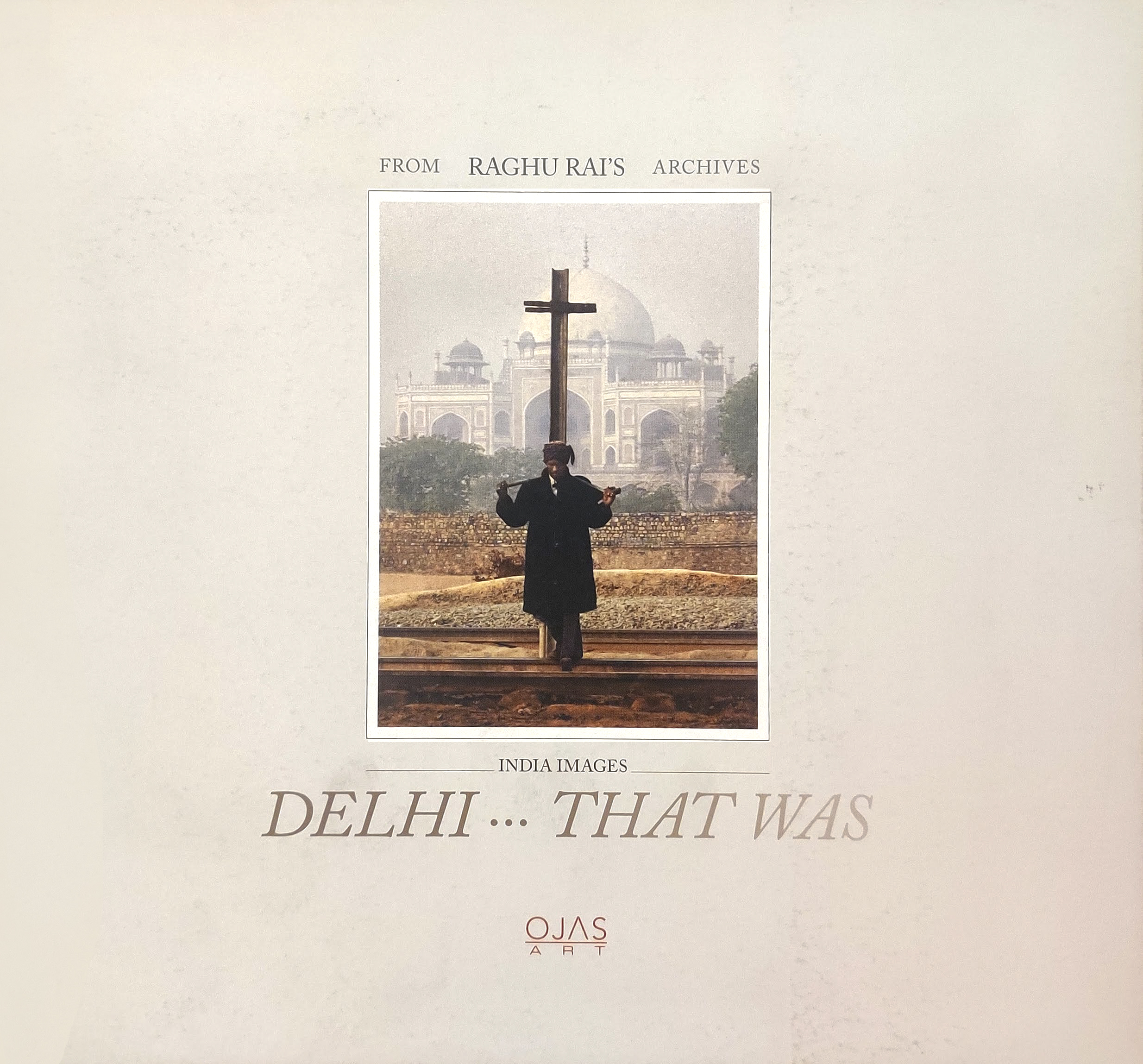
As a design agency we had the privilege of designing and printing catalogues of Raghu Rai’s shows that were assigned to us by art galleries. These catalogues gave me a chance to interact with RR on personal level for many reasons – be it technical or simply emotional. The last catalogue I did for him was for a show that exhibited photographs of three senior photographers of Delhi; namely Habib Rahman, Madan Mahata and Raghu Rai. The show was titled “Delhi… That Was”. Some of the finest pictures of these three greats were on display. On the day of the opening, Raghu went around the entire gallery interpreting each image for us who were keen to listen to him. Late Habib Rahman and Madan Mahatta would have been very happy that day listening to their pictures being deconstructed.
In Raghu Rai we have lost a visual historian, an artist, a photographer and a extraordinary human being.
P.S.: Social media platforms are a treat today to see some of Raghu Rai’s pictures that one had not seen before. It is also a rare day when we got a break from the seeing the sullen pictures of a rotten politico and his brigade.
Rajinder Arora, 27 April 2026


You must be logged in to post a comment.