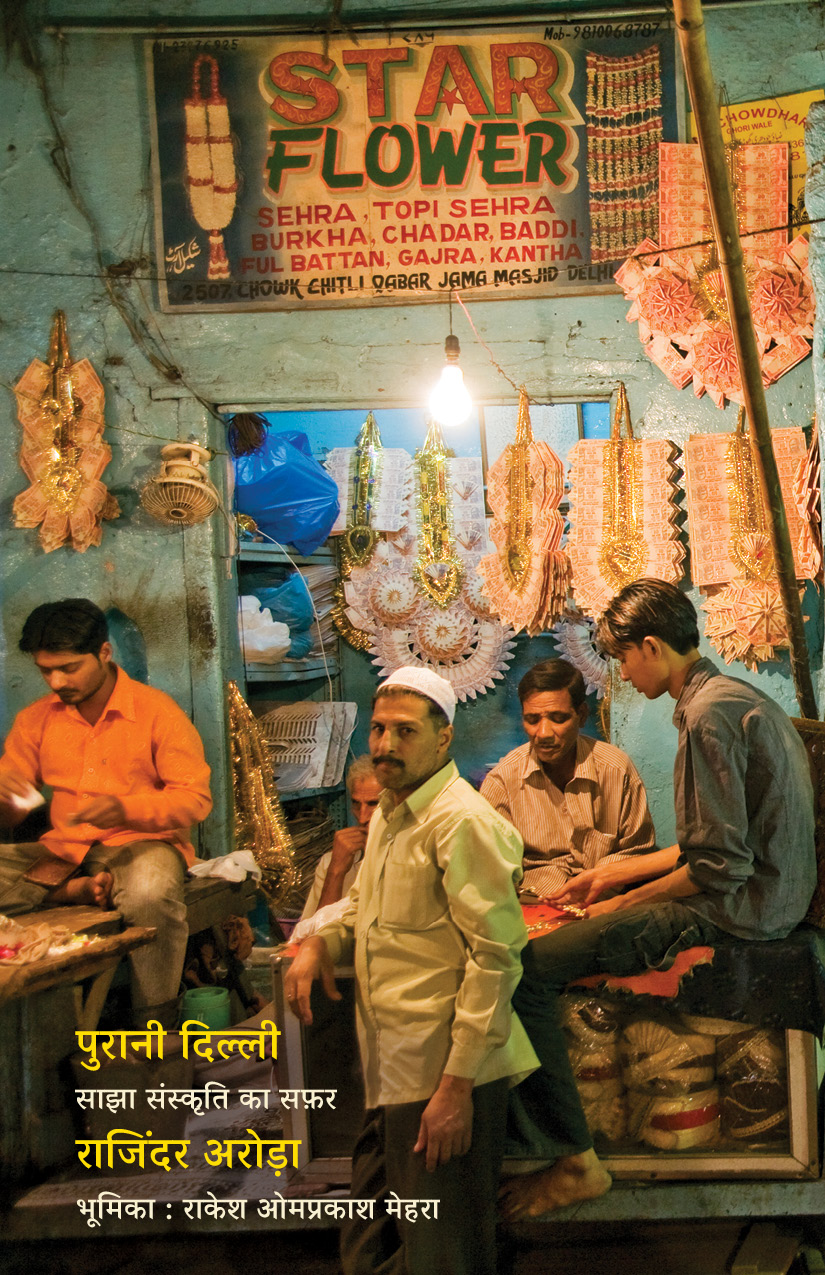
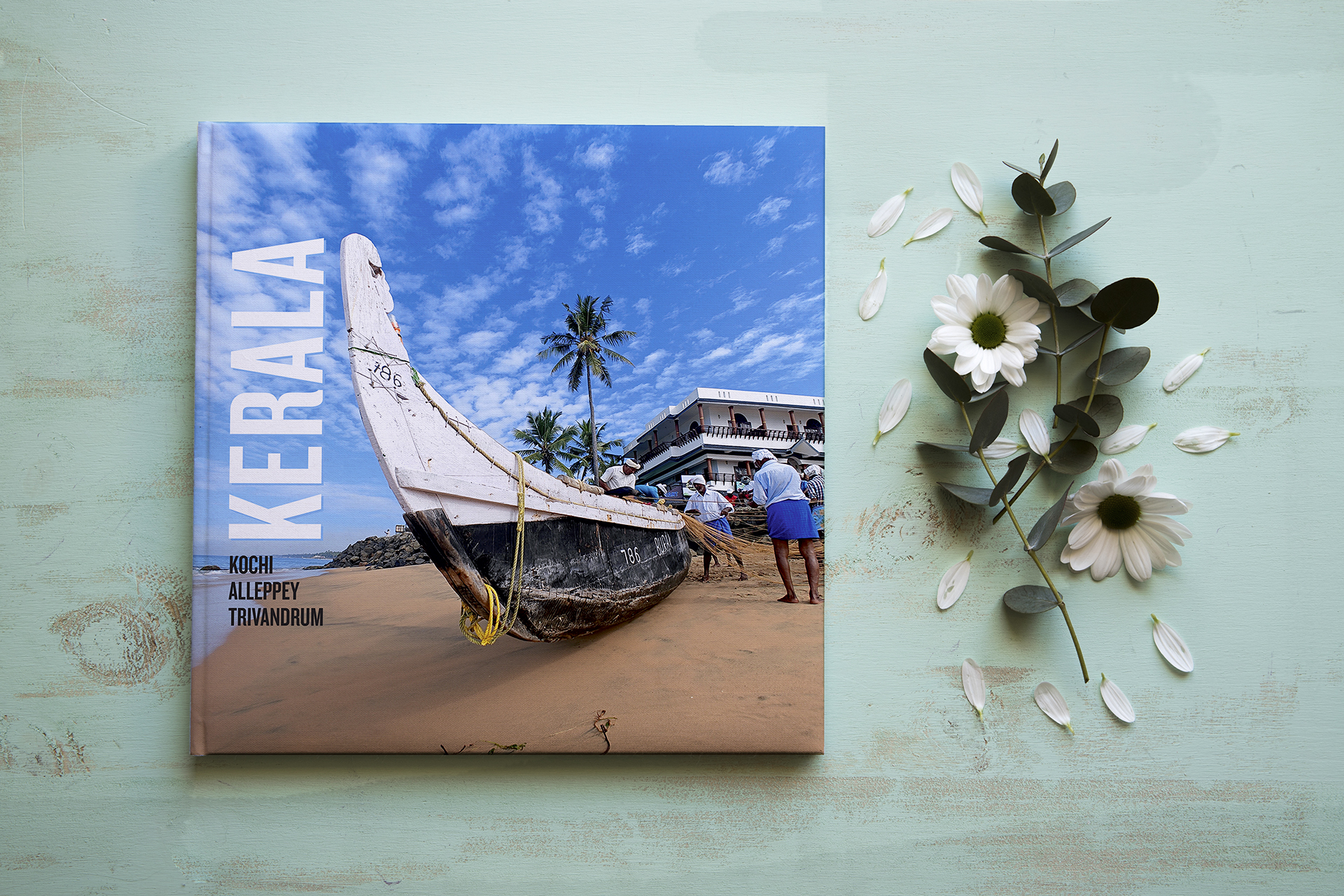
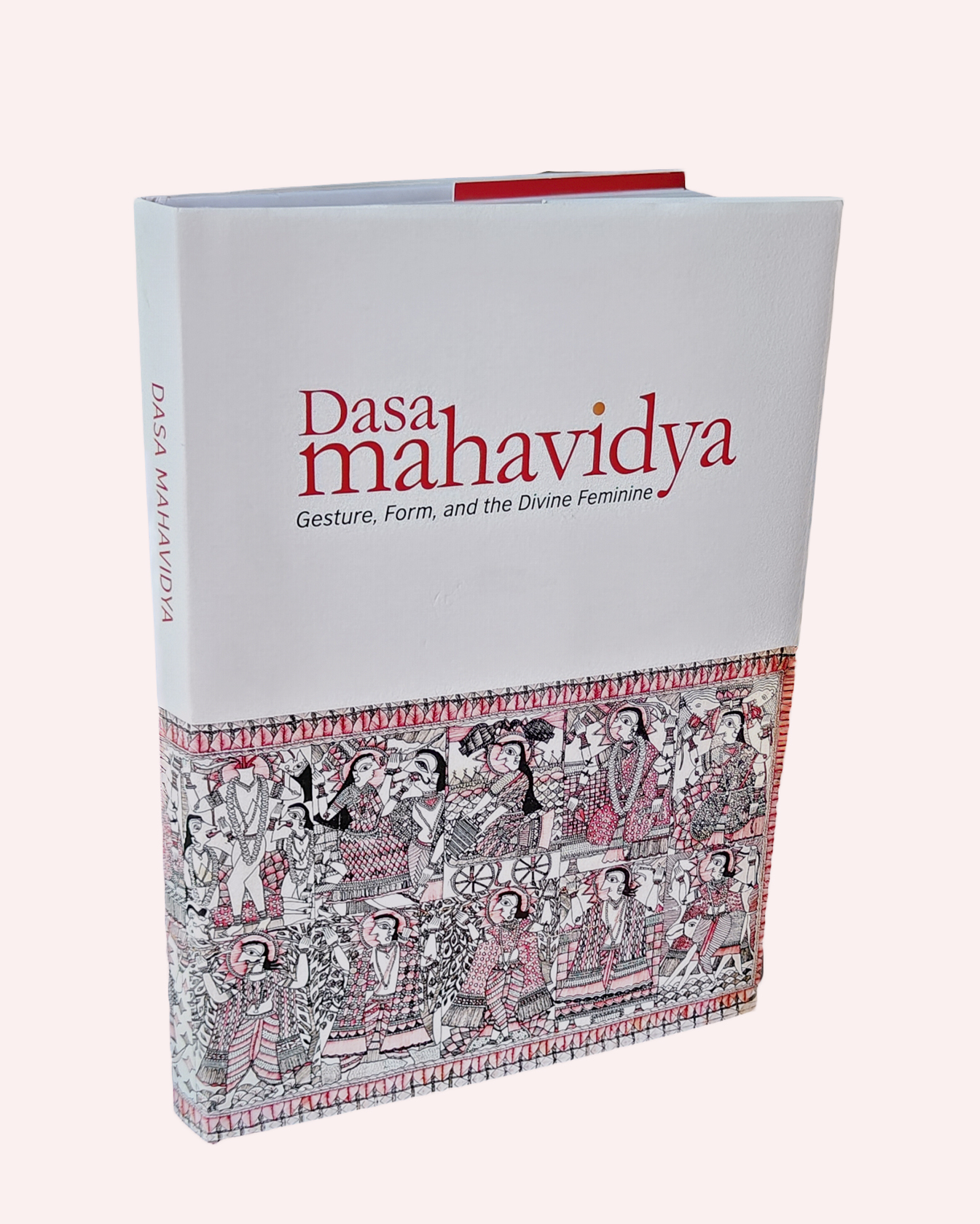
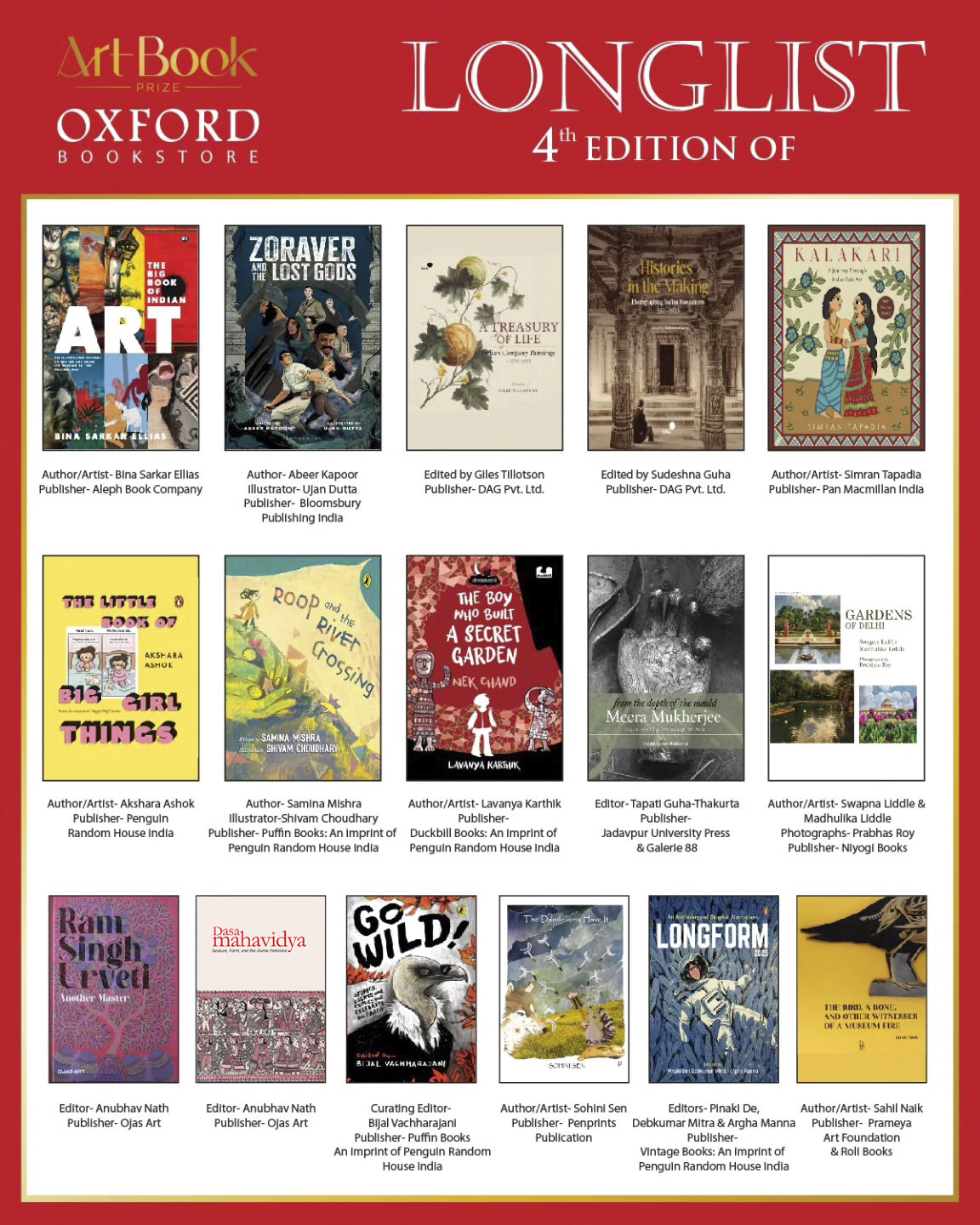
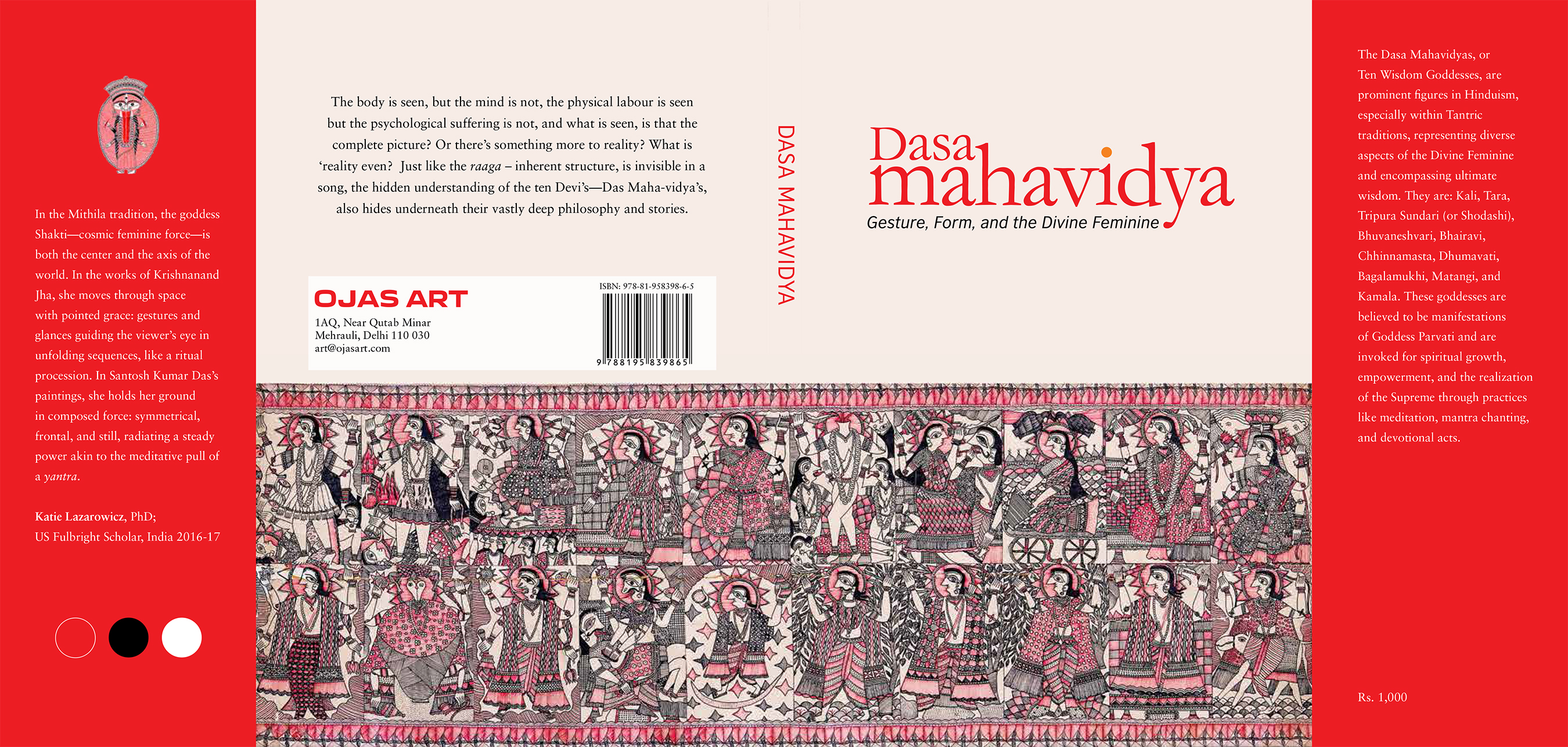
Delighted to share that Dasa Mahavidya: Gesture, Form, and the Divine Feminine, designed by Rajinder Arora/Ishtihaar and published by Ojas Art, has been Longlisted for the 4th Oxford Bookstore Art Book Prize among the other fifteen.
Dasa Mahavidya reflects on the visual, philosophical and symbolic dimensions of the Ten Wisdom Goddesses through the lens of contemporary artistic practice. The Dasa Mahavidyas, or Ten Wisdom Goddesses, are prominent figures in Hinduism, especially within Tantric traditions, representing diverse aspects of the Divine Feminine and encompassing ultimate wisdom. They are: Kali, Tara, Tripura Sundari (or Shodashi), Bhuvaneshvari, Bhairavi, Chhinnamasta, Dhumavati, Bagalamukhi, Matangi, and Kamala. These goddesses are believed to be manifestations of Goddess Parvati and are invoked for spiritual growth, empowerment, and the realization of the Supreme through practices like meditation, mantra chanting, and devotional acts.
The Oxford Bookstore Art Book Prize is India’s only award dedicated to recognising excellence across art publications and their contribution to the larger discourse on art and culture. At Ishtihaar we are honoured to see our work recognised among this year’s selected titles.
Best wishes to Anubhav Nath and Ojas Art, who have another art book “Ram Singh Urveti: Another Master”in the Longlist. The final winners will be announced later this year.
On a burning-hot April afternoon (like today), sometime in 1994 or 95 Suneet Chopra entered the Ishtihaar office, his face red and profusely sweating. A safa, the kind worn by a peasant-mazdoor leader was dripping on his head. Without saying a word he pulled up a chair and sat down. Cleaning his glasses with the gamachha, he ran his fingers through his beard and drank two glasses of water. A cup of tea later he asked me to get up and come with him. “Where to?” I asked. At the Delhi College of Art, there is a show of final year students’ works on display and for sale.” When Suneet spoke with that kind of authority you couldn’t say no. We drove to the college where the artworks of final-year BFA students were on display for assessment and for sale. Walking up and down the corridor and the hall, we looked at the artworks but weren’t ready to pay the prices students had labelled them for. We were about to leave when we met Saam Lal (that’s how he pronounced his name). Saam (Shyam), a peon-like assistant at the college, held a few rolled sheets in his hand. He had displayed two others on a cord along the outer wall. Those were HIS paintings. Shyam Lal, who had never attended school, learnt to draw and paint at DCA only. A few works that he managed to sell in a year supplemented his meagre salary. Looking at his works Suneet retraced his steps, and so did I. Suneet kept looking at the “Goats” – a gorgeous single one, and a clean-coated family of four. Suneet asked Shyam Lal to open the roll in his hand, which had two more artworks; Goats again. He looked at me and nodded, signaling that we should take these. Between the two of us we bought all four works. Shyam Lal asked for 2,500 each. Mind you, these are 3×2 feet fabulous works, watercolour on acid-free chart paper. The two in picture are with me, I wonder what Suneet did with his. Over thirty years now… every time I look at these works I remember both Suneet and Saam. Suneet is gone, I wonder what ever happened to tall, emaciated, smoker Saam who could hold both a brush and a bidi in his left hand while painting. Syam signed these works for us with a pencil tucked in his left ear. I cherish these.
For those who don’t know: late Suneet Chopra was an art critic, writer, and poet. He was a trade unionist; Secretary of the All India Agricultural Workers Union and a Central Committee member of CPI(M). Born in Lahore, Suneet was an alumnus of Modern School and St. Xavier’s College, Calcutta. He taught regional development at Jawaharlal Nehru University Delhi. More than everything else, the ever-smiling Suneet was a fine human being.
When Pushpesh Pant talks about food, he makes your mouth water even before you’ve really known the dish. By discussing the history, origin, species, process, and the love that goes into making a dish, he makes it so interesting that you feel like trying it the very next day. Just meeting him and listening to his tales of life and the kitchen truly satiates—both the spirit and the appetite. An evening with him is a harvest of culinary wisdom. Yesterday, at the Hans magazine’s “Zayka aur Zaban” event, the air was further seasoned by the presence of Vineet Kumar, author of Bachelor’s Kitchen, alongside Vandana Rag and Rachna Yadav.
पुष्पेश जी को मिलने और उनसे ज़िंदगी और रसोई के किस्से सुनने में ही आदमी तृप्त हो जाता है, मन से भी और पेट से भी, जिसके बाद इधर उधर कुछ खा कर आप जायका खराब नहीं करना चाहते। बहुत फ़ायदे हैं हर बैठक के। बीती शाम हंस पत्रिका के ज़ायका और ज़बान कार्यक्रम में बैचलर्स किचेन के लेखक विनीत कुमार, वंदना राग और रचना यादव से भी मुलाक़ात हुई।
Pushpesh PantProgrammeVineet Kumar and Vandana RaagRachna Yadav, Director Hans magazine
Sunil Janah would have been 108 today (17 April). His powerful photographs documented India’s independence movement, its peasant and labour movements, famines and riots, rural and tribal life, as well as the years of rapid urbanization and industrialization. The pictures he took were “a powerful mobilising tool, bearing witness to a brutal famine that the British were actively trying to deny.” About this picture of two tribal women, he said, “I took a number of photographs unknown to them; they were watching Margaret Bourke-White at work. The young girl was particularly striking.” Janah is quoted about his picture in the book, ‘The Second Creature‘, published by Signet Press in 1943. In the next picture (from a show at Museuo Camera, Gurgaon) are Sunil Janah and Margaret Bourke-White, c.1946, who collaborated on many projects. Sunil Janah was an Indian-American photojournalist and documentary photographer who worked in India in the 1940s.
A kind aunt recently gifted this curio to Rajni together with its two cousins – the three being sea shell cones. The pattern and markings on this one fascinated me as I had not seen anything like this before so I searched a bit about it. Lo and behold, it is called “Lettered Cone” – it has found home finally – I told myself.
Not surprising that even among the marine species of snails, gastropods, and mollusks there are ‘lettered’ and the ‘unlettered ones’. Just guessing, that among the lettered ones there must be poets and literary masters too – this one looks as if its pattern is rhyming with nature. In its top view it looks like the top of an ice cream cone filled with chocolate chunks in vanilla. Its sides look like a fancy snake skin. Holding it in hand is sheer delight, its inner curves still carrying the smell of saline waters of Indian Ocean where it is found in plenty. Don’t worry much about the red spot, it is some plastic stuck to it which I plan to remove carefully.
A species of predatory sea cone snail or mollusk, Lettered Cone is also known as leopard cone. Like all species of conus these are venomous and capable of stinging humans. Fishermen don’t even touch it. It is the chocolate brown pattern on it which looks like a long forgotten ancient script that gives it its name and makes it look special. I learnt that “…the patterns on the Lettered Cone shells are also reminiscent of chromosomes. Possibly this is the undecipherable story the Lettered cone shell is trying to tell; a glimpse into the genetics of life on earth. For now, this deadly beauty will keep its secrets – possibly hidden in the letters of its shell.
I am told people have been obsessed with seashells since the Stone Age. These have been used as money, worn as jewelry, and used in trade. But if you’re beachcombing in the tropics, there’s one beautiful shell you can leave alone: the Cone Snail.
The Lettered Cone is the “femme fatale” of the ocean. It gets its name from the dark patterns on its shell that look like handwriting or secret codes. Every shell is unique, like a fingerprint, and some collectors even hunt for ones that look like they spell out actual words. Collectors say ‘no two messages’ are ever the same on these cones.
People have seen everything from early Arabic letters to lost codes in these patterns. Some collectors specifically hunt for “word shells”—specimens where the dots and dashes happen to line up to look like actual words.
In some cultures, these markings weren’t just seen as random; they were viewed as a way for the divine to speak to us.
From a scientific lens, these patterns are actually a real-world example of “Rule 30″—a complex mathematical rule used to study chaos and complexity in nature. It’s as if the snail is printing out a chaotic computer code as it grows.
I am not the only one obsessed with these. Over 2,000 years ago, people in Japan went on dangerous sea voyages just to find these shells turning these into bracelets for high-society women. Wearing one was not just the ultimate fashion statement it also marked the wealth of the owner enough to own something for which literally some lives could be risked.
The predator inside this pretty shell carries a harpoon of poison. Its needle-sharp tooth shoots out toxic cocktail that can paralyze a prey in an instant. For humans, it’s incredibly dangerous—some species are nicknamed “cigarette snails” because the joke is you’d only have time for one last smoke after being stung.
But here’s the crazy part: that deadly venom of Lettered Cone is actually saving lives. A subject of neuroscientific research, scientists are turning its venom into medicine for neurological diseases like Alzheimer’s, Parkinson’s, depression and even epilepsy. They’ve even created a painkiller from it that’s 1,000 times stronger than morphine but isn’t addictive.
So, if you see one of these gorgeous patterned cones in the sand, just remember: it’s a tiny, beautiful masterpiece that packs a punch strong enough to change the world—or end your day very quickly.
You must be logged in to post a comment.