St. John-in-the-Wilderness Church, Naini Tal

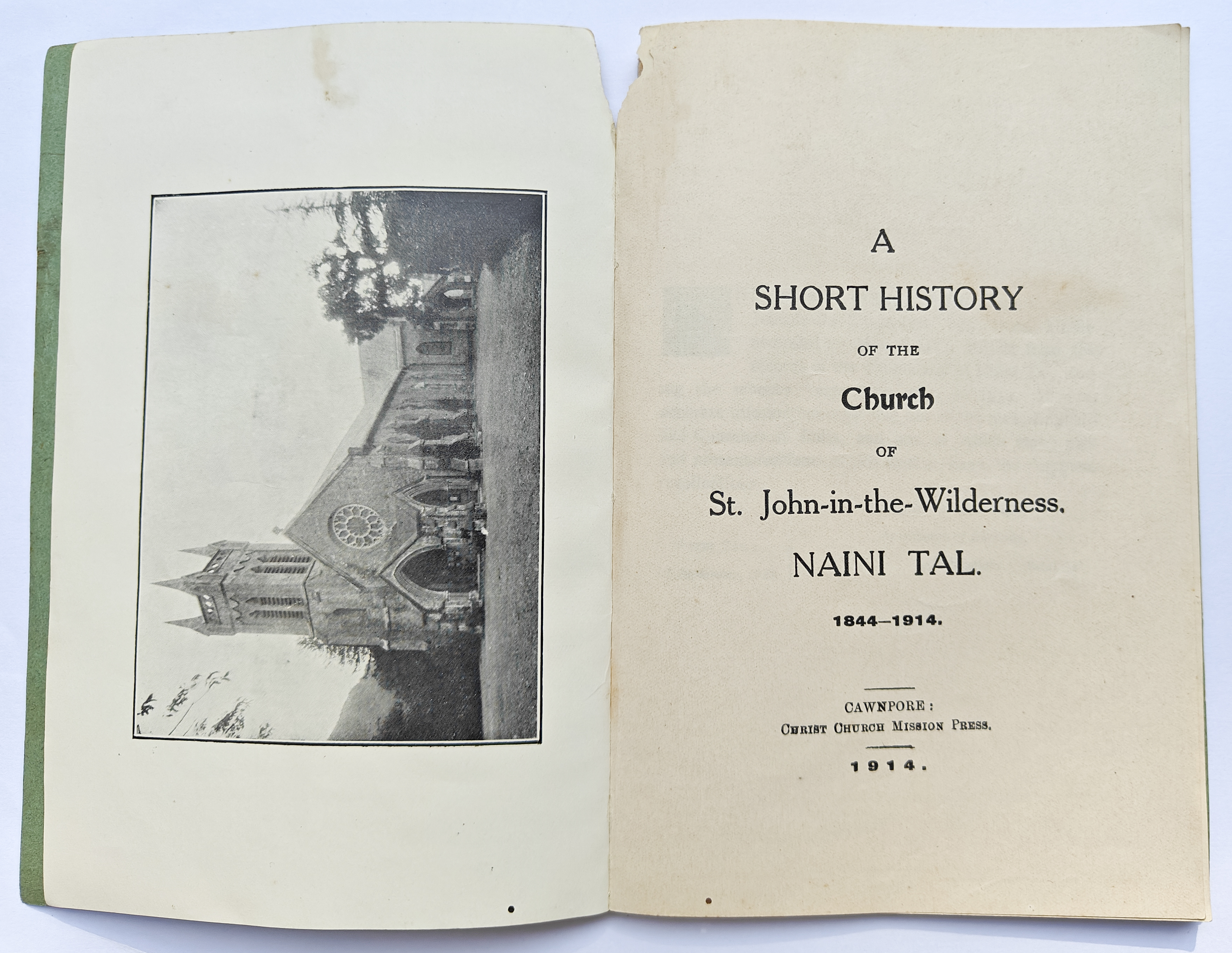
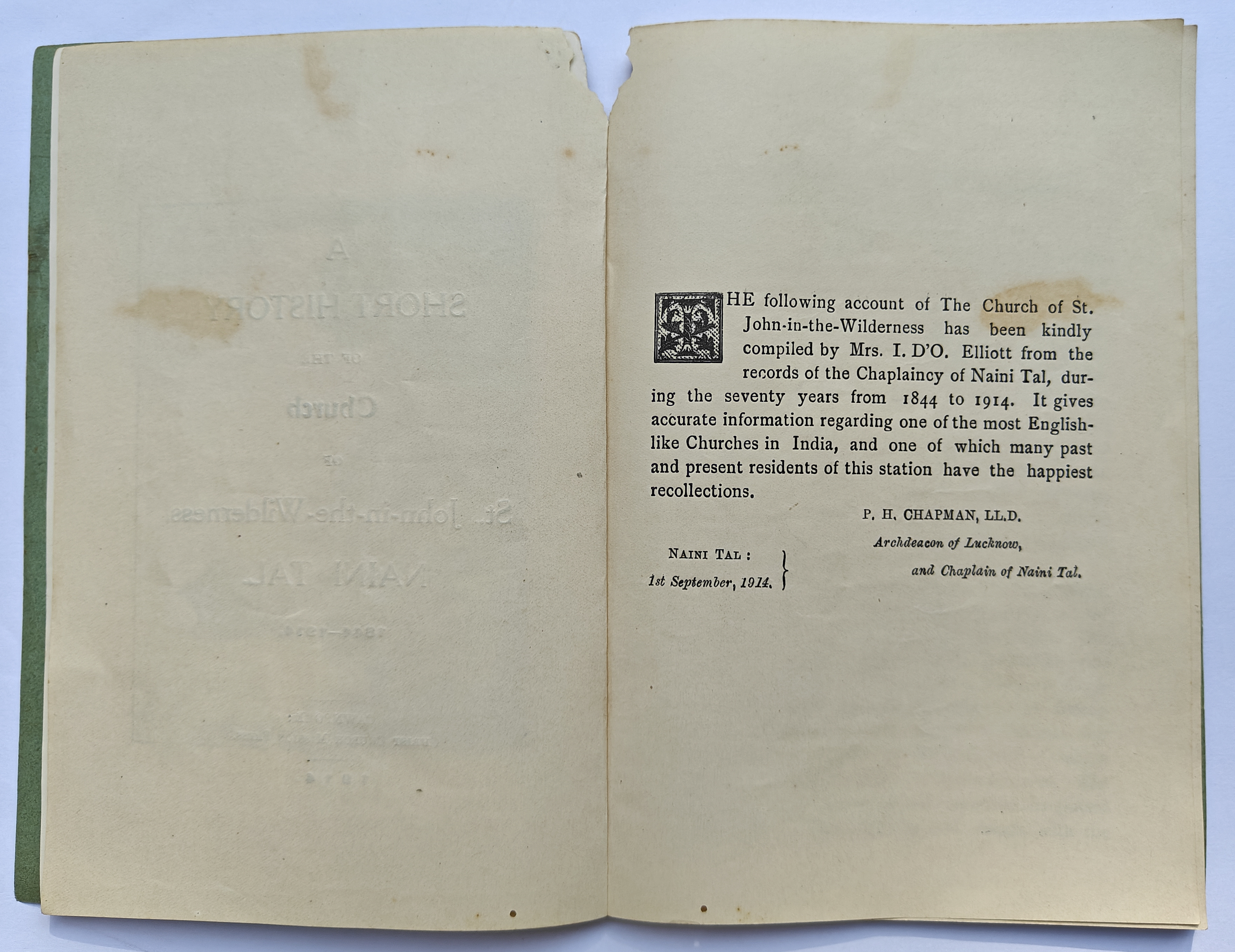
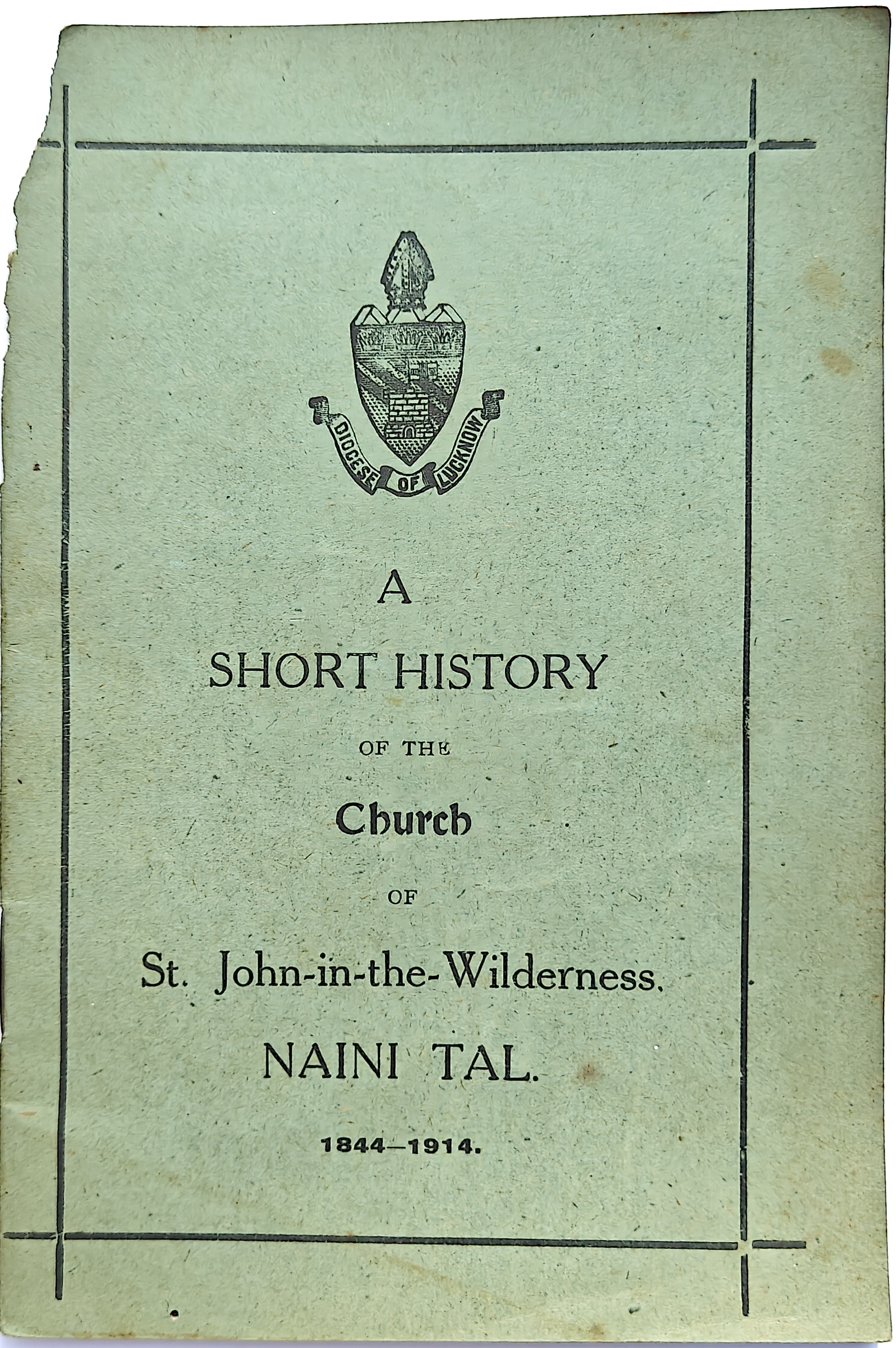
I bought this booklet from a street vendor walking The Mall outside the Naini Tal Club sometime in the winter of 1978 or 79  (I prefer the usage Naini Tal instead of Nainital). This booklet, together with a set of four colour slides, cost eight rupees.  Printed in 1914 (111 years back), in Cawnpore (Kanpur), this 28 page booklet about St. John-in-the-Wilderness Church in Naini Tal continues to be a treat, probably one of the first collectibles I acquired unknowingly. Accidently pulling it out of the shelf today, triggered a chain of thoughts about my one-time-favourite pahad or what people call as hill-station (which sounds so impersonal and bechara). 

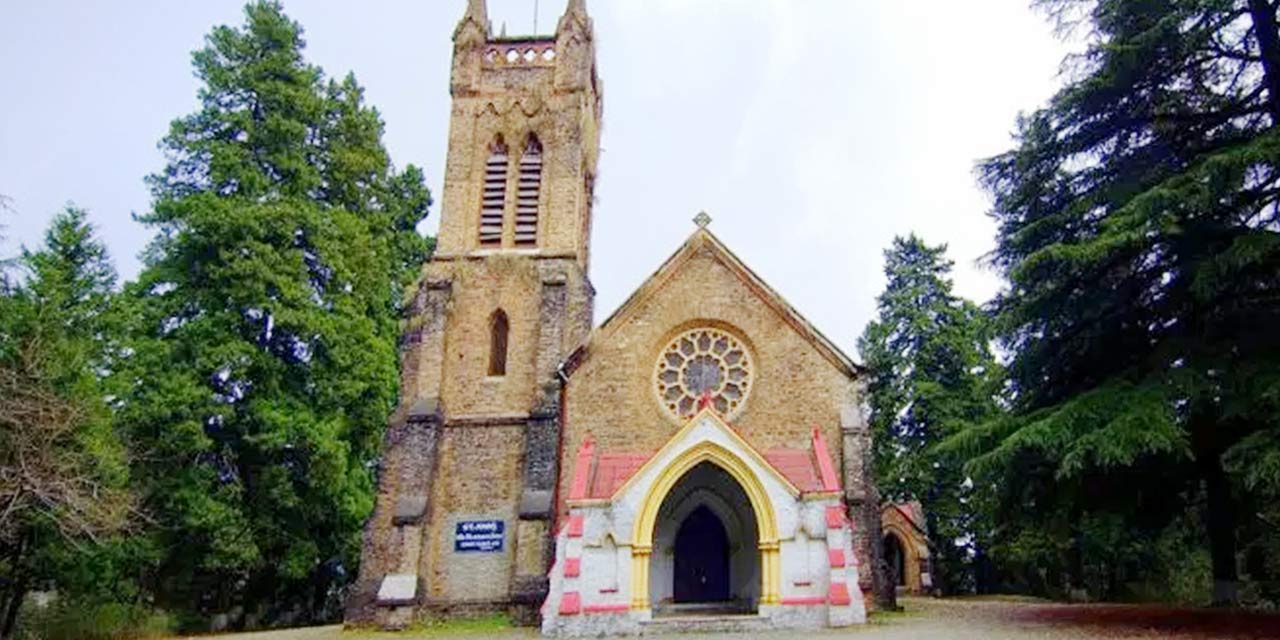
I don’t have any pictures from that trip. This picture of the church is not my picture. Our family’s Kodak Box 120 format camera was an expensive hobby those days, thus picture postcards were all one could afford over and above one roll of film, its processing and prints. I acquired a 35mm film format camera much later.

Those days the way up to the elegant stone structure church was from behind the Talli Tal (तल्ली ताल) over a kuccha or a mule trail through thick Banj (Oak), Deodar and Cheed (Pine) trees. Even at peak noon very little sunlight filtered down to the path. It would feel colder under the foliage. The hills behind the church were an untended jungle, completely covered with trees and very few locals had their houses up there. The trail up to Kilbari and snow view ridge was infamous for bear attacks. One would go up only on clear sunny days, more to look  at the shimmering, blue, kidney-bean-shaped Naini Lake from the top and not so much for the Himalayas which lay perpetually hidden by the clouds. Only a few people came to Naini Tal in winters. There was no direct bus from Delhi, one had to board the Naini Tal bound bus either at Haldwani or Kathgodam. Some of these buses reached Nainital via Bhimtal. Sighting mule-trains, bringing essentials from the plains, was common sight enroute. 

The soothing bells of Naina Devi temple enticed even atheists and lazy city boys like us to line up for prasad on a freezing winter morning when even the Sun took leave off work. The Mall was a peaceful place. I miss that bansuri wala who played painful yet magical notes leaning on the stone wall. Sitting on a bench by the placid lake had a calming effect unlike any ‘substance’. Locals used to smile more often and were helpful to visitors. Tourists respected the hills and hill folks (pahad and pahadis). Mules had the right of way over Marutis or Marshalls. No one ogled at hand-holding lovers strolling on serene Thandi Sadak which was pedestrian only. The soothing scent of flaming red Buransh (rhododendron) and the pine needles is what we missed when back home.

The skating rink and the football ground reverberated with the laughter and excitement of children and the young ones. The elderly sun-bathed or sulked depending which team they were backing. Thankfully Nanak restaurant had still not debuted with its golgappas and chicken tikka. Those days we drank endless glasses of hot and sweet tea without ever thinking of Old Monk.  A late evening show at Capitol cinema was all that one needed to get a high and entertain oneself. During sunny afternoons we watched shining Cadillacs parked outside the most expensive hotel in Naini Tal, The Metropole. Some of the Chauffeurs of those guzzlers looked as handsome as Bollywood actors. A decade later I had the opportunity to stay in that hotel when I almost spoiled their three-tiered German Pipe Organ with a pedalboard. Despite that they offered us excellent tea in the well-provided tea lounge. 

Naini Tal was all that I had dreamed of when in Delhi and Naini Tal was where I wanted to own a small cottage with my own small library ‘all for myself’ – just like the White House Cottage my friend Bipin Pande owned on higher slopes. His father owned a shop next to the Ghoda stand. Bipin was the one who took me to (NTMC) Nainital Mountaineering Club and stoked my passion for mountaineering. I wonder where Bipin is now !!! The last time I met him was in Jipti camp during the Kailash-Manasarovar Yatra. Pahad nostalgia will kill me sooner than later. And now Mary Hopkins is killing me with her husky voice singing ‘those were the days my friend we thought they’ll never end…’, the song, btw, was produced by another great – Paul McCartney. Mary Hopkins too belonged to mountains.

Coming back to the booklet and the St. John-in-the-Wilderness church. In the booklet put together by Mrs I. D’O Elliott – she tells us that it is an Anglican church and one of the oldest buildings in Naini Tal. The site for the church was earmarked in 1844 by Bishop Daniel Wilson. Its cornerstone was laid in October 1846. Captain Young, an executive engineer with the Company, made its design plans and had it constructed at the cost of Rs 15,000 raised from private subscriptions. Built in a Gothic style, it was inaugurated on 2 April 1848. A memorial in the church commemorates those killed in the 1880 landslip. There have been many landslips (landslides) since then when parts of the church building have been damaged. The once famous Sookha Tal (Dry Lake), which was behind the church, has since been lost. Similarly, no records are available to dig out more information about Mrs I. D’O Elliott. Rest in Peace Ma’am, your booklet is precious and useful.

The last time I visited the church was sometime in 1993 or 1994 with Rajni, my wife. Till then its exterior, the prayer benches inside, and its large sized beautiful stained-glass windows were all intact. I have those colour negatives tucked safely somewhere (meaning untraceable now). The church keeper and an attendant had opened the main church door for us with a metal key that was nearly 12 inch in length.  I wonder if they still hold Sunday Service in the church. I must visit it soon.  I miss you Naini Tal. 

There is another church by the same name ‘St. John-in-the-Wilderness’, which is a Protestant church dedicated to John the Baptist. It was built in 1852 and is located near Dharamshala, on the way to McLeod Ganj, at Forsyth Gunj. True to its name that church is still in the wilderness with few visiting it.

Sun God and Mother Earth

A new artwork that we recently acquired is titled “Sun God and Mother Earth”. It is done by eminent Gond tribal artist Mr Veerendra Kumar Dhurvey, based in Bhopal, Madhya Pradesh. The story behind the artwork is mentioned below as given by the artist. The details are: Acrylic paints on canvas, 2024. Size 36 x 48 inch.

There was only water in this world, there was no earth, at that time Mother of the world is sitting on a lotus, on her the form of a deer has been given, Mother Earth is Mother Earth, on which Gond farmers are plowing and tribal villages are celebrating the festival of greenery. Women and men are dancing and celebrating festivals.
And there is a man on the tail of a deer, he is plowing, he is sowing seeds there and there is the Sun God who is coming on his chariot with seven horses and the trees are the whole world. Just as the whole world looks beautiful in the light of the Sun God, I have given the form of the world on my body on the basis of that.

​​पृथ्वी नहीं इस संसार में जल ही जल था वह समय जगत जननी मा कमल पे बैठी है उसके ऊपर हिरण का रूप जो दिया है माता पृथ्वी धरती मां है जिसके ऊपर गोंड किसान हल चल रहा है और हरियाली के त्यौहार मनाते हुए आदिवासी गांव ​की महिलाएं और पुरुष नाचते और त्यौहार मना रहे हैं। और जो ये हिरण की पूंछ पर एक आदमी है ​वह हल चल रहा है वहां पर वे बीज डालते जा रहे हैं और सूर्य देवता हैं जो अपने सात घोड़ों वाले रथ पर चले आ रहे हैं और पेड़ जो हैं वो सारा संसार ​हैं। ​जैसे सारा संसार सुंदर लगता है सूर्य देवता के प्रकाश में उसके आधार पर ही संसार का रूप ही मैं देह पर दिया हूं।

​Prithvi nahin is sansar mein jal hi jal tha use samay Ma Jagat-Janani hai jo Kamal per baithi Hain uske upar Hiran ka roop Jo Diya hun Mata Prithvi Dharti Ma hai jiske upar Gond Kisan hal chala raha hai aur hariyali ke tyohar manate hue aadivasi gond mahilayen aur purush naachte aur tyohar Mana rahe hain aur jo yah Hiran ke Poonch per ek aadami hai Kisan hal chala raha hai vahan per vah bij dalte ja raha hai aur Surya Devta Hain Jo Apne sath ghode Wale Rath per chal rahe hain aur ped jo hai vah sansar hai Jaise Sara sansar Sundar lagta hai Surya ke Prakash mein uske Aadhar per hi sansar ka roop main is ped per Diya hun

Prithvi Nahi Jal hi Jal Tha. Veerendra Kumar Dhurvey

that must be some else…

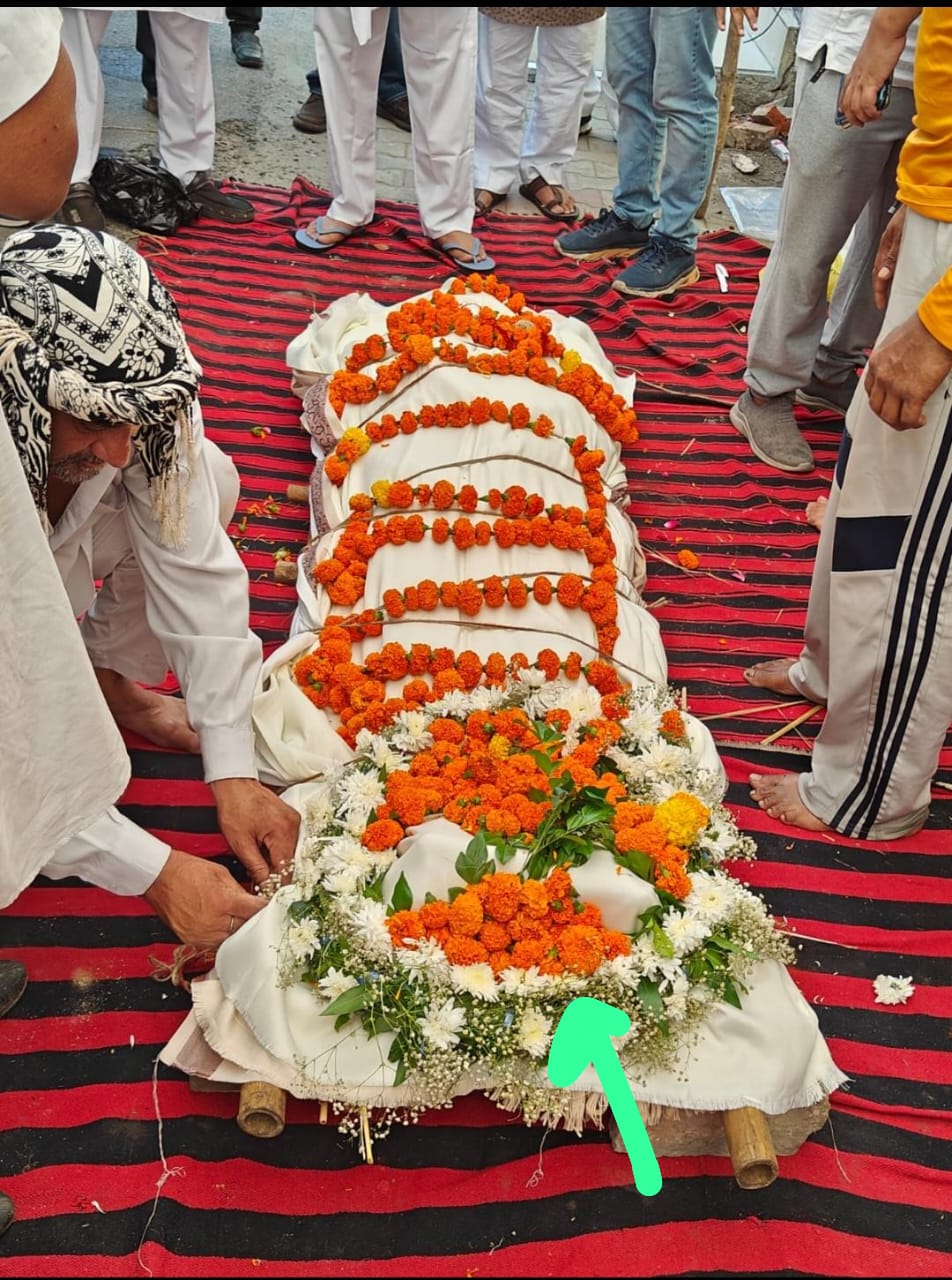
‘It couldn’t be him. It just can’t be. It must be someone else.’, was my first reaction when a common friend sent me a picture of his flower-decked bier lying outside his house in Jalandhar. I recalled Ashok Gupta reciting a Kafi of Baba Bulleh Shah at Zoji La pass where we saw a holy man being carried for burial.  

बुल्ले शाह असां मरणा नाहीं गौर पया कोई होर 

“It must be someone else, we ‘the immortals’ don’t die”, Ashok had said.

Years before he had said something similar when we had ‘together’ seen death at close quarters.

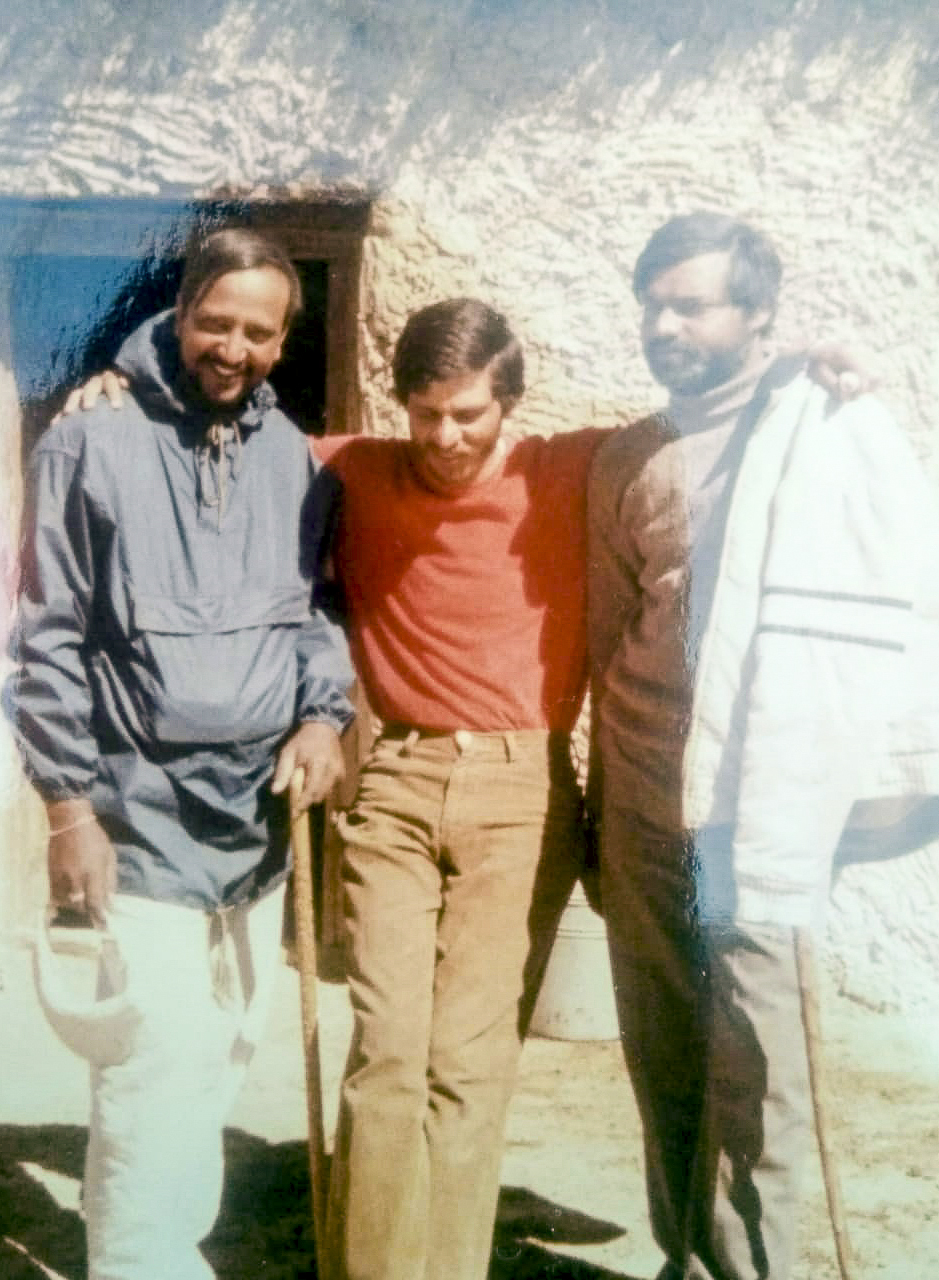
It was the month of June. Twenty-ninth read the date in the year 1985. By mid-night the temperature was 12 below zero. On the Tibetan plateau our altitude was 17,300+ feet. We were at the western edge of lake Manasarovar. We kiss-drank its partially frozen surface the next morning. Without gloves our hands were slowly turning blue. Strong easterly winds howled the earlier part of that night. I wonder how we survived that night amid nothingness. Yes, survived brutal cold, hunger, fatigue and the fear. The fear of having lost our way in the Himalayan desert. The fear that no one may come looking for us or consider us dead in that Himalayan moonscape. One more night out in the open would have meant certain death for the three of us. But, but Ashok had said “We can’t die here uninvited”. 

That night Ashok Gupta was wearing his trademark white kurta-pyjama, no thermals inside. The hood of his blue wind-cheater protecting his ears and head. Arun Singhal, our other friend was decently clad in a high neck sweater but not enough for that altitude or the open skies where a little more cold could have frozen us. Unless you are a Mongol nomad, a Tibetan herder or a Chinese military jawan you dont fools around Mt Kailash or Ghurla Mandhata ranges carelessly at night. We were not fooling around, we had lost our way. 

Five other members of our group were accompanied by a Tibetan yak herder who was transporting our camping equipment. That night we clung to each other in a tight embrace to conserve body-heat, arms locked we jogged in-sync, we created a tight triangle of bodies using our breath to warm our chests and ward off the cold with our back, we pissed on our feet when our toes were freezing. We cursed ourselves but never once thought that we would die that night. The thought of death came only next afternoon when despite all our efforts we were not able to find the trail that would lead us to our campsite. Our batchmates were supposed to leave for the next campsite by noon. None of us had any communication equipment or anyone to guide. 

The morning before was the most inviting one which lured us to make multiple mistakes. We decided to shed extra layers and trek leisurely around the undulating Barkha Plains. The day temperature tempted us to slow down our pace, rest more often, fish in streams, stop to photograph each Marmot peeping at us from its hole, admire and lure herd of Tibetan Wild Ass and the colony of white woolly hare. We were in the awe of the beauty, the sheer scale of the Himalayan plains where a hundred aeroplanes could land together. With no clouds and a bright sun that hurt during noon we enjoyed the stark contrast of the blue skies against white Himalayan peaks and stunning granite rocks. That morning, together, we had spotted a Brahminy Duck diving in Mansarovar for its catch. Ashok had said it was a good sign.

My brown corduroys, a wind breaker and a muffler around the neck worked well during the day but at night I was the worst clad. We hadn’t had a morsel since we left last camp and I was reminded of the Brahminy Duck all the time. How many fish it would have devoured that morning? We trudged up and down a dozen hills that evening before the Lords switched off the light in that stunningly beautiful playground for their ilk to sleep.

To reach our Himalayan Eden we traversed four major valley systems connecting India, Nepal, Tibet and China. We trekked over 129 km in 28 days, without a day’s break, crossing two high-altitude mountain passes one of which, Dolma La, was over 18,470 feet, braved treacherous crevices over unstable glaciers, were beaten down by winds and thunder, negotiated and forded near-freezing streams, glacial melts and rivers. We slipped around gorges; skidded off steep gradients; spent sleepless nights with minimal food; braved freezing winds, rain and snow but we survived. We survived our bursting lungs in rarified atmosphere, yes we survived this and dangers of many other climbs and high-altitude treks. Did we survive to die like this? 

Sorry, I can’t say my Alvida, not yet.
गौर पया कोई होर
Yes, that must be some else.

Lord Hanuman and Mt. Dronagiri

Hanuman ji and Dronagiri Parbat

There are a few mountains that one has heard of and known from early childhood itself but never had the opportunity to see, travel to, or to tread and climb. Some of these mountains are also connected to or are a part of a myth – thus they do not find credence with you unless you are ru-baru (face-to-face) with the mountain and admire not just its beauty but also start relating to it in more ways than one. These myths, especially if they are served wrapped in stories from a religious epic, become part of one’s life. 

Now imagine a myth that has been repeatedly enacted in front of your eyes every year, year-after-year. Such a myth or the story doesn’t remain pure myth any more – somewhere in your head and heart you start relating to them as if they are/were historical and did exist. Unfortunately, a story, a myth, a belief that is played on the idiot box inside your own house for years doesn’t take long to settle in your mind as a credible one. 

The story or myth of pavanputra mahabali Hanuman, uprooting part of a mountain from Himalayas and carrying it all the way to Lanka on his right palm is that part of Ramayan that one can’t forget. But no one tells you where exactly this act played up in geography. Would you believe me if I told you that this episode is supposed to have happened at a place just about 520 km away from Delhi by road. However, currently the road to it is in a bad shape and the area is risky to approach.

The catastrophic and devastating floods in Rishiganga and Dhauliganga river valleys on 7 February 2021 which left hundreds dead and destroyed every single settlement in its way have also left some indelible and ugly marks on the Himalayan topography in this part of Uttarakhand. I, together with two friends, witnessed and passed through a very large section of this area in October 2022, a year after rampaging floods brought about terror to this land. I can say with some amount of certainty that this disaster was man-made and caused by our hunger for so called ‘development’, making roads, blowing up unstable hills with dynamite, reckless cutting of trees and bushes, making dams, blocking river passage with construction waste etc. in a fragile ecosystem called the Himalayas. This area is near the China border. 

The narrow road from Tapovan (Joshimath) to Malari has barely been made motorable, it is still broken in patches, the hill sides are still rolling down and rockfall is common in many sections risking the lives of people passing through this area and those working to repair it. Dhauliganga river is still choked at many places by large rocks and boulders impeding its flow. Clearing these may take years. The large rocks partly blocking the river pose further threat that these spots may end up becoming large lakes that could devastate villages downhill when they break. If you don’t look at these and only look up, the mountains appear to be sitting in graceful silence. 

 ‘Beauty in barrenness’ is exemplified in the rocky pinnacles of this difficult to access area. I am certain in the times of Lord Ram the area must have been a paradise and environmental issues would not have been so serious. Hanuman Ji, while flying over this area, must have peeped inside the Nanda Devi Sanctuary and would have felt happy flying over the sparkling white peaks of Himalayas. I wonder if he had also flown over Badrinath and the town of Joshimath blessed by Adi Shankaracharya as supreme seat Math. If Hanuman ji turned his head right or looked further north he would surely have bowed to Shiva’s abode Mount Kailash and the splendid lower arctic region beyond that from where the Aryans entered India. Originating from near Lake Manasarovar, the silvery streak of Sindhu river (Indus) must have been a guide to Hanuman in flying to Ravan’s Lanka.   

In Kamba Ramayan Sushen Vaidya asks Hanuman to bring the Sanjeevni booti (herb) to save the life of Lakshman who was seriously wounded by a weapon hurled at him by Ravan’s son Indrajit. Having forgotten the name, unable to identify the herb and running short of time, Hanuman, it is said, carried a part of the mountain itself. While his effort was able to save the life of Lakshman, the villagers living in and around the mountain were upset with Hanuman’s act. For this they are angry with Lord Hanuman till date. 

It was raining when we left Tapovan on a cold October morning. Looking at the dark and grey skies our driver was not happy with the prospects of having to drive on a dangerous route on a slippery road. For nearly 20 kilometres there was no vegetation on the hills. The river, deep below in the valley, was in torrents and noisy because of many large boulders blocking its flow. It had been raining for the past 15 days in this area so a lot of water had been flowing down the hills. There were no roadside chai shacks as very few locals were going up. The vehicular movement was restricted to army vehicles only. 

It was cold and windy. My first glimpse of the beautiful peak came from between two ridges which were dropping down on the other side of the Dhauliganga river. It was for a flash of a second as the clouds parted revealing the peak. I shouted for the car to be stopped. A little ahead we spotted a roadside sign board put up by ITBP with an arrow indicating Dronagiri Village. The car windows were rolled down and we trudged back some 100 metres to view the peak from between two ridges. There was nothing but clouds. We were disappointed.   

It is said that the villagers of Dronagiri do not hold Hanuman as sacred and don’t pray to him. There are no Hanuman temples in the small village. The area surrounding Mount Dronagiri or Dunagiri  is blessed with dozens of such life-saving herbs. Closer to the Badrinath area, around the Valley of Flowers Mount Dronagiri and Dronagiri village can be reached on route to Malari (closer to China border) from Tapovan area in Joshimath.

This is one of the high peaks of the Himalayas in the Chamoli District and can be easily identified. Dunagiri (7,066 m) lies at the northwest corner of the Nanda Devi Sanctuary Wall, which is a ring of peaks surrounding Nanda Devi in Uttarakhand. Even on our way back we could not see the mountain. But luck was with us as we decided to trek up to Kartik Swami temple from Kanak Chauri in Rudraprayag. 

We left our camp Kanak Chauri at five in the morning. It was still dark, the sky was spotless, clear and glittering with millions of stars. We reached the uppermost chamber of the temple located atop of a ridge by 7.30. Sunlight had started peering from thin clouds and in a matter of minutes a humongous crescent of peaks showed up in front of us. It was mesmerising to see some of the most beautiful 7,000m+ high peaks dressed up in all their finery in front of us. 

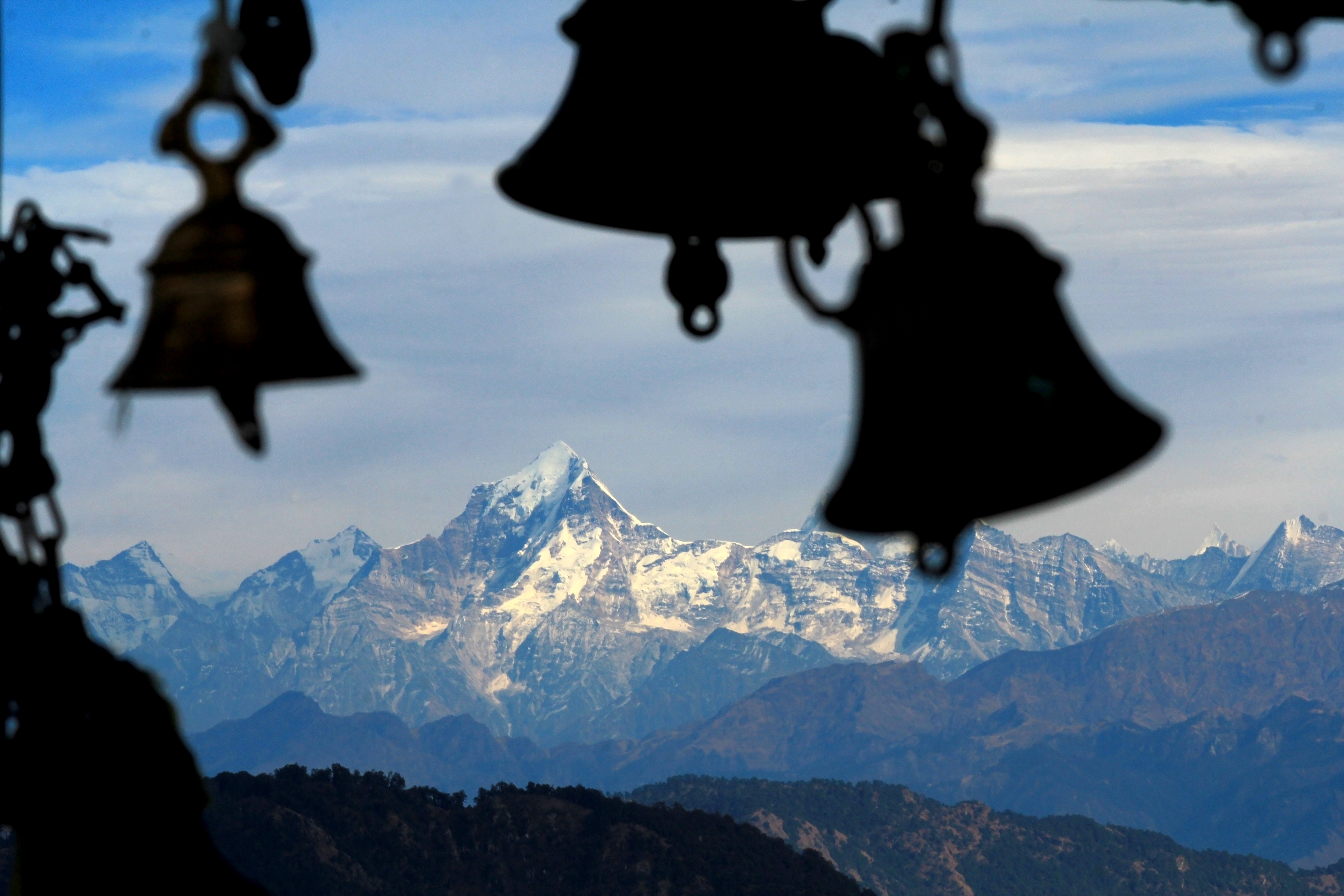
Through the copper bells, sacred threads and red chunnis tied to the railings of the temple courtyard, I could immediately spot the twin peaks of Nanda Devi and Dunagiri. With its conical peak and difficult routes over sharp ridges Dunagiri was first climbed on 5 July 1939 by the Swiss team and has since been climbed by many. (in picture Mount Dunagiri from Kanak Chauri)

As the sun shone a little more and we came out of the initial shock we could identify other important and enchanting peaks like Nanda Ghunti, Trisuli, Meru-Sumeru, Chaukhamba, Panchachuli, Kamet, Neelkanth, Bandarpoonch, Kedarnath Dome and Balakun. There were many others at a distance and some closer which we could not identify.

Barefoot on that freezing cold stone platform we were shivering but the shutters of our cameras went berserk. The fear that the cloud cover could envelope the view anytime made us stand there in awe and offer our thanks and gratitude to the Himalayas for giving us this opportunity to see this magical spectacle which few are lucky to watch.

Mt. Dronagiri from Kartik Swami temple complex above Kanak Chauri, Rudraprayag District, Uttarakhand

Designers and artists can’t complain

Hopefully all of you had a wonderful year 2023 – successful, joyous, and healthy. While we wish each other ‘HNY’ on January 1st, a few of us while responding to the wishes, also reflect and think of the year gone by and, in the hindsight, pray that they don’t go through the bumpy patches again.

Thirteen days down the line while a cold wave sweeps the city and a grey sky adds to the gloom, I suppose it is time to look back at the year 2023 while tucked in a warm duvet with a cup of hot coffee or a glass of rum in hand. 

But then going back is not easy unless one has maintained a meticulous account, a diary of sorts. It is difficult to recall all events – so before I began writing this I put down a broad selection of month wise events after which it was easier to sum it up.  

The year 2023 was tiring and tough, though equally rewarding. At times trying and testing, at the others back breaking and on a few occasions frustrating to downright unpassable. Yet, the time-hardened bones, the stubbornness not to back down, to take it all upfront – not just face it but challenge it too – sailed me through. I can now say with a grin that both the clock and the time looked back and smiled. That reward was bigger than the financial one. 

Till about the second week of March 2023 things were sailing smooth at work and home. Towards the last week we went to Bhopal to mount the exhibition ‘Hum Sab Sahmat: Resisting a Nation without Citizens’ (‘We All Agree’ – a testament to resisting a nation being shaped without its citizens). That’s where we got the news that two of our friends had been hospitalised. We rushed back only to see both of them pass away in a matter of three days. Comrade Suneet Chopra was first one to leave us and dear dear friend Vivan Sundaram followed on 29 March 2023. It was a huge setback.  

Back at work picking up the threads I was debating the existential crisis that the death of a dear one leaves one with. Though a little hard to push, yet the wheel of life carries on gently patting the past. 

Somehow I have always found that the Financial Year has a​ kind of continuity with the calendar year. As one settles in the comfort zone of a benign April suddenly challenges pounce on you from a hidden corner. Till then I was pretty much enjoying whatever came my way and what I was doing, professionally or on a personal level. I was more than happy with last years’ financials and with ​the healthy number of projects in ​our hand. Come May, the first unseasonal rain and a burst of seepage from the second floor terrace of our home brought with it an unending spate of problems at home​ which was also doubling up as part-office. Lo and behold, a civil works contractor and a melee of labour took over our place ​in an army-like operation disrupting everything for the next three months. 

Between the work supervision and rounds to the market I could barely attend to work. On the professional front work suffered, deadlines overshot, clients screamed, and expenses piled. How can one even pretend to be creative and churn out campaigns or designs that satisfy the soul while one is tumbling over sacks of cement and slipping over stone dust, how? Most unhappy with myself and the team I was losing my shirt on everyone around which made matters worse. Fortunately, I got a grip on myself in time and calmed down before things went out of hand. The pressure of office work was increasing so did the delays at home caused by absentee workmen. 

On June 1st bad news came from Dubai. My life-time mentor and guide Zamir Ansari passed away after a massive heart attack. I was devastated. We had a long association of nearly 35 years. He was the most gentle, the kindest and a god-like being who helped anyone with everything he had. While his loss jolted me no end, at a memorial meeting for Mr Ansari something good came up. I shook hands with two people with whom a misunderstanding had cropped up a few years back. In my heart I felt much lighter having cleansed my heart and having made-up with them. There is so much good in the world to see, feel, share, and give. Life trudged.

Home renovation is an unending pain. Once you start fixing seepage, masonry creeps in together with water-proofing; plumbing replacement brings down functional bathrooms which need to be redone from the scratch. Electricals and woodwork soon follow which necessitates paint work and floor polishing, if not entire floor replacement. The whole house was in a mess. It was physically and mentally draining running up and down the three levels at the peak of summers. With the dust and noise all around us Ma fell ill and then all of us followed one after another, flu, sore throats, congestion and the viral fever kept us down. A nagging threat of corona persisted with unmasked labour sauntering around the house for ten hours each day. With tea and snacks to be served twice a day to a team of thirty odd workers, the household help and the kitchen was operating more like a free-canteen about to collapse any day.

In between the saving grace was a decent exhibition design and execution project that came our way. Normally of short duration but hectic, exhibition projects are well paying, we made a packet for a week of sleepless nights. 

While all this was happening I managed to hurt my knee and limped my way through latching on to stair railings and walls. Over weeks it came to a point that I couldn’t attend to work or even go for my morning walks. The orthopaedic said that I had a bone abrasion and had torn knee-joint ligaments. A busy work season had begun. With September came the festival rush of north India. Visits to the doctor and the physiotherapist were added to the hectic work schedule. Work pressure continued without ​respite (good it did). 

We hadn’t had a break for over seven months. Not even a decent and calm Sunday. Catching a drink in peace seemed luxury. No friends, no party, no outings. Life was dull and boring​ only dealing with masons, plumbers, carpenters, painters, welders, electricians and floor polishers. Finally, ​and somehow​ having pushed everyone out, we managed to get the house ​back in shape and sing with us sometime in October. It was such a relief. 

While we were enjoying our wine and cheese and the music played in the background a hearty duet joined the chorus. My brother and his wife, from pardes, joined us in the freshly redone space. Warmth filled the place. From then onwards it was a party each morning, noon, and night. Evenings were only for drinks which drowned us. World Cup Cricket was here – the fever gripped us too. Succumbing to the loot by the black marketeers we headed to the Private Gallery view of matches in Chennai and Ahmedabad. The on-ground cricket entertainment is a different game. It is heady when you know that the rest of the universe is watching the game 17 seconds after you.

Bad news somehow smells of the relative peace and joy one is enjoying. This time it came from Palestine. Innocent Gazans have had to suffer unending brutalities at the hands of Israeli forces for over three months now.

Clients were kind during the next two months. No one was dying or flying. No one asked for a brochure at the last minute. No press conference wanted a PR push, no Annual Reports were delayed. All in all work sailed smoothly.  There were more holiday breaks and parties than work during this time. Festivals, together with a spate of birthdays, meant celebrations. Fun and frolic carried on with heritage walks, concerts, visits to monuments and museums, excesses of street food topped with heady overdose of drinks. 

Finally, as all good things end, so do parties and celebrations. Work pressure increased together with the knee pain. Brother and bhabhi went back home. Life was coming back to the drudgery of a routine when the happy bells rang.

A new, prestigious, and fairly large exhibition project came our way. This one was to happen in Shahjahanabad – inside the great monument built by Emperor Shah Jahan. I fell in love with the Red Fort all over again as we had the special permission to drive our car straight inside the Fort through the historical Delhi Darwaza with its life-size elephant statues guarding the magnificent edifice and its age-old secrets. Despite the limp and the pain it was a joy to work inside the 17th Century fort. Even in the peace and quiet of Diwan-i-khas I could hear the nautch girls sing and dance. 

The commute from Gurgaon to purani Delhi was a dampener but it also had the bait of ‘Delhi 6 ka khaana‘. The near 5,000 sq feet of our exhibition space finally turned out as a stunning art gallery overlooking the Mughal grandeur spread around us. Decked with priceless artworks from across the country the hall looked like a haseen dulhan. The design and the display was appreciated and applauded. In our hearts we were more than happy for having done a bloody-good job. 

The successful completion of a project has to be celebrated, so, leaving the foggy and cold Delhi behind, off we went to the balmy and sunny coastal Kerala. The year was coming to an end and we knew that one has to reward oneself for the accompanishment/s and all the hard work. Driving along the south-western coast we rode further down south from historic Kochi to the backwaters of Alleppey to Trivandrum and to the blue-water and white-sand beaches of Kovalam enjoying fish fillets and toddy – all the way through watching Bharatanatyam and Mohiniyattam performances while admiring the pollution free sparkling blue skies. While in Kovalam as I watched the sun set behind the Arabian sea two clients called to say that their “Calendar designs” were delayed. What???? Didn’t you get an auto reply saying I am out of town? Ugghhhh!!!

I wondered, could I complain to the sun why was it setting, could I? A fishing boat crossed the pale orange sphere as it dipped in blue waters. A flock of birds were circling the boat waiting for the catch. A few stars peeped out from the dark northern sky. I poured a drink.

Designers and artists can’t complain even when their dreams are broken. 

To sum up, the year 2023 indeed was tough yet it was rewarding in more ways than one. Hoping that 2024 will be kind and joyous for all of us, personally I look forward to more vacations, explorations, more journeys and more laid back weeks over work, work and work. Cheers to all of you. Stay safe and stay in love.

Some noteworthy jobs of the year 2023 were: Advantage Tennis magazine. Annual Reports for SISCOL, IFFCO and CEQUIN. Brochures for Global Health Strategies, Ashoka University, Jainson and Ojas Art. Books for NLGI, Ruzbeh Bharucha, Aditya Saikia and Dr. Kamal Rustomejee.  A portfolio for Vivan Sundaram. Table calendars for SISCOL and Sahmat. Exhibition designs for IAADB and Jainson.

– 13 January 2024

IADDB
IADDB